
Map reading skills Normal Our Planet and Environment Worksheets for Ages 5-8
1 filtered results
Difficulty Level
Grade
Age
-
From - To
Subject
Activity
Standards
Enhance your child's geography prowess with our "Map Reading Skills" worksheets, tailored for ages 5-8. These engaging activities, found at Kids Academy, aim to build foundational understanding of maps, directions, and symbols. Perfectly curated to introduce young minds to our planet and its environment, the worksheets combine fun learning with practical skills. Through colorful exercises and interactive tasks, children will develop critical thinking and spatial awareness while exploring various geographical elements. Ignite their curiosity about the world and lay the groundwork for advanced geographic knowledge with our expertly designed resources.
Favorites
With answer key
Interactive
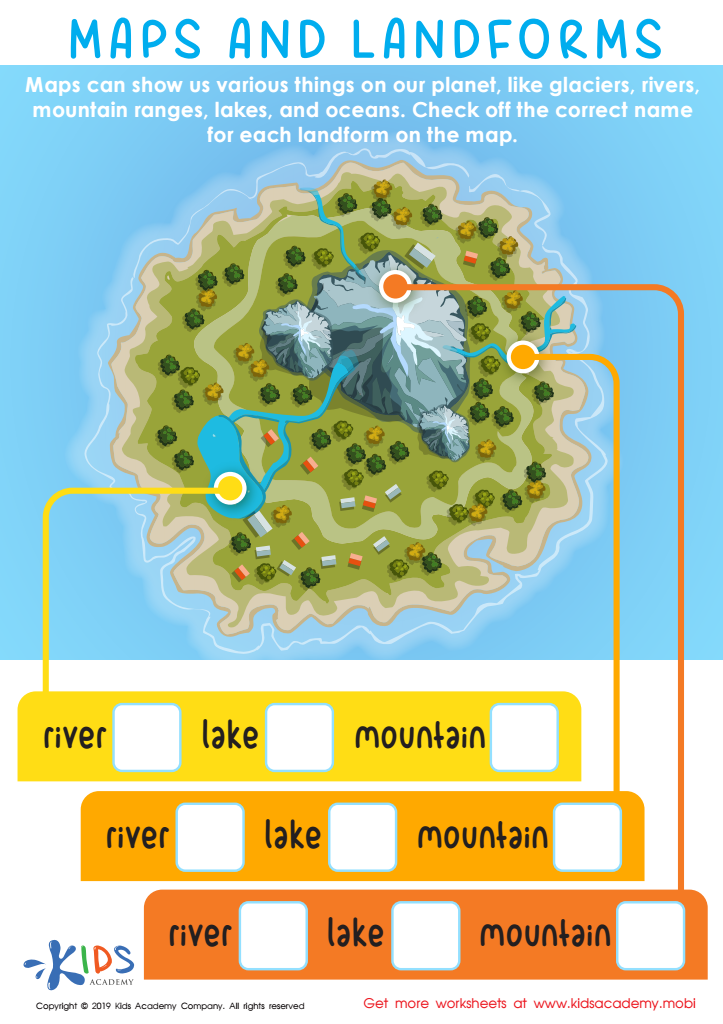
Maps and Landforms Worksheet
We can educate our kids on the world and its landforms by showing them a map. Point out mountains, rivers, and oceans, and help them identify each correctly. With this knowledge, they will better understand our planet.
 Assign to My Students
Maps and Landforms Worksheet
Worksheet
Join Kids Academy for Free
Who is primarily going to use this learning content?





Map reading skills are vital for young children, laying the foundation for spatial awareness and critical thinking abilities. When kids learn to read maps, they not only understand geographical locations but also build essential skills like recognizing symbols, understanding scales, and interpreting data. At ages 5-8, children's brains are highly receptive, making it an ideal time to introduce map reading.
Caring about these skills goes beyond academics. Understanding maps fosters a greater sense of our planet and its environment. Kids learn about continents, countries, wildlife habitats, and physical landscapes, which broadens their worldview. This awareness can spark curiosity and respect for different cultures and the natural world, encouraging them to be more responsible global citizens.
Furthermore, in an age of digital navigation, traditional map skills shouldn't be neglected. They enhance logical reasoning and problem-solving capabilities. For example, navigating a simple route on a paper map fosters students' confidence and independence.
Lastly, engaging in map-related activities also promotes teamwork and speaking skills, as children often collaborate and discuss routes or landmarks. For parents and teachers, investing time in teaching map reading is an investment in a child's all-rounded development, from intellectual growth to environmental stewardship and social skills.







