
Critical Thinking Normal Division Worksheets for Ages 5-9
3 filtered results
Difficulty Level
Grade
Age
-
From - To
Subject
Activity
Standards
Enhance your child's analytical skills with our "Critical Thinking Normal Division Worksheets for Ages 5-9" from Kids Academy. Designed to foster problem-solving and logical reasoning, these worksheets introduce kids to division in a fun and engaging way. Each activity encourages critical thinking, helping children to better understand division concepts and apply them in real-world scenarios. Perfect for preschoolers and early grade students, our worksheets transform learning into an interactive adventure. Equip your young learner with essential math skills that form a strong foundation for future academic success. Explore our selection today and watch your child excel!
Favorites
With answer key
Interactive
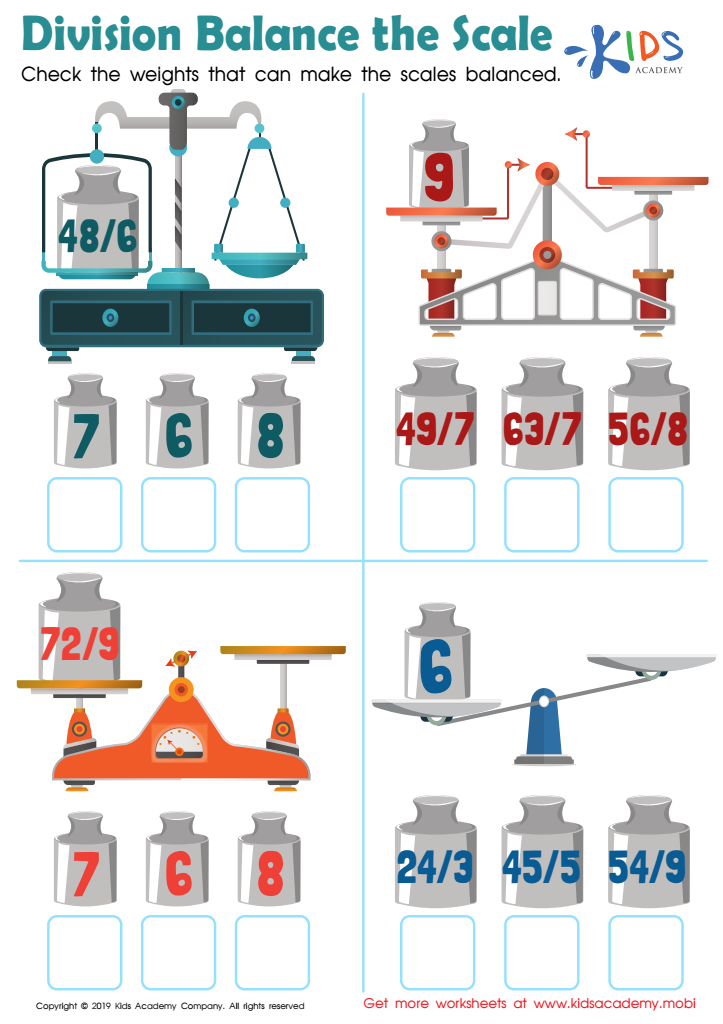
Division Balance the Scale Worksheet
Students can learn math better when they understand the relationships between numbers. This free worksheet helps them practice division: solving problems and matching the correct quotient to balance the scales. Fun visual boxes make it a unique way to engage with the material.
 Assign to My Students
Division Balance the Scale Worksheet
Worksheet
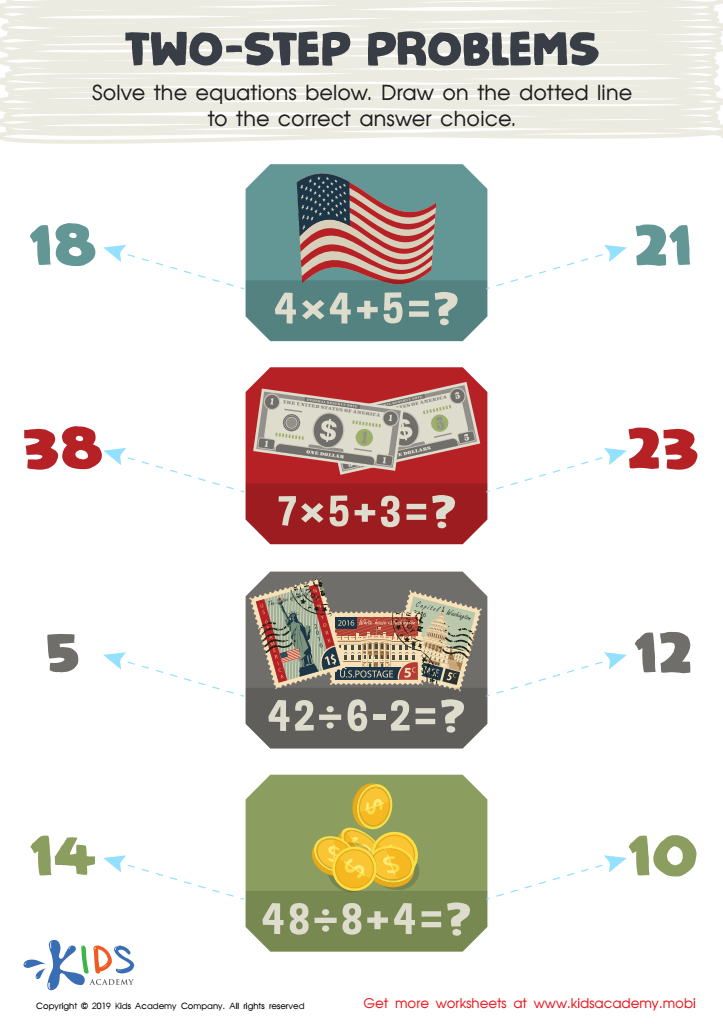
Two-Step Problems Worksheet
Help your child practice their math problem-solving skills with this worksheet. It covers the basics of subtractions, additions, multiplications, and divisions. With four simple equations, your kids can solve them and draw the correct answer on the dotted line. Reduce their strain and give them the help they need.
Two-Step Problems Worksheet
Worksheet
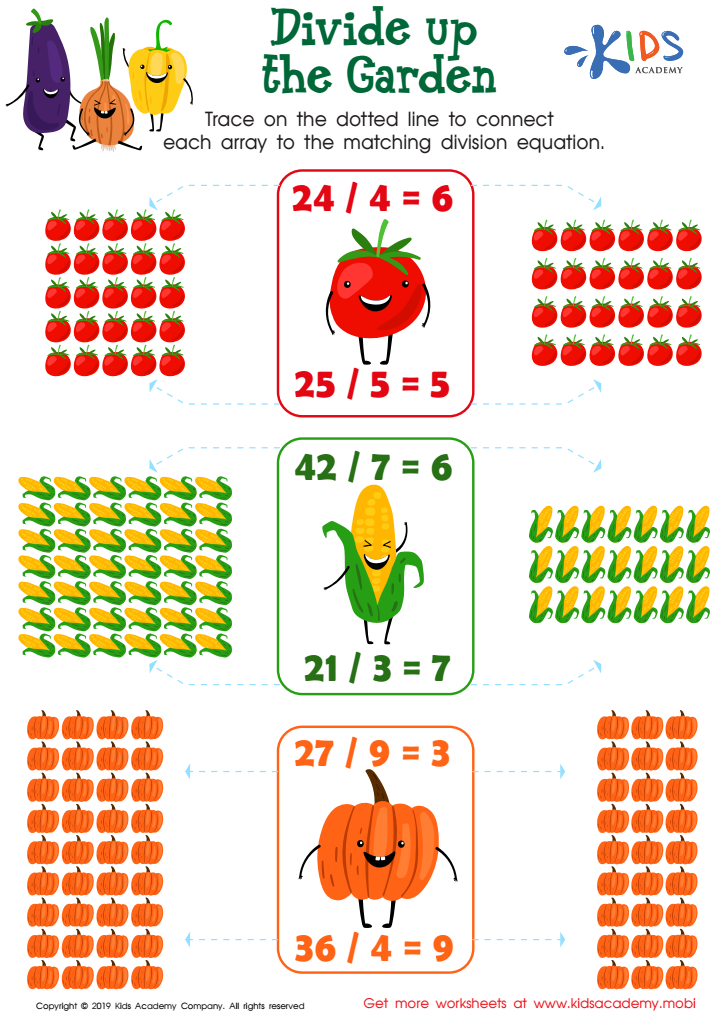
Divide up the Garden Worksheet
Dividing is simply grouping items into equal sets. This worksheet helps kids see division problems in array form. They'll match each equation with a picture group, using the lines provided. It's a great way for beginners to understand division more concretely.
Divide up the Garden Worksheet
Worksheet
Join Kids Academy for Free
Who is primarily going to use this learning content?








Fostering critical thinking and an understanding of normal division in children aged 5-9 is foundational for their intellectual and personal growth. This essential skill set helps youngsters become logical and independent thinkers capable of solving complex problems throughout their educational journey and in real-life situations. When parents and teachers emphasize critical thinking, they nurture a child’s ability to ask pertinent questions, assess information critically, and make sound decisions—a critical aspect of lifelong learning.
Introducing normal division at an early age aligns with their cognitive development and enhances numeracy skills, forming a cornerstone of mathematics. Division promotes an understanding of fair sharing, equal distribution, and ratio, which are practical concepts children encounter everyday. Mastery of these concepts early on facilitates an easier grasp of more advanced mathematical operations in the future, boosting their confidence and performance in school subjects.
Interactive and engaging activities can make these lessons enjoyable and relatable, helping children assimilate these skills naturally. For parents and teachers, the focus on such competencies prepares children not only for academic success but also for becoming analytical and self-reliable individuals. Moreover, it bridges a crucial gap in early education, ensuring children are well-equipped to face various intellectual and practical challenges as they grow.








