
Understanding place values Normal Worksheets for Ages 6-7
7 filtered results
Difficulty Level
Grade
Age
-
From - To
Subject
Activity
Standards
Discover our engaging "Understanding Place Values" worksheets designed specifically for children ages 6-7. These normal worksheets provide a fun and educational way for young learners to grasp the concept of place values, crucial for their mathematical foundation. With colorful illustrations and varied activities, children will learn to identify ones, tens, and hundreds while enhancing their counting skills. Ideal for homeschoolers or classroom use, our worksheets promote critical thinking and ensure that learning remains enjoyable. Watch your child gain confidence in math as they explore place values through this exciting resource! Start their journey to mastering numbers today!
Favorites
With answer key
Interactive
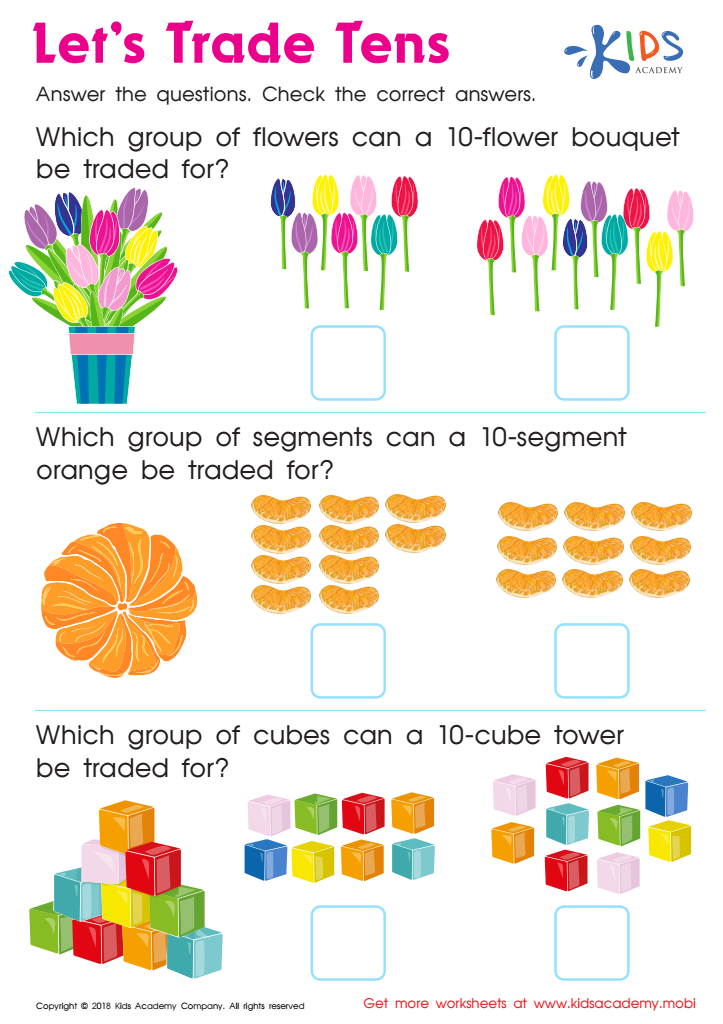
Lets Trade Tens Worksheet
This free worksheet strengthens counting and logic skills. Kids will enjoy exchanging flowers for bouquets, orange slices for a whole fruit, and cube towers for individual cubes. Combining numbers and problem solving is essential for first grade math. Seeing two options helps them understand how 10s look.
 Assign to My Students
Lets Trade Tens Worksheet
Worksheet
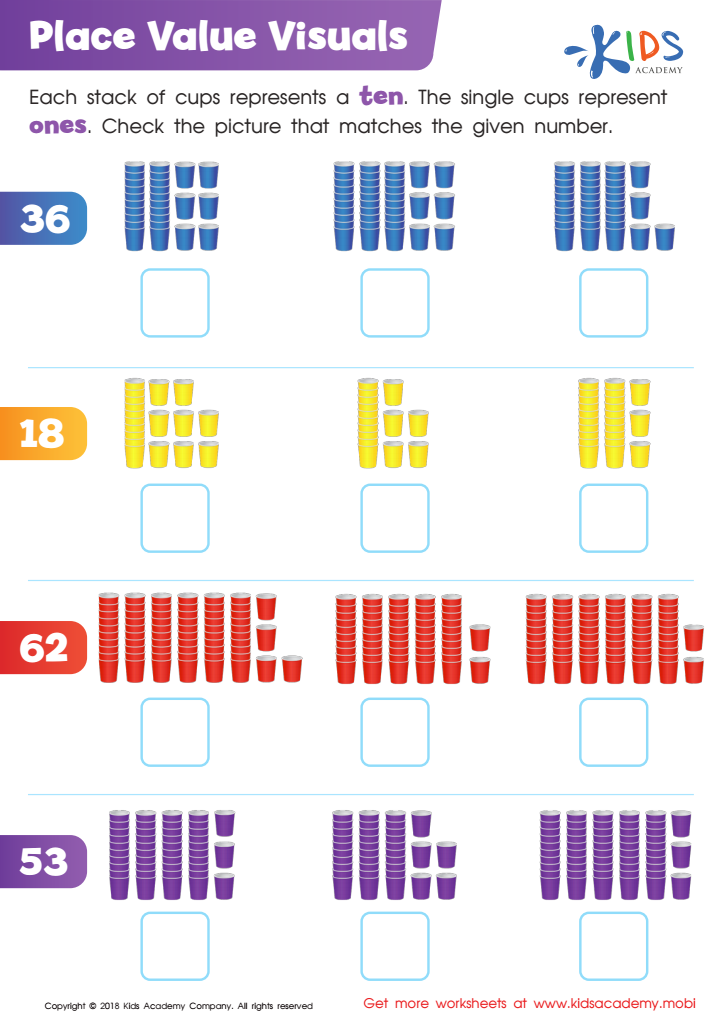
Place Value Visuals Worksheet
Help your child count the cups in each picture, using the simple rule that each stack is 10 and each single cup is 1. Ask them to match the number on the left to the picture on the right. No need to count each cup individually; since each stack is 10, 3 stacks is 30 and so on.
Place Value Visuals Worksheet
Worksheet
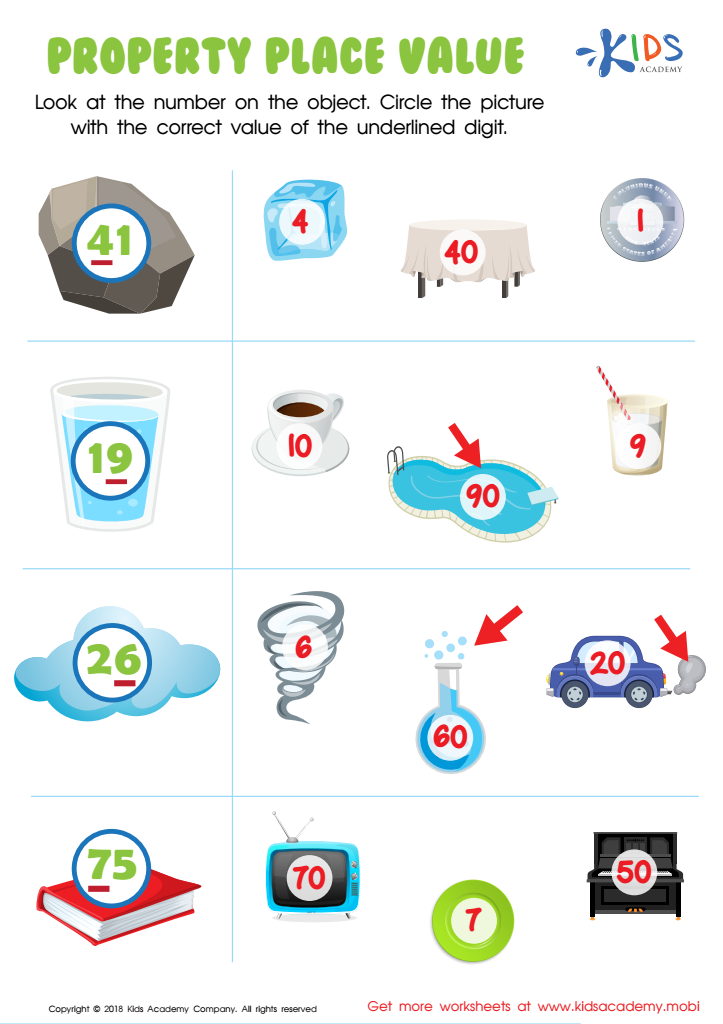
Property Place Value Worksheet
Help your child learn place value with this engaging worksheet! Kids Academy knows that colorful pictures motivate learners. Instruct them to name the place value of the underlined numbers on the left. Then, look through the images on the right to find the numbers that represent the indicated place value.
Property Place Value Worksheet
Worksheet
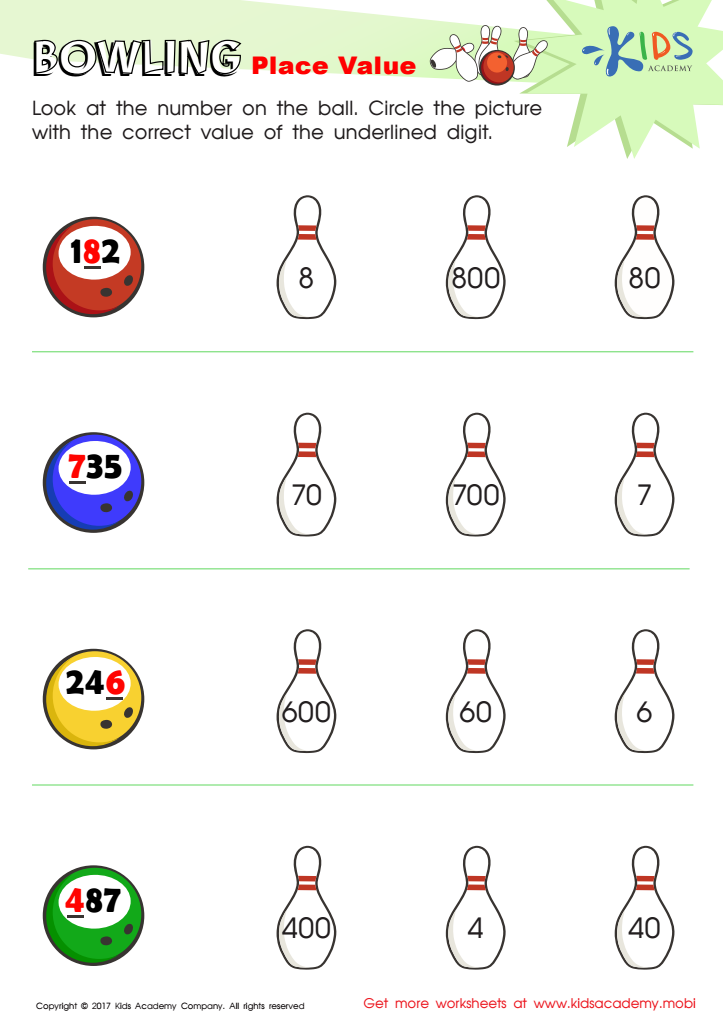
Place Value Worksheet
Try this place value worksheet to help your 2nd grader understand place value in a more meaningful way.
Place Value Worksheet
Worksheet
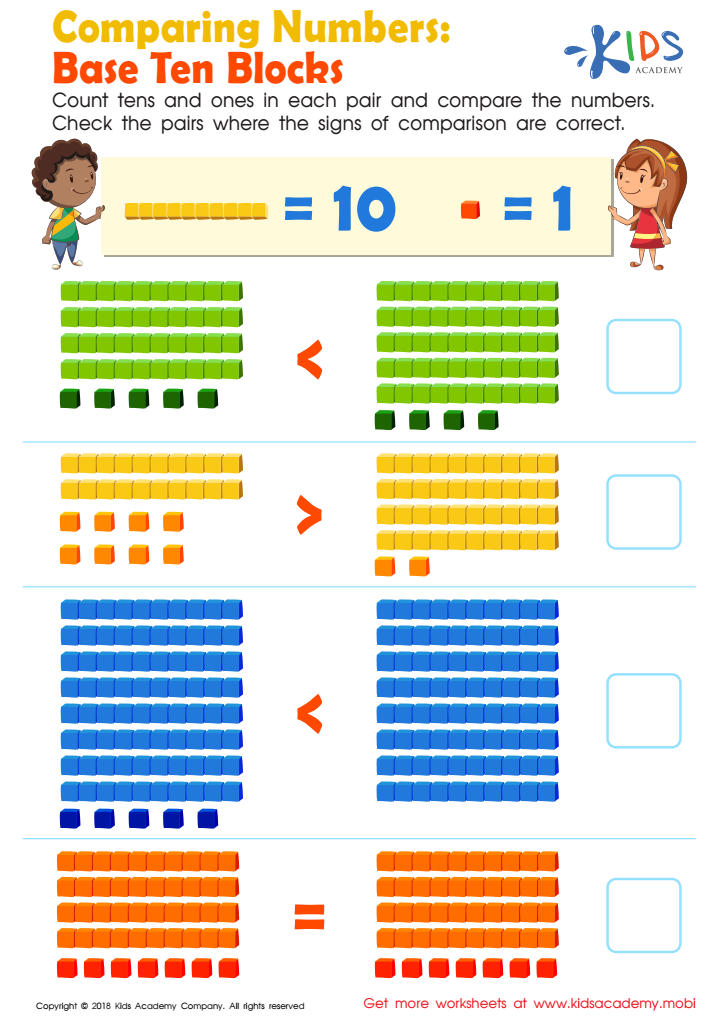
Comparing Numbers: Base Ten Blocks Worksheet
Make math fun for your child with a colorful worksheet. They'll need to compare signs by counting blocks on each side and signifying whether it's correct or not. This is one way to help your child beat the unhappiness that comes with math.
Comparing Numbers: Base Ten Blocks Worksheet
Worksheet
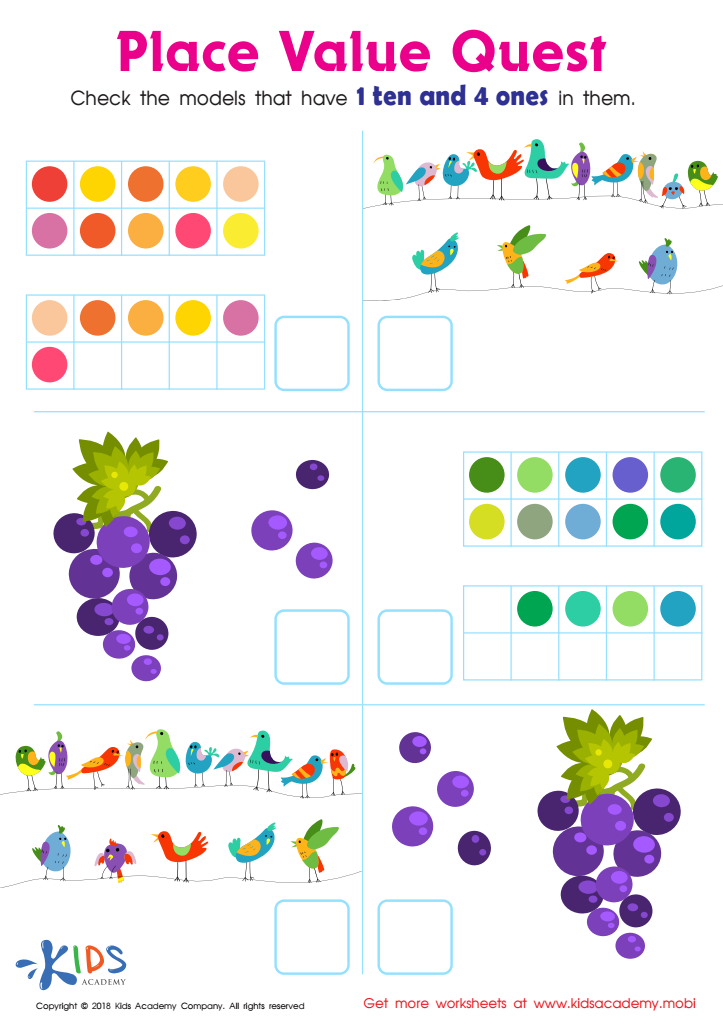
Place Value Quest Worksheet
Help your child explore place value with this fun worksheet! They'll pick the set of images that have 1 ten and 4 ones from a selection of birds, grapes, and dots. Checking the boxes that contain the answer, your child will learn to count and identify tens and ones. A quick math practice page that's sure to be a hit!
Place Value Quest Worksheet
Worksheet
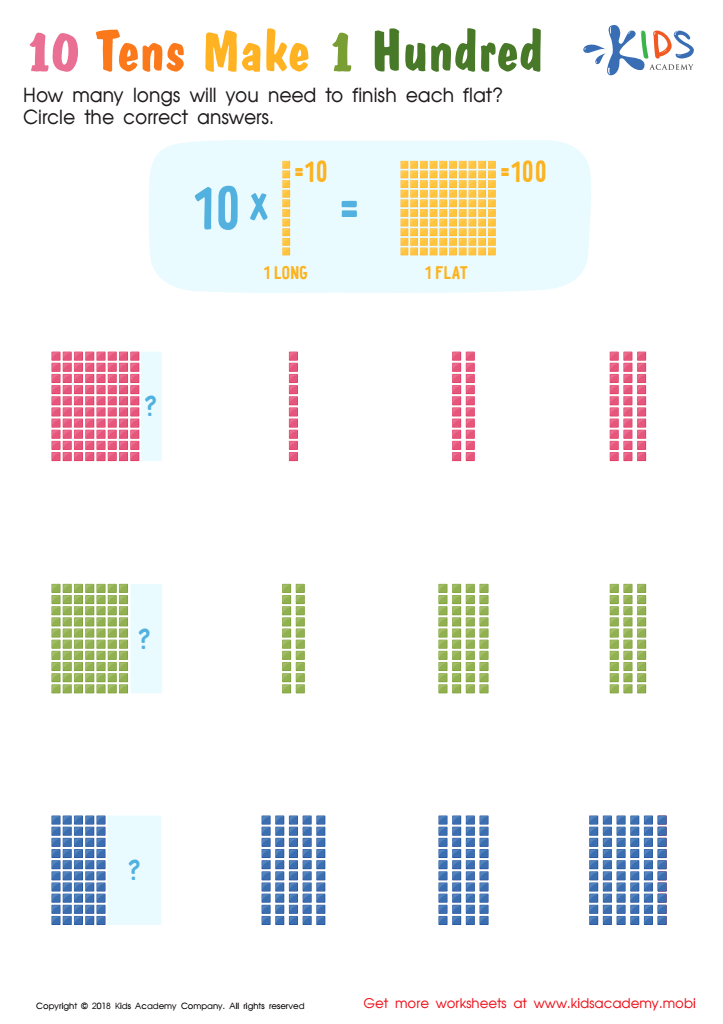
10 Tens Make 1 Hundred Worksheet
Help your child understand multiplication with this worksheet. Ask them how many 'longs' will be needed to complete each flat, then have them circle the correct answer from the options. With this exercise, your child will learn that 10 'tens' make 1 'hundred'!
10 Tens Make 1 Hundred Worksheet
Worksheet
Join Kids Academy for Free
Who is primarily going to use this learning content?




Understanding place value is crucial for children ages 6-7, as it lays the foundation for their mathematical learning. At this age, children begin to grasp how our number system works; recognizing that the position of a digit determines its value. For instance, in the number 245, the "2" represents two hundred, the "4" represents forty, and the "5" represents five. This foundational concept not only enhances numerical understanding but also promotes critical thinking and problem-solving skills.
Parents and teachers should care about teaching place values because it influences children's ability to perform operations like addition, subtraction, multiplication, and division. Without a solid grasp of place values, students may struggle with larger numbers and more complex mathematical concepts later on. Furthermore, understanding place values supports effective estimation and reinforces the memorization of basic math facts.
Moreover, mastering place value can build children's confidence in math, allowing them to tackle more advanced concepts in the future. By fostering a strong understanding of place values, caregivers and educators equip children with essential tools necessary for academic success and everyday problem-solving, making math more relatable and enjoyable for young learners.








