
Improving mental arithmetic Normal Math Worksheets for Ages 6-7
3 filtered results
Difficulty Level
Grade
Age
-
From - To
Subject
Activity
Standards
Discover our expertly crafted Normal Math Worksheets designed to enhance mental arithmetic skills in children aged 6-7. Developed by educational experts, these engaging worksheets cater to young learners, fostering sharp number sense and arithmetic fluency. Each worksheet balances fun and challenge, featuring colorful illustrations and a variety of activities to maintain interest. Through consistent practice, kids develop quick thinking and problem-solving abilities, setting a strong foundation for future math success. Perfect for classroom or home use, these resources ensure children build confidence and proficiency in mental math, making learning both effective and enjoyable. Start your child's math journey today!
Favorites
With answer key
Interactive
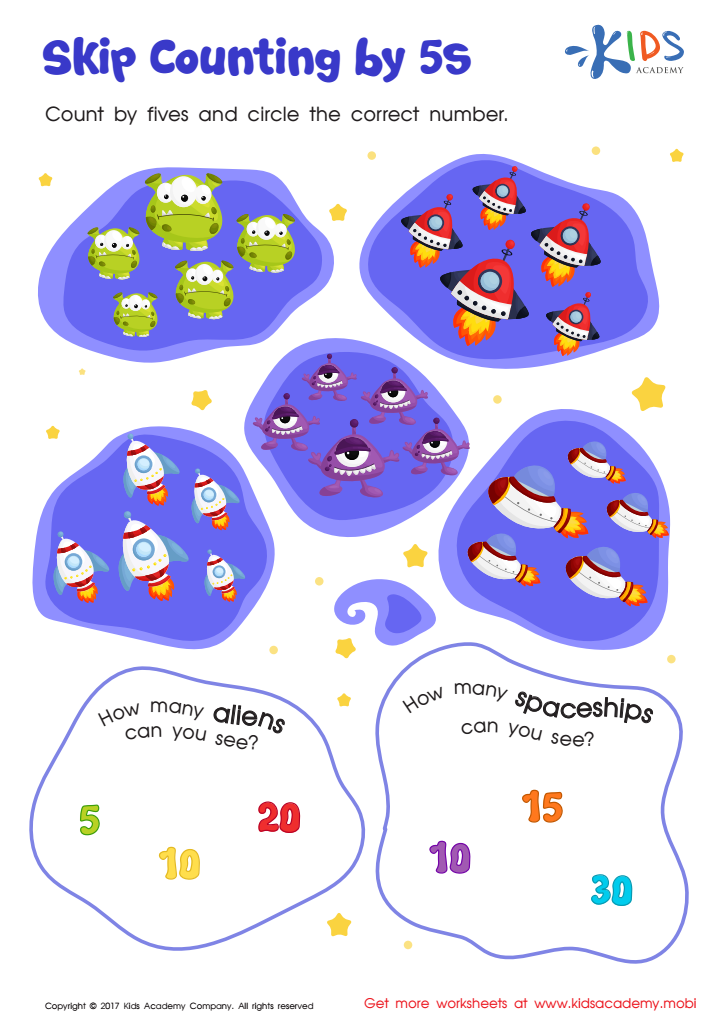
Skip Counting by 5s: Aliens and Spaceships Printable
Your child will love taking an intergalactic adventure as they practice skip counting by 5's with this worksheet! It'll help them identify and recognize large groups of numbers, categorize objects to count them, and prepare them for math concepts like multiplication. And with silly space graphics, they'll be motivated for more practice!
 Assign to My Students
Skip Counting by 5s: Aliens and Spaceships Printable
Worksheet
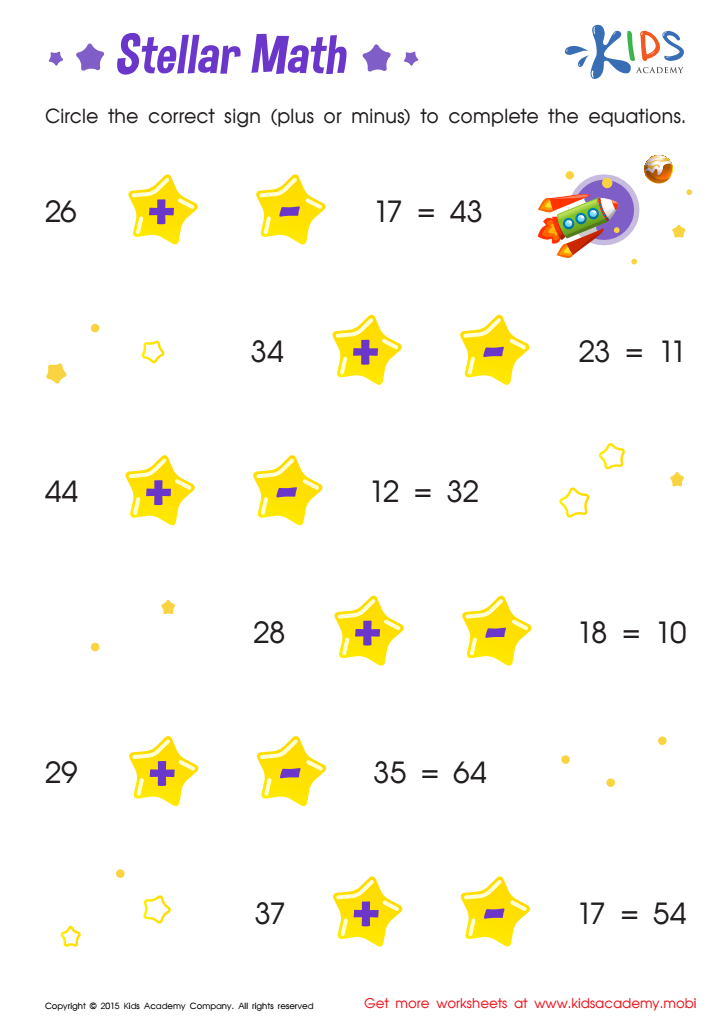
Stellar Math Substraction Worksheet
This worksheet offers more than just subtraction- your little learner can practice addition too! It will help them use number sense and mental math, as well as logical reasoning strategies, to complete the equations. With this worksheet, they'll use higher level thinking skills to determine which sign (plus or minus) is needed. Plus, they'll improve their cognitive skills too! Check out our rich collection of math worksheets for a fun and exciting math experience.
Stellar Math Substraction Worksheet
Worksheet
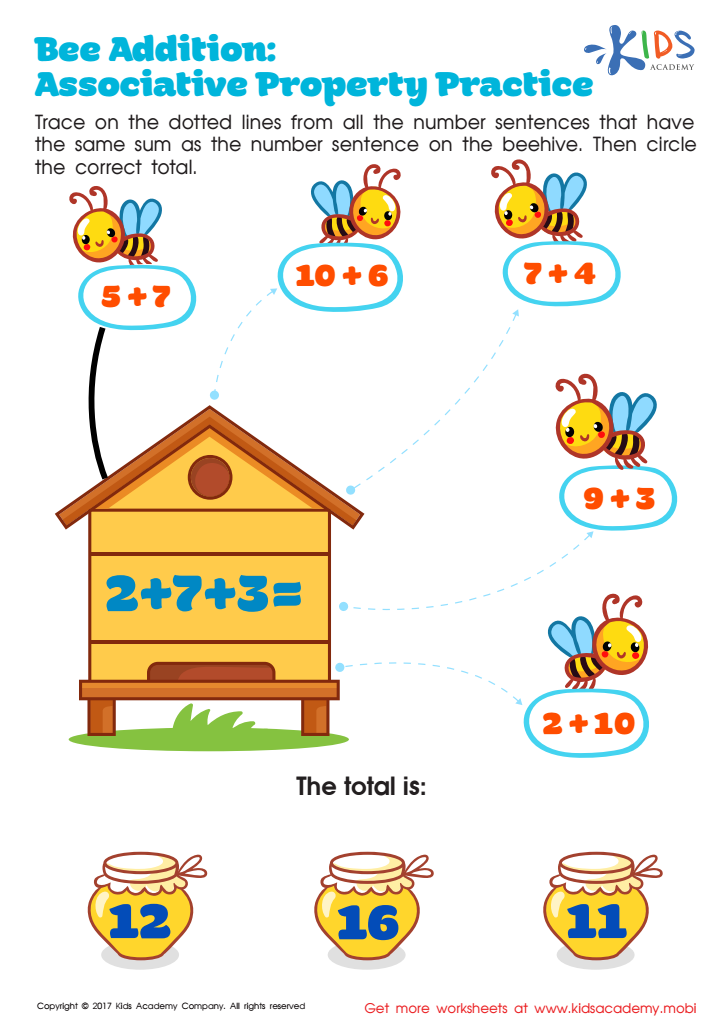
Bee Addition: Associative Property Practice Worksheet
Come to the beehive to practice the associative property of addition! This worksheet will help your child better understand addition facts. Compare equations to the 3-digit problem in the hive, solve each to find the correct answers, and trace the dotted line to show the worker bees home. Complete the sheet to find all the matching equations!
Bee Addition: Associative Property Practice Worksheet
Worksheet
Learning Skills
Join Kids Academy for Free
Who is primarily going to use this learning content?







Improving mental arithmetic skills in children aged 6-7 is crucial for several reasons. At this age, children's brains are highly flexible and capable of rapidly assimilating new information. Strengthening mental arithmetic not only solidifies foundational mathematical concepts but also enhances overall cognitive abilities. Quick mental calculations foster better problem-solving skills, improve memory, and encourage logical thinking, all of which are essential across various academic subjects.
Moreover, strong mental arithmetic capability builds children's confidence in handling math without relying on paper or calculators, making them more self-reliant learners. This confidence can propagate a positive attitude toward math, reducing anxiety and increasing enthusiasm for more complex problems in later years.
Improved mental arithmetic also has real-world applications, such as in daily life when making quick estimations during shopping, cooking, or planning schedules. These practical skills make learning relevant and meaningful, motivating students to engage actively.
For teachers, a focus on mental arithmetic creates more versatile and interactive classroom activities, allowing for immediate feedback and correction. For parents, encouraging these skills at home reinforces school learning, creating a harmonious educational environment. Therefore, prioritizing mental arithmetic is imperative for fostering well-rounded, competent, and confident young learners.








