Addition Practice Normal Subtraction Worksheets for Ages 6-9
3 filtered results
Difficulty Level
Grade
Age
-
From - To
Subject
Activity
Standards
Enhance your child's math skills with our engaging "Addition Practice Normal Subtraction Worksheets" designed for ages 6-9. These worksheets provide a perfect balance of addition and subtraction exercises, reinforcing key concepts while keeping learning fun. Children will refine their problem-solving abilities through varied, age-appropriate activities that challenge their understanding of basic arithmetic. With clear visuals and intuitive layouts, these worksheets make mathematical practice enjoyable and effective. Ideal for homeschoolers, classroom settings, or supplemental learning, our resources are crafted to build confidence and competence in young learners. Explore these worksheets today and watch your child's math skills flourish!
Favorites
With answer key
Interactive
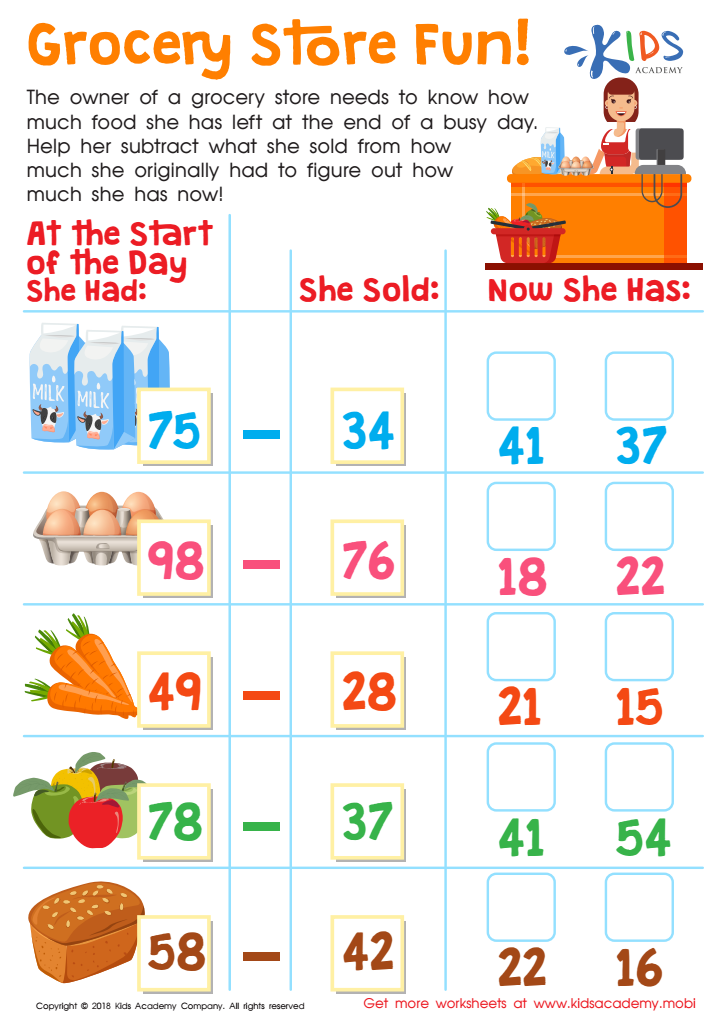
Grocery Store Fun! Worksheet
Let your kids have fun with this store worksheet. It requires them to help the owner by subtracting what she has sold from the original amount to figure out how much is left. Have them read and solve the equations in the printout to give the store owner the answer.
 Assign to My Students
Grocery Store Fun! Worksheet
Worksheet
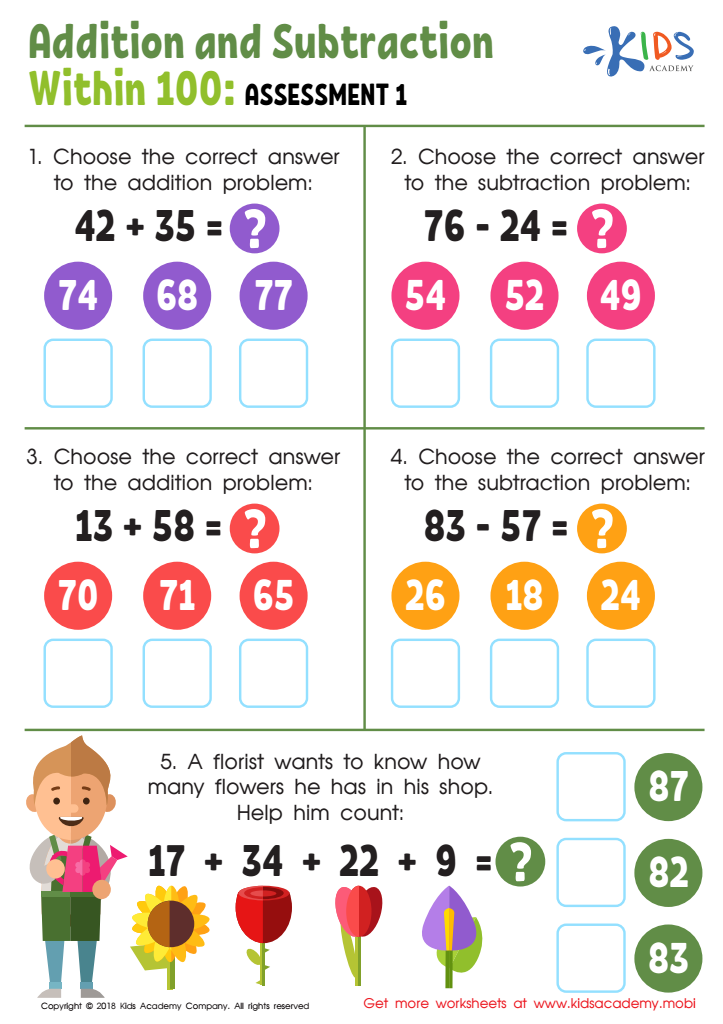
Addition and Subtraction Within 100 Worksheet
This worksheet has four math problems for your child to solve. It's perfect for building their addition and subtraction skills. Read each problem aloud and help them pick the right answer. With your guidance, your child will soon be able to complete such tasks on their own.
Addition and Subtraction Within 100 Worksheet
Worksheet
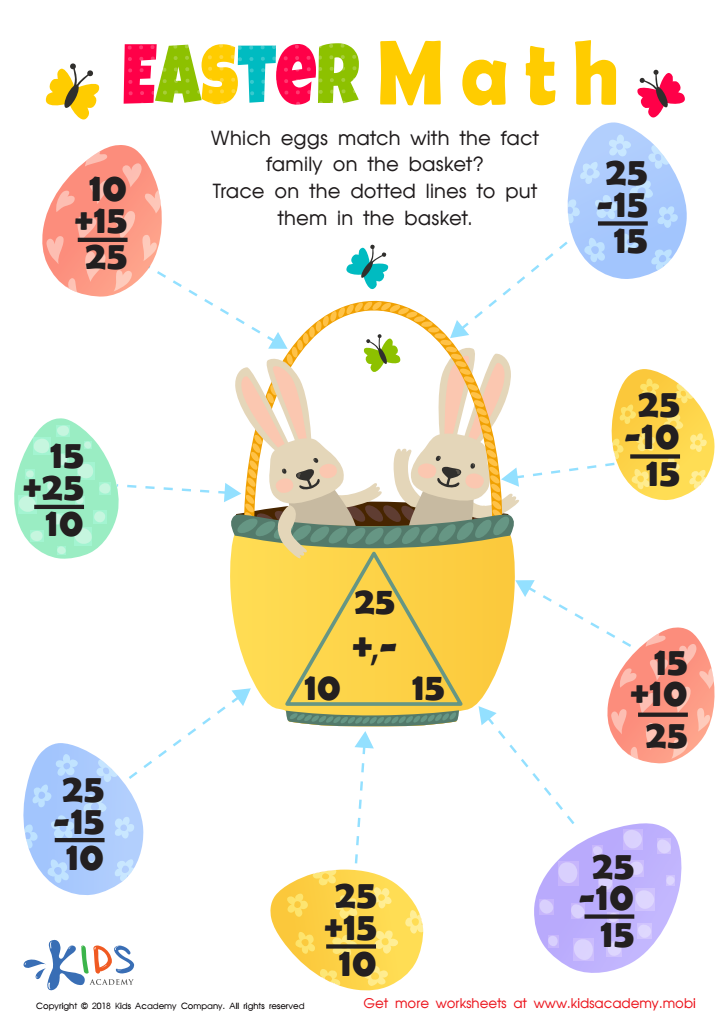
Fact Families: Easter Math Worksheet
Kids will love this vibrant PDF packed with Easter math fun! Match facts with the colorful eggs, add and subtract multiples of five to boost automaticity, and have a blast with the bunny friends!
Fact Families: Easter Math Worksheet
Worksheet
Join Kids Academy for Free
Who is primarily going to use this learning content?








Addition and subtraction are fundamental building blocks in mathematics, and for children aged 6-9, mastering these skills is crucial for their overall academic development. Parents and teachers should prioritize addition and subtraction practice during this age because it sets the foundation for more complex mathematical concepts later on, such as multiplication, division, and problem-solving strategies.
Engaging children in regular practice helps reinforce their understanding of number relationships, promotes mental math skills, and enhances their confidence in handling everyday situations involving quantities. Additionally, as students progress in their education, proficiency in these basic operations enables them to tackle more challenging topics in math, reducing anxiety and building a positive attitude towards the subject.
Furthermore, the development of addition and subtraction skills is linked to critical life skills, such as budget management and analytical thinking. Collaborative learning activities, like games or real-life problem-solving scenarios, can turn practice into enjoyable experiences, fostering a love for math. Ultimately, by supporting addition and subtraction practice, parents and teachers contribute significantly to shaping a child’s cognitive development and prepare them for future educational challenges, making it an investment in their lifelong learning journey.