Filters

54 filtered results

Clear all filters
Favorites
With answer key
Interactive

54 filtered results

Difficulty Level

Grade


Check out this FREE Trial Lesson on Chess for age 7-8!

Special Moves: Promotion

Favorites
With answer key
Interactive
  • 7-8
  • Chess
  • Normal
How Bishops Move Worksheet

How Bishops Move Worksheet

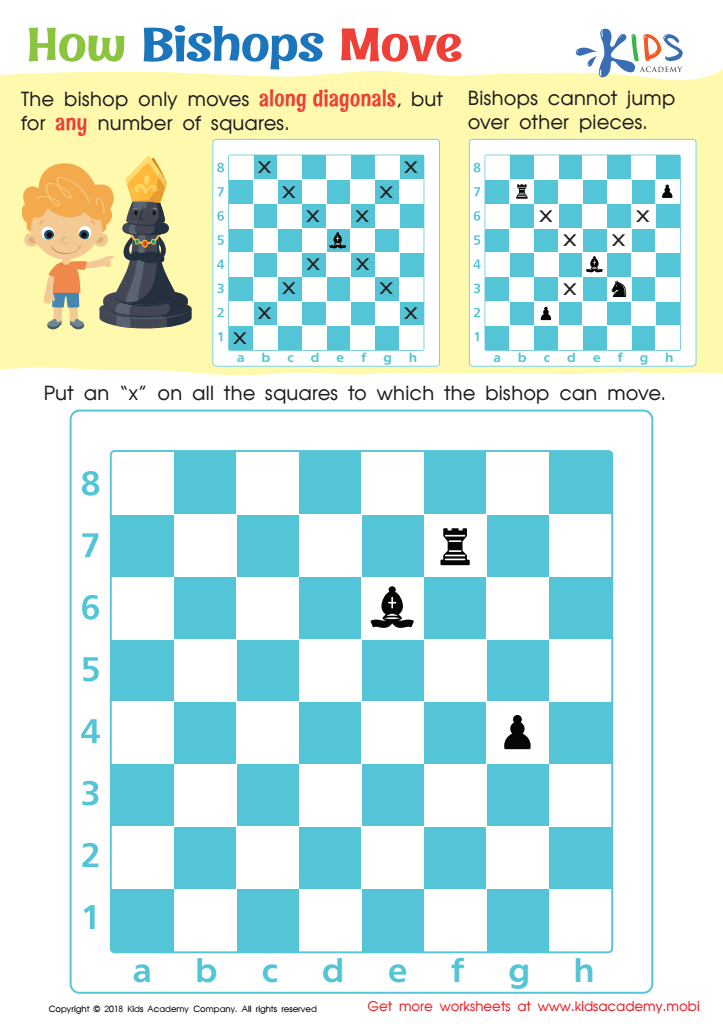
There is no such thing as too much sharpening of skills. Encourage your child to learn more about chess technicalities with this simple worksheet. It shows them how a bishop moves: along diagonals any number of squares, but it can't jump over other pieces.
How Bishops Move Worksheet
Worksheet
Rook and Bishop Worksheet

Rook and Bishop Worksheet

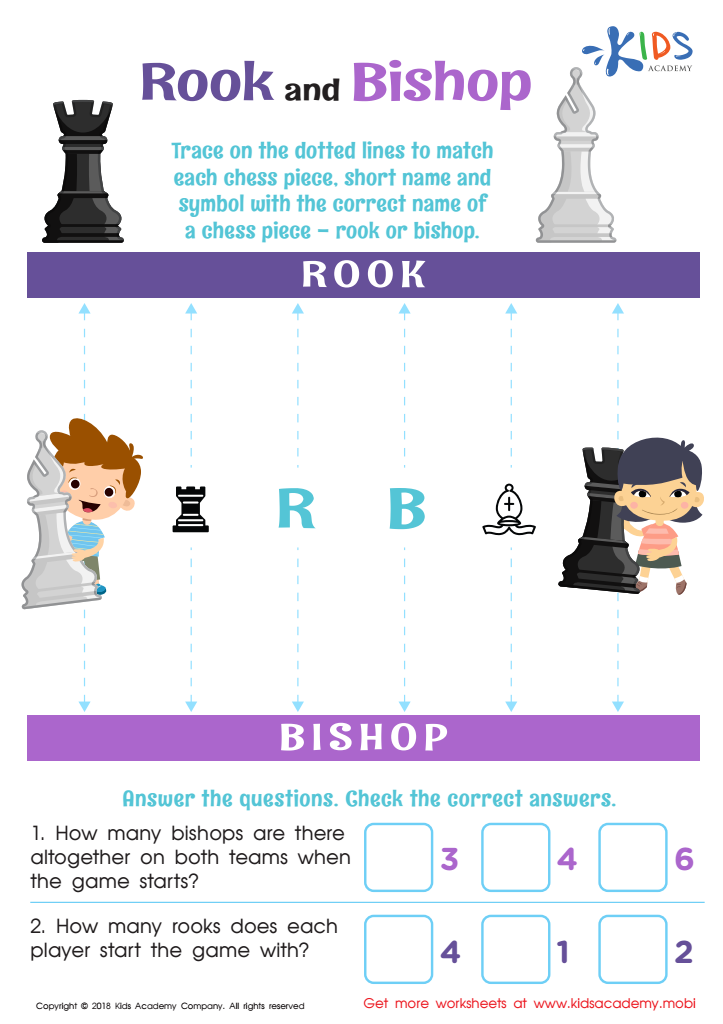
This tracing sheet helps your child learn chess pieces by matching each piece, short name and symbol to the correct name. After tracing, have them answer the questions and check their answers. It's a great way for them to become familiarized with chess.
Rook and Bishop Worksheet
Worksheet
Knight Quest Worksheet

Knight Quest Worksheet

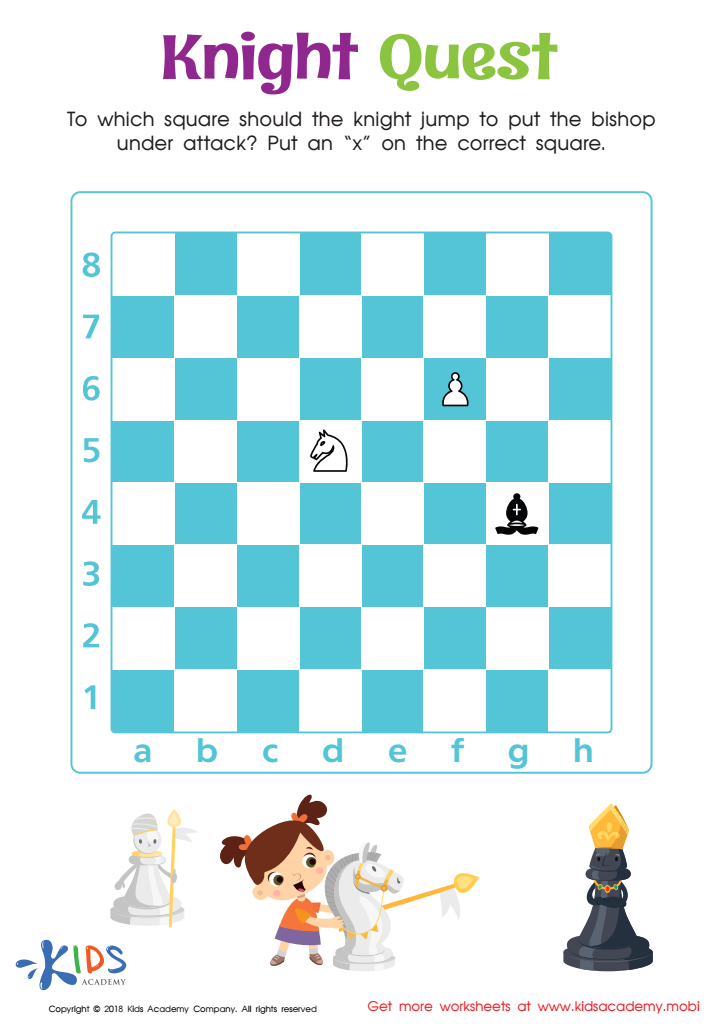
Testing your child's strategic planning and chess skills? Give them this worksheet: Ask them to mark an 'x' on the square where the knight should jump to attack the enemy bishop. See how well they plan for a win! (80 words)
Knight Quest Worksheet
Worksheet
Smart Capturing Worksheet

Smart Capturing Worksheet

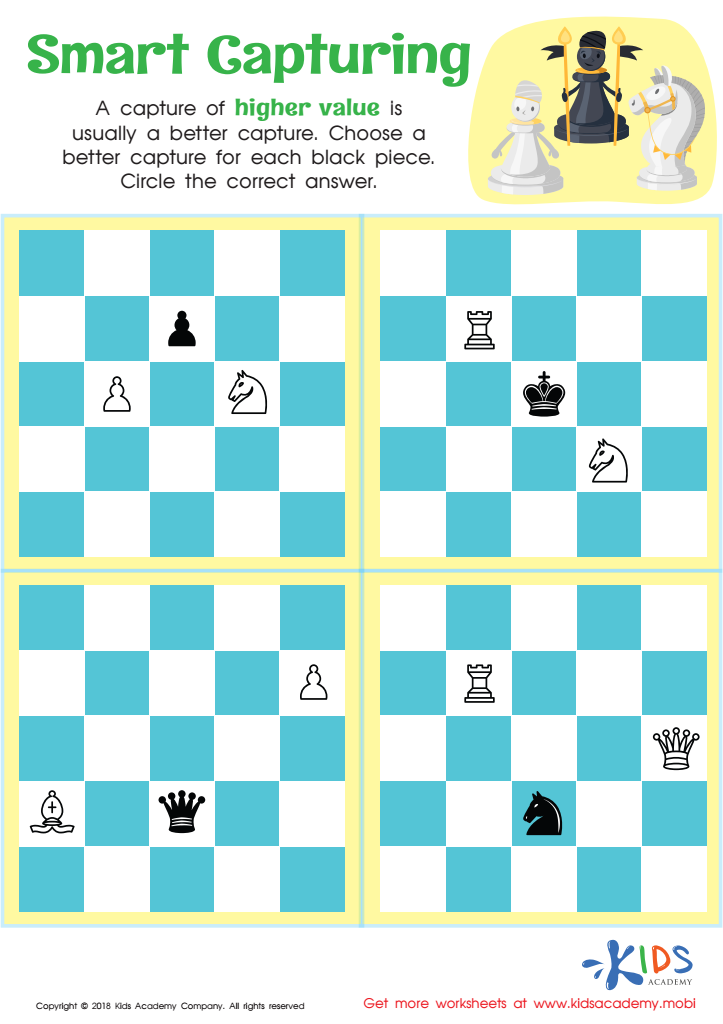
Chess is a game of strategy and calculation. When presented with two captures, a player should always go for the one that yields the highest value. For example, taking a knight over a pawn. In this worksheet, your children will choose the best capture for each black piece. Ask them to circle the correct answers. (80 words)
Smart Capturing Worksheet
Worksheet
Promotion Practice Worksheet

Promotion Practice Worksheet

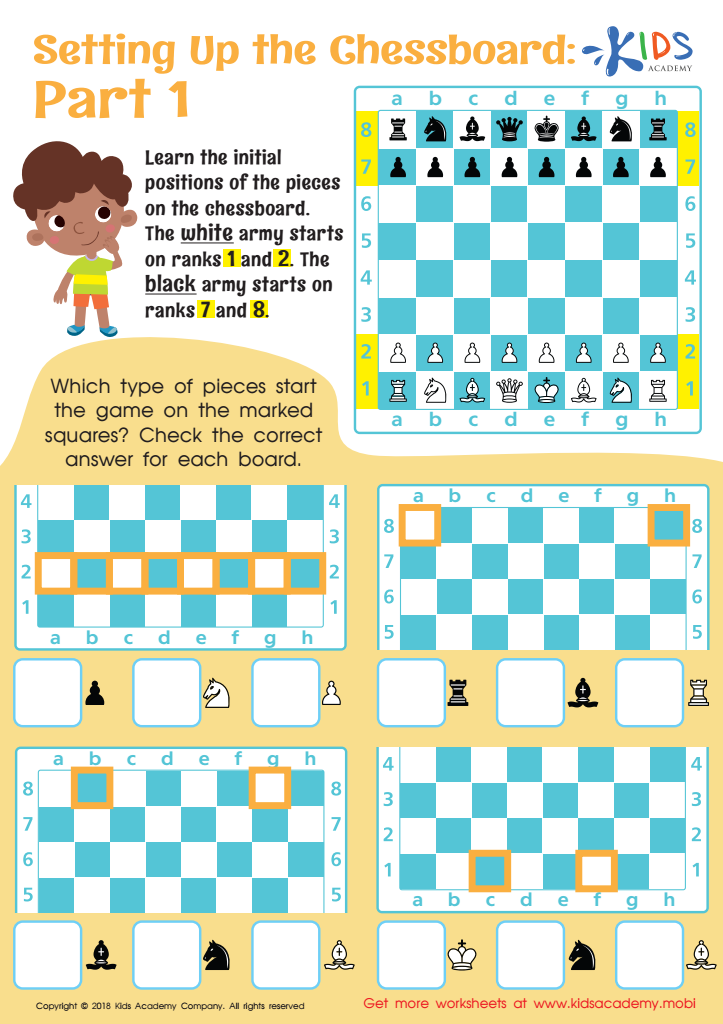
Test your kids' promotions skills with this worksheet! Ask them to find the pictures in which the pawns are correctly promoted. Remember, when a pawn reaches the last rank it may be promoted to a queen, bishop, knight or rook. In addition, a pawn can be promoted when it captures a chess piece on the last rank.
Promotion Practice Worksheet
Worksheet
Setting up the Chessboard: Part 1 Worksheet


Setting up the Chessboard: Part 1 Worksheet
Teach your child the starting positions of the black and white armies on the chessboard. Black pieces are placed on ranks 7 and 8, and white pieces on ranks 1 and 2. Have them check the highlighted boxes on the chessboard to make sure they know the correct pieces to start with.
Setting up the Chessboard: Part 1 Worksheet

Worksheet


... 2 3

Parents and teachers should care about introducing Normal Chess to children aged 7-8 for several compelling reasons. Firstly, chess is an excellent tool for enhancing cognitive skills. Learning how to play chess helps develop critical thinking, problem-solving abilities, and logical reasoning. These skills are not only essential for academic success but are also foundational for everyday decision-making.

Secondly, chess promotes social skills. Children learn to take turns, be patient, and respect their opponents. Playing chess in a structured environment encourages collaboration and communication, fostering a sense of community and belonging.

Additionally, engaging with chess can boost emotional intelligence. Children learn to deal with victory and loss gracefully, building resilience and sportsmanship. Such experiences can enhance their self-esteem and confidence, which are crucial during formative years.

Lastly, introducing chess gamifies learning. It transforms complex concepts into an enjoyable experience, making it easier for children to engage, focus, and retain information. By facilitating an early introduction to chess, parents and teachers can equip children with valuable life skills that foster academic growth, emotional development, and healthy social interactions. Overall, supporting children in learning chess can significantly impact their holistic growth and development.