Number Recognition Normal Addition & Subtraction Worksheets for Ages 7-9 - Page 2
26 filtered results
-
From - To
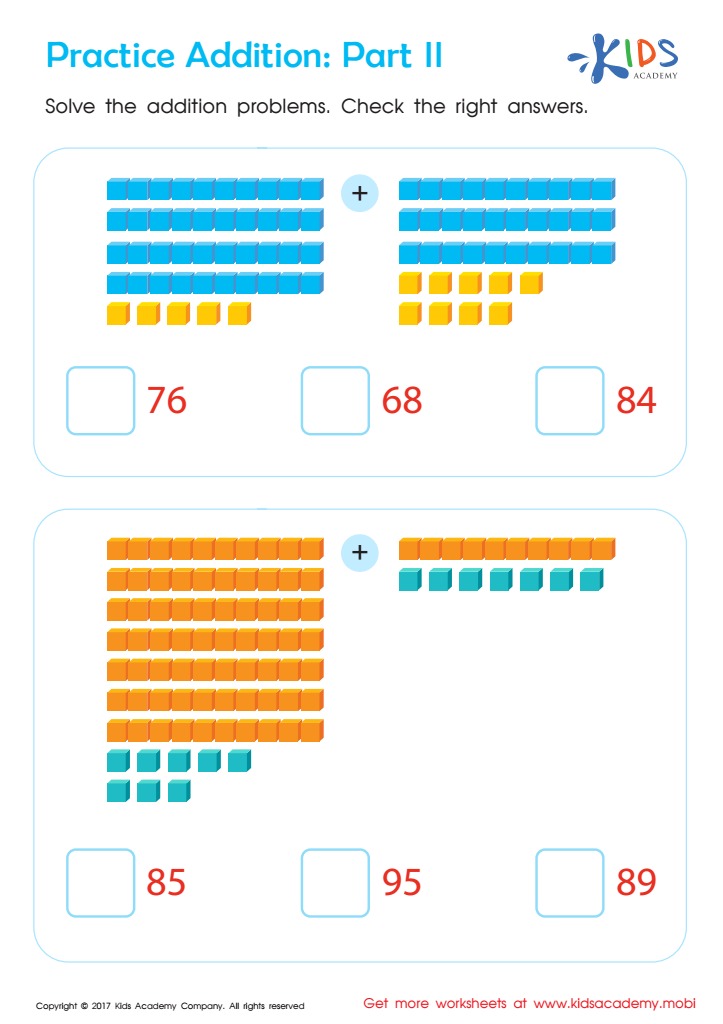
Practice Addition: Part 2 Worksheet
 Assign to My Students
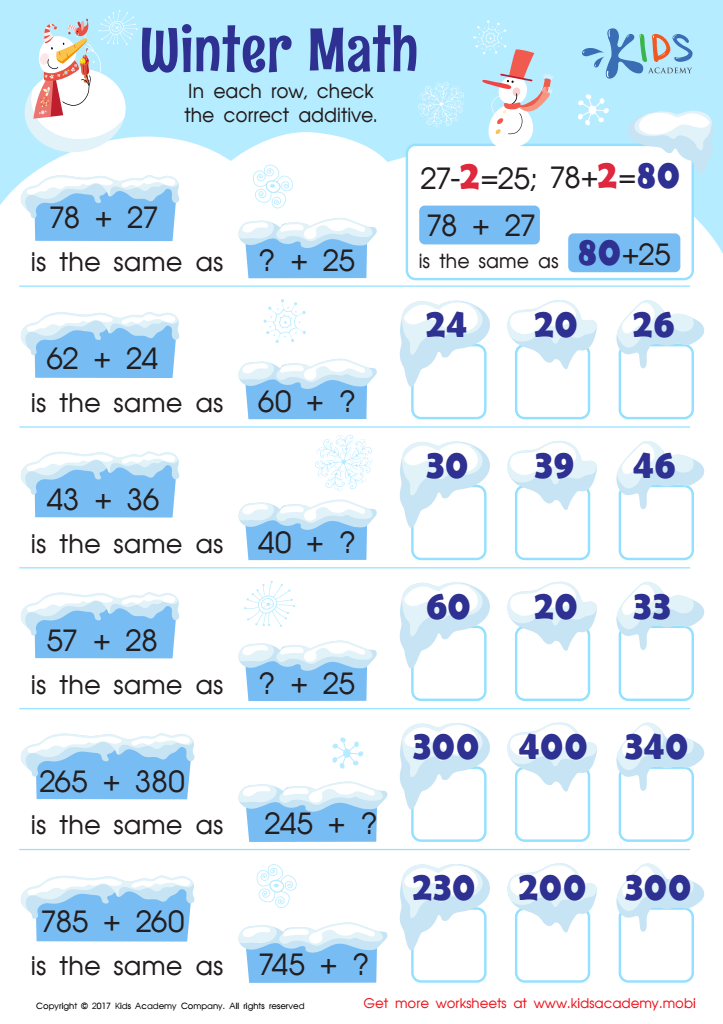
Free Addition Worksheet








Number recognition, alongside normal addition and subtraction, is crucial for children aged 7-9 as these skills lay the foundation for future mathematical understanding. At this developmental stage, children transition from simple counting to more complex arithmetic, and strong number recognition abilities serve as a crucial stepping stone. Recognizing numbers accurately enables children to grasp concepts, such as place value and the relationship between numbers, which are essential for performing addition and subtraction effectively.
Mastery of addition and subtraction not only bolsters mathematical confidence but also enhances problem-solving skills. These basic operations are omnipresent in real-life scenarios, ranging from counting money to dividing treats among friends. Without a solid grasp of addition and subtraction, children may struggle with advanced concepts like multiplication, division, and fractions, potentially hindering their academic progress.
For teachers and parents, consistent support and practice in these areas can significantly impact children's attitudes towards math, potentially cultivating a positive and resilient learning mindset. Engaging activities like math games, practical examples, and visual aids can make learning number recognition and basic arithmetic enjoyable and impactful. Hence, investing time and effort in these foundational skills sets children on a path to mathematical proficiency and overall academic success.








