
Enhancing calculation skills Normal Math Worksheets for Ages 7-9
5 filtered results
Difficulty Level
Grade
Age
-
From - To
Subject
Activity
Standards
Enhance your child's calculation skills with our engaging Normal Math Worksheets designed for ages 7-9. Our comprehensive resources focus on essential arithmetic operations, enabling young learners to develop confidence and proficiency in addition, subtraction, multiplication, and division. Through interactive exercises and colorful illustrations, students will enjoy practicing math in a fun and effective way. These worksheets are aligned with educational standards, ensuring that your child stays on track with their math skills. Perfect for classroom use or at-home practice, our worksheets foster a love for learning while helping children build a strong mathematical foundation. Download and start today!
Favorites
With answer key
Interactive
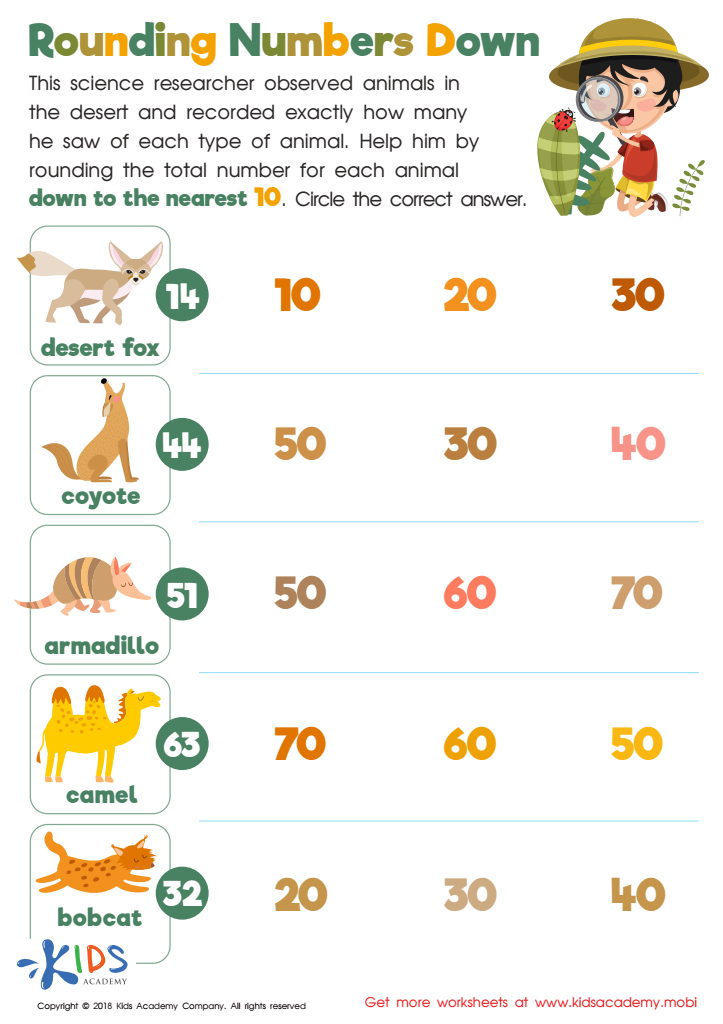
Rounding Numbers Down Worksheet
Does your child aspire to be a science researcher? This worksheet is the perfect place to start! Help your little one round the total number of animals seen in the desert to the nearest 10, then circle the correct answer for each. Fun and educational, this activity is a great way to help your kids get a taste of the science researcher lifestyle.
 Assign to My Students
Rounding Numbers Down Worksheet
Worksheet
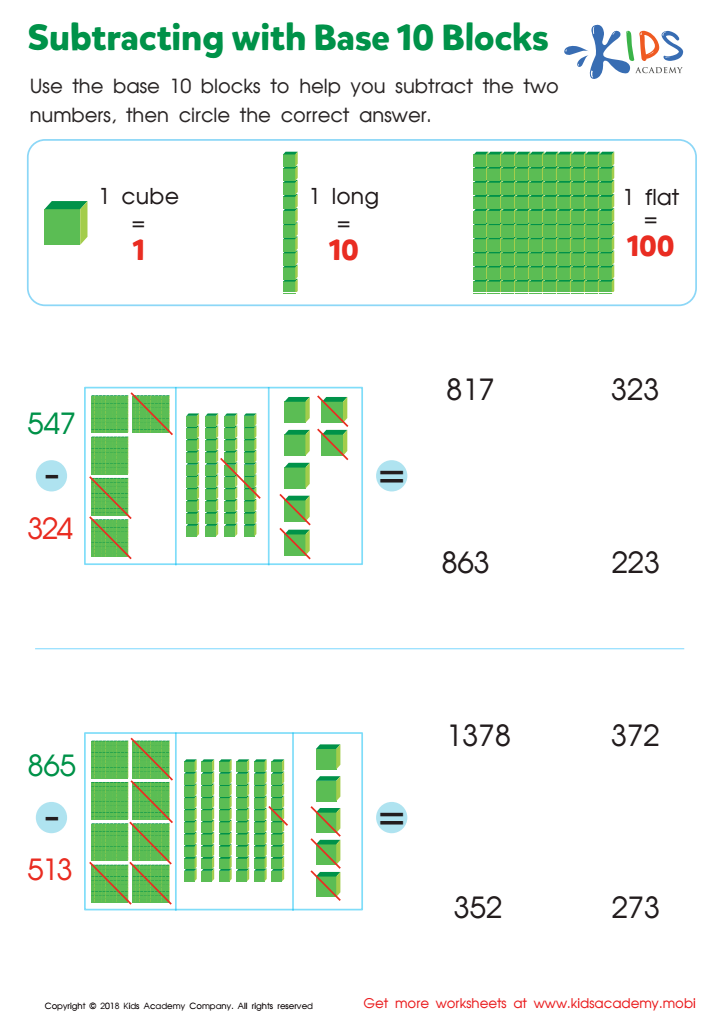
Subtracting with Base 10 Blocks Worksheet
Is your child having difficulty with 3-digit subtraction? They're not alone! Show your kid the idea behind subtracting with the help of Kids Academy's PDF worksheet. Colorful green base blocks are used to visualize the concept. Starting from the tens column, subtract each number and use the images for guidance. Allow your child to circle the correct answer for a comprehensive math lesson.
Subtracting with Base 10 Blocks Worksheet
Worksheet
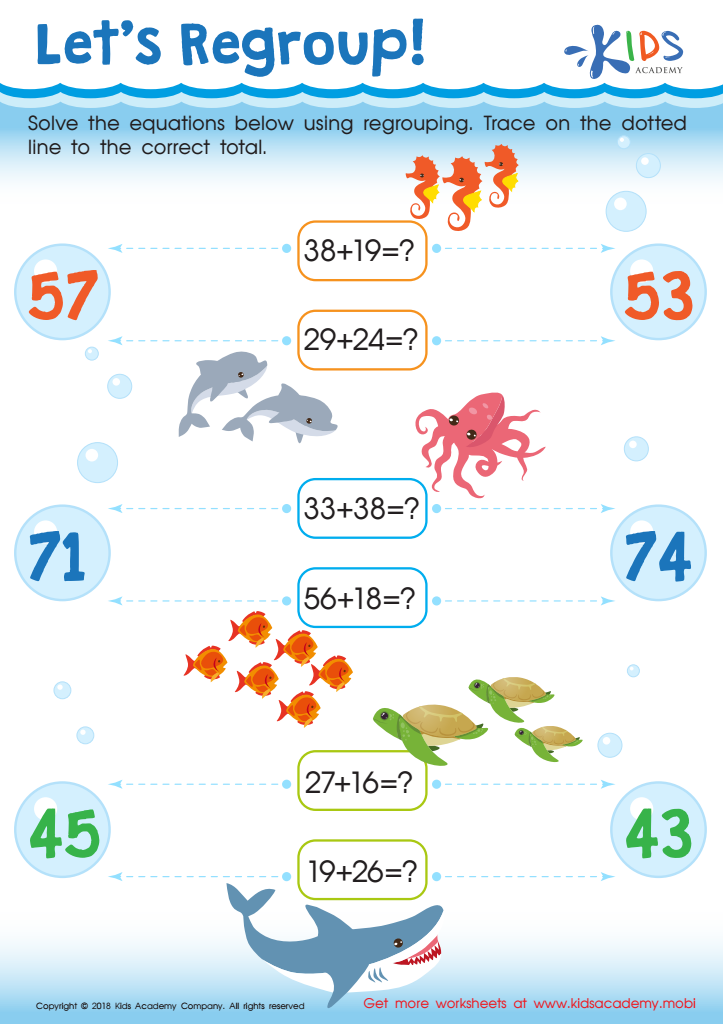
Let's Regroup! Worksheet
Your child will love completing this easy tracing sheet! The bright colors and simple equations will encourage them to solve problems by regrouping methods. Guide their hands as they trace the dotted lines to the correct answers. When they're done, check how many they got right!
Let's Regroup! Worksheet
Worksheet
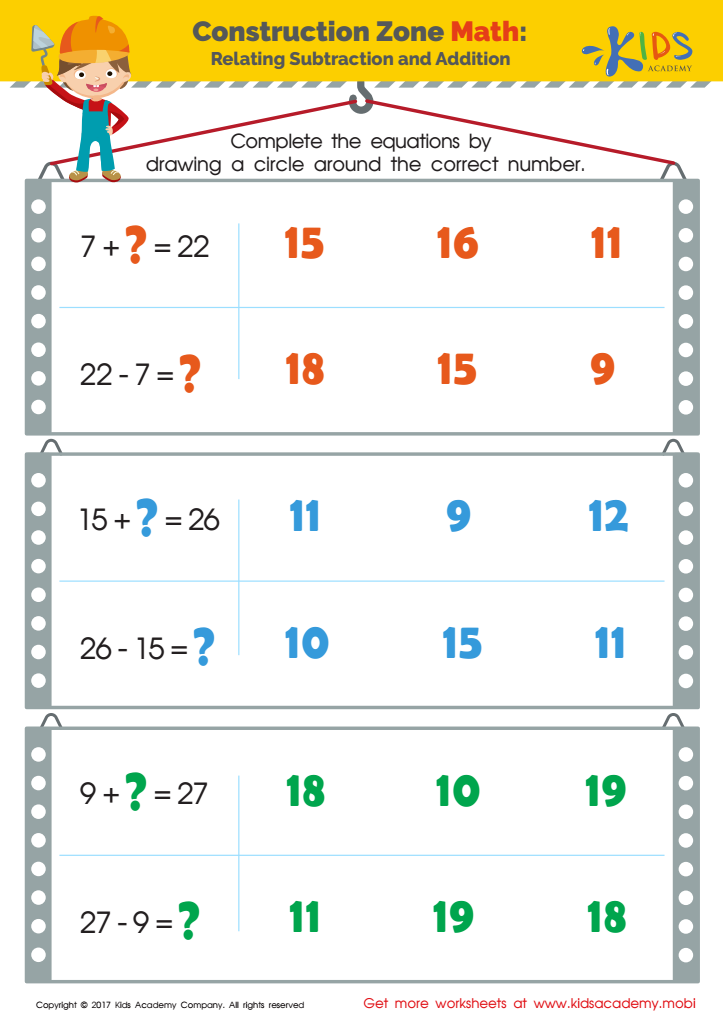
Related Addition and Subtraction Facts Worksheet
Help your child nurture their numeracy skills by introducing them to related addition and subtraction facts. Worksheets like this will give them a fun and easy way to learn how numbers work.
Related Addition and Subtraction Facts Worksheet
Worksheet
Join Kids Academy for Free
Who is primarily going to use this learning content?








Enhancing calculation skills in Normal Math for children aged 7-9 is vital for their academic growth and confidence in mathematical concepts. At this developmental stage, children are transitioning from basic to more complex mathematical operations, such as addition, subtraction, multiplication, and division. Strengthening these foundational skills fosters problem-solving abilities and critical thinking—skills essential for success not only in math but across subjects.
Moreover, strong calculation skills enable children to tackle more advanced mathematics in later grades, facilitating a smoother academic journey. By providing a solid grasp of calculations, parents and teachers help cultivate a positive attitude towards math, reducing anxiety and fear that often accompany the subject as children progress in their education.
Additionally, developing calculation fluency enhances everyday life skills. Children will encounter situations requiring math—whether it’s managing allowances, understanding time, or engaging in activities involving measurements. As they build these competencies early on, they gain a sense of independence and responsibility.
Ultimately, when parents and teachers prioritize enhancing calculation skills, they empower children to succeed both academically and in their everyday lives, laying the groundwork for lifelong learning and curiosity in mathematics. Supporting these skills during this crucial age can have lasting positive effects.








