
Basic Addition Skills Normal Math Worksheets for 7-Year-Olds
6 filtered results
Difficulty Level
Grade
Age
-
From - To
Subject
Activity
Standards
Boost your child's confidence in math with our Basic Addition Skills Normal Math Worksheets, perfect for 7-year-olds! These engaging worksheets from Kids Academy are designed to make learning addition fun and effective. Each worksheet focuses on simple addition problems, gradually increasing difficulty to build a solid mathematical foundation. Your child will enjoy colorful illustrations and interactive tasks that make practicing addition stress-free and enjoyable. Whether for school or home use, these worksheets help develop critical thinking and problem-solving skills. Empower your young learner today with our expertly crafted addition worksheets to help them excel in math!
Favorites
With answer key
Interactive
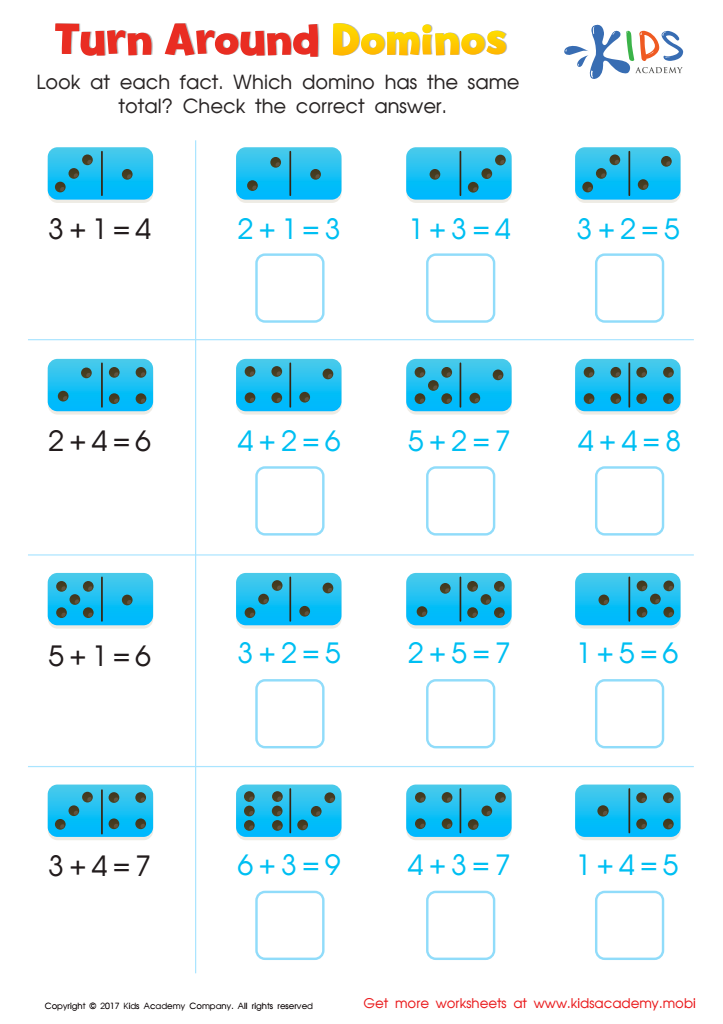
Turn Around Dominos Worksheet
Encourage your child to flex their mental muscles with this math worksheet. Look through the left side's dominos and their values and then check the three boxes on the right. Ask your child if any of the right box's dominos are similar. This requires focus and careful observation.
 Assign to My Students
Turn Around Dominos Worksheet
Worksheet
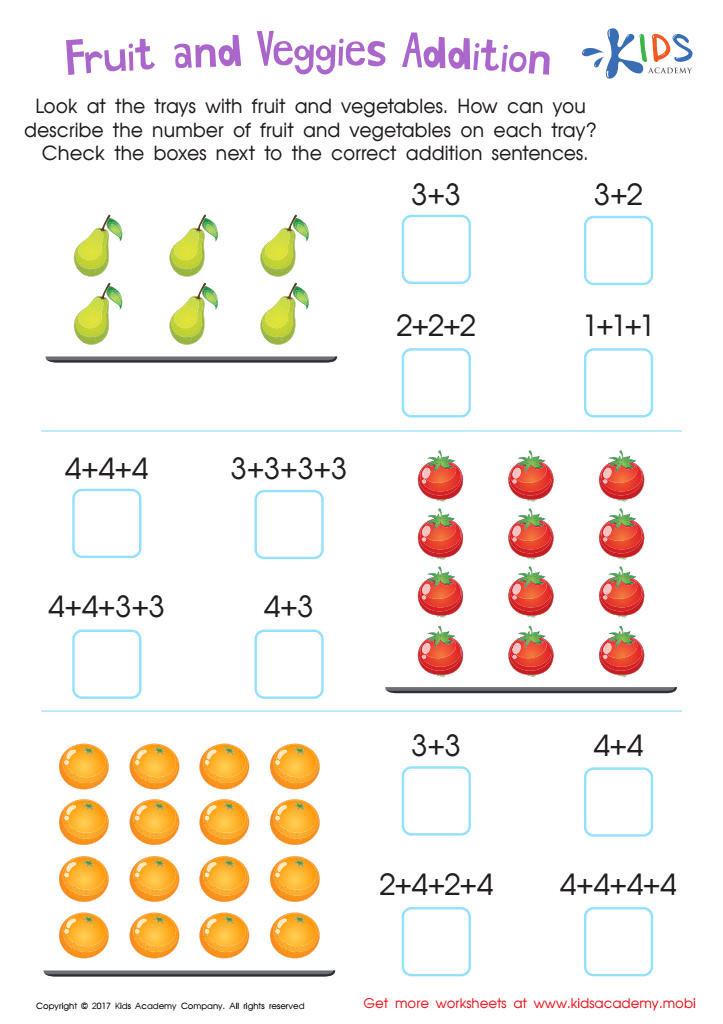
Fruit and Veggies Worksheet
It promotes problem-solving and analytical skills as kids match pictures to correct addition sentences. Help your child go beyond simple addition with this PDF worksheet!
Fruit and Veggies Worksheet
Worksheet
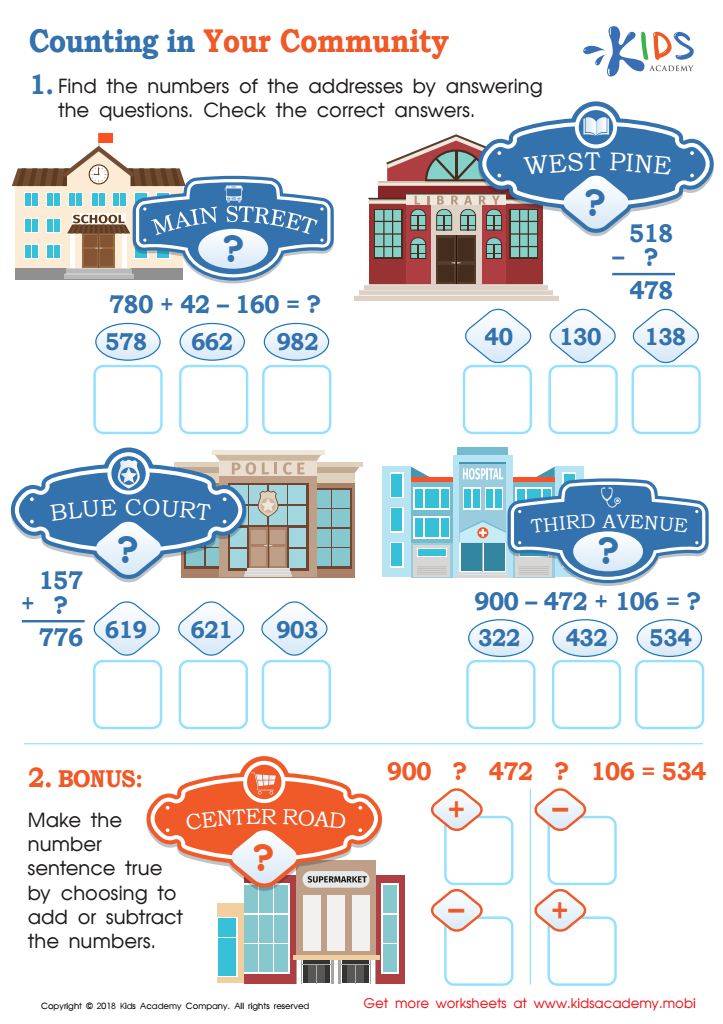
Counting in Your Community Worksheet
Introduce your kids to the idea of a community, where different people and buildings co-exist, each playing their part for the community's progress. Ask them to name the buildings they see in their community. Then work through this worksheet to find the numbers of the addresses by answering the questions. Check the answers once they've solved the equations.
Counting in Your Community Worksheet
Worksheet
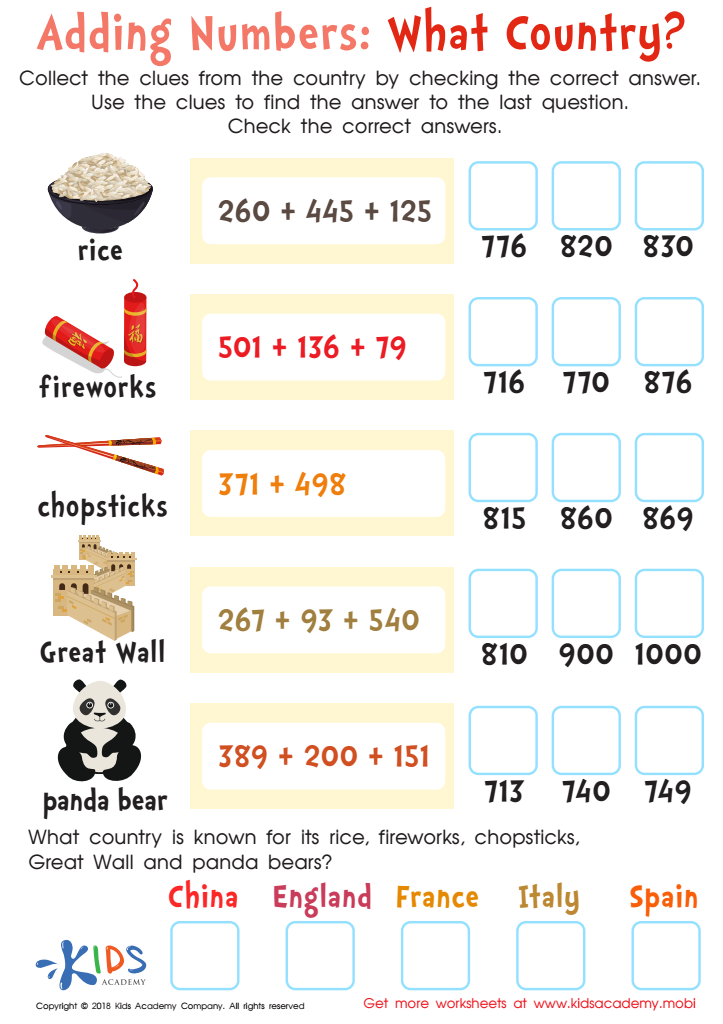
Adding Numbers: What Country Worksheet
Students can use this worksheet to learn more about different countries. Have them collect clues from the worksheet to answer the last question. Help them check the correct answer, and they'll gain knowledge about each country's food, animals, celebrations, and landmarks.
Adding Numbers: What Country Worksheet
Worksheet
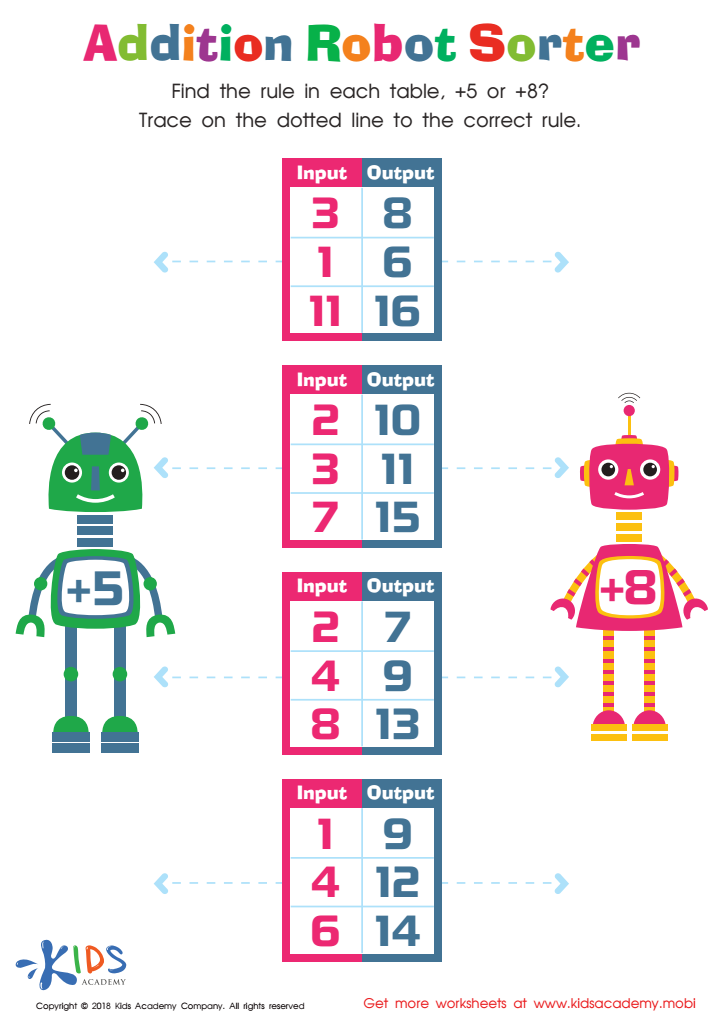
Addition Robot Sorter Worksheet
This worksheet helps your child understand addition. Have them trace the dotted lines to the correct equations: +8 and +5. It's a great way to aid their mathematical comprehension and get them comfortable with adding equations.
Addition Robot Sorter Worksheet
Worksheet
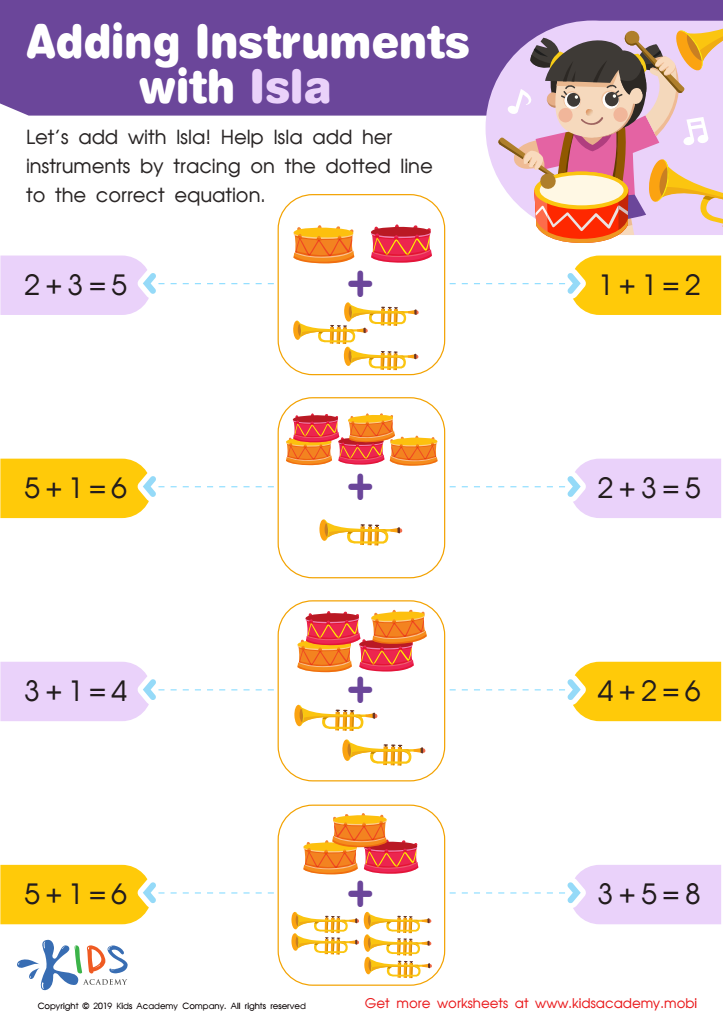
Adding Instruments with Isla Worksheet
Your kids can have fun helping Isla add her musical instruments. With colorful pics and one-to-one representation, they can pick the correct addition sentence. They can connect each pic with traceable lines and get to the right sum up to 10.
Adding Instruments with Isla Worksheet
Worksheet
Join Kids Academy for Free
Who is primarily going to use this learning content?







Caring about basic addition skills for 7-year-olds is crucial for both parents and teachers because it forms the foundation for all future mathematical learning. At this age, children are developing critical cognitive skills, and grasping basic addition smoothly will boost their confidence, making them more comfortable with math overall. Strong addition skills also enhance problem-solving abilities, logical thinking, and decision-making, which are essential skills beyond the math classroom.
Furthermore, early mastery of addition is vital for understanding more complex arithmetic operations, such as subtraction, multiplication, and division. If children struggle with addition, they are less likely to succeed in these advanced areas, which can lead to frustration and a negative attitude toward math.
Parents and teachers play a pivotal role by reinforcing these skills in fun, engaging, and practical ways. When addition is integrated into everyday activities, like playing games or cooking, children are more inclined to see math as a positive aspect of their lives. By prioritizing basic addition skills, parents and teachers can help set the stage for academic success, fostering a lifelong love for learning, and better preparing children for future educational challenges. In essence, strong addition skills are a small investment with substantial, long-lasting returns.








