
Critical Thinking Normal Division Worksheets for Ages 8-9
3 filtered results
Difficulty Level
Grade
Age
-
From - To
Subject
Activity
Standards
Discover our engaging Critical Thinking Normal Division Worksheets designed specifically for children ages 8-9. These worksheets challenge young learners to enhance their division skills while simultaneously developing critical thinking abilities. Each worksheet features diverse problems and stimulating exercises to promote a deeper understanding of mathematical concepts. By applying logic and reasoning, students will become proficient problem solvers, ready to tackle more complex math challenges in the future. Ideal for classroom use or at-home practice, these worksheets provide a fun and interactive approach to mastering division. Encourage analytical thinking and math confidence in your young learners today!
Favorites
With answer key
Interactive
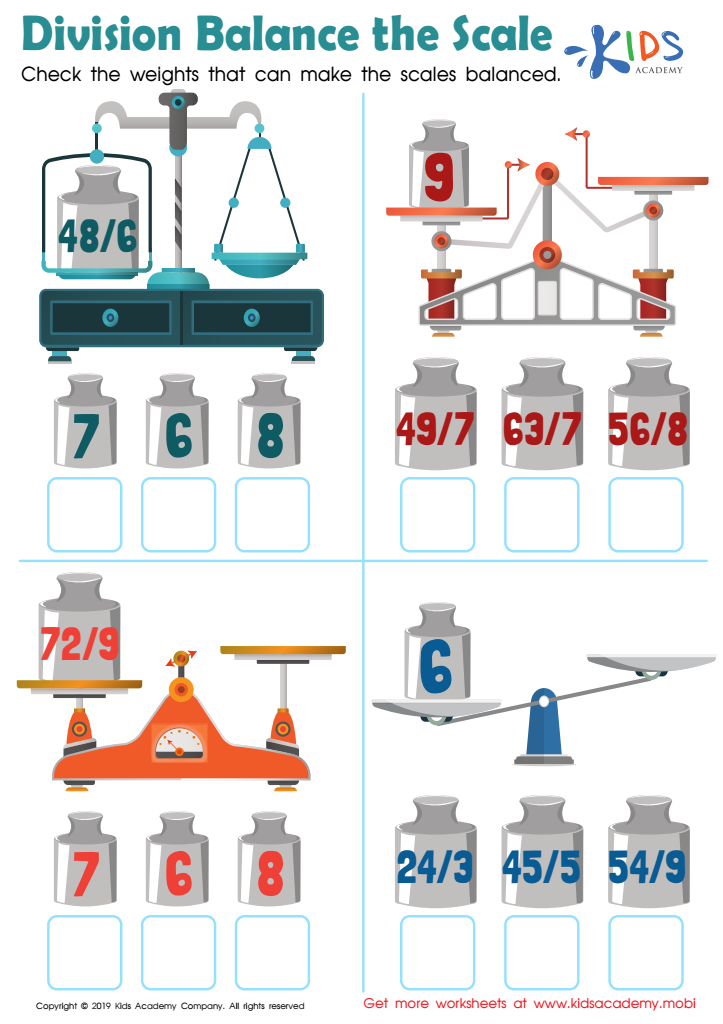
Division Balance the Scale Worksheet
Students can learn math better when they understand the relationships between numbers. This free worksheet helps them practice division: solving problems and matching the correct quotient to balance the scales. Fun visual boxes make it a unique way to engage with the material.
 Assign to My Students
Division Balance the Scale Worksheet
Worksheet
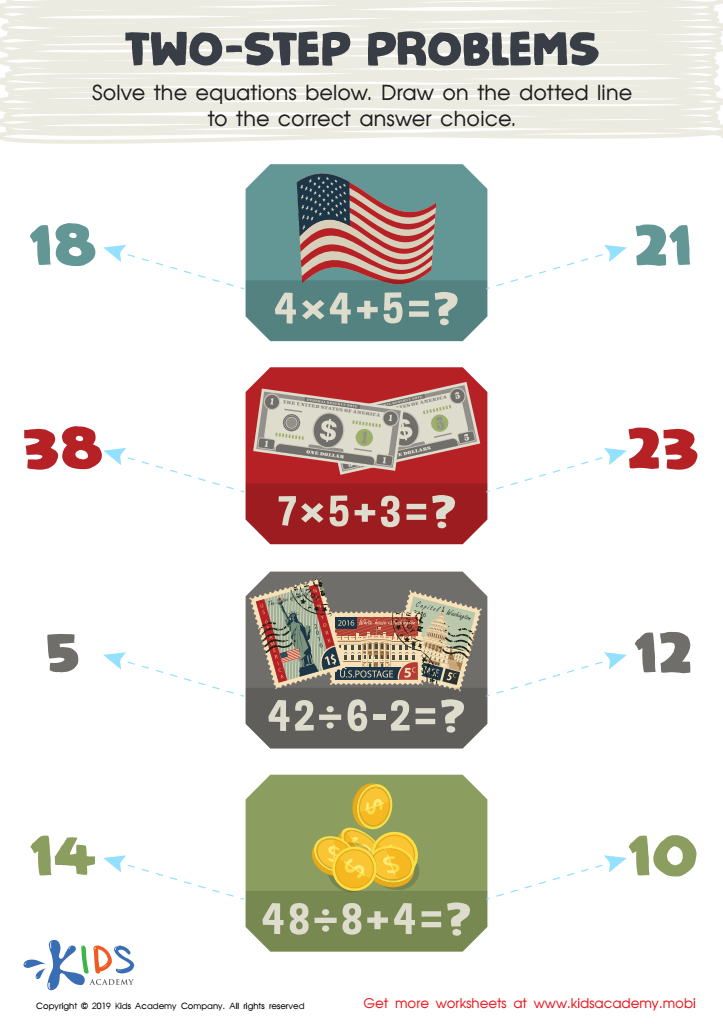
Two-Step Problems Worksheet
Help your child practice their math problem-solving skills with this worksheet. It covers the basics of subtractions, additions, multiplications, and divisions. With four simple equations, your kids can solve them and draw the correct answer on the dotted line. Reduce their strain and give them the help they need.
Two-Step Problems Worksheet
Worksheet
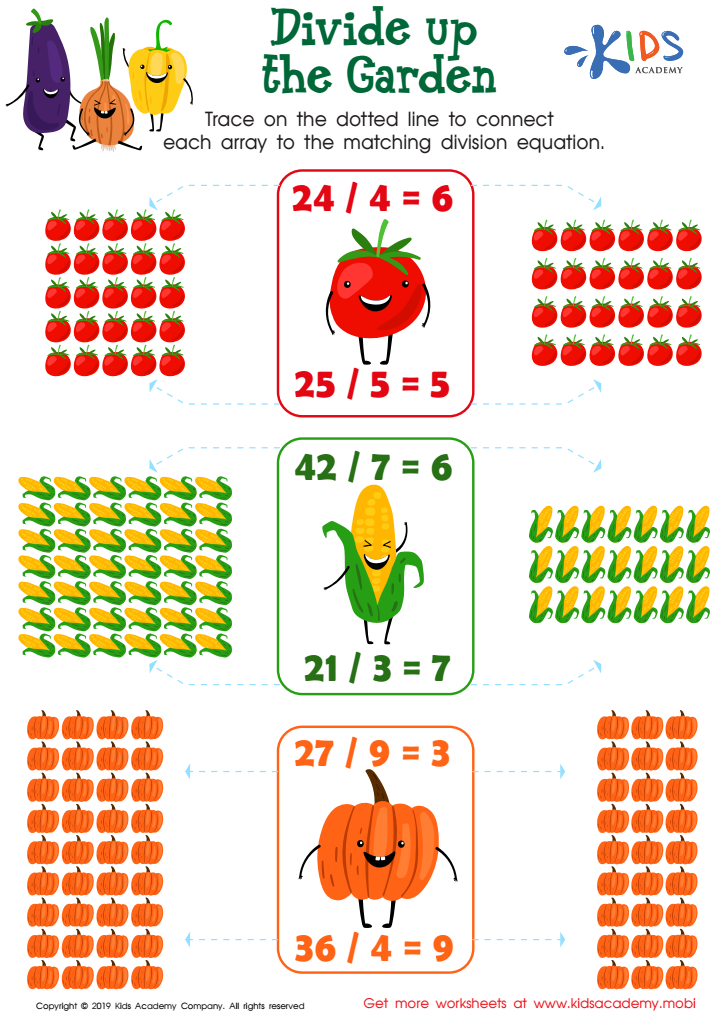
Divide up the Garden Worksheet
Dividing is simply grouping items into equal sets. This worksheet helps kids see division problems in array form. They'll match each equation with a picture group, using the lines provided. It's a great way for beginners to understand division more concretely.
Divide up the Garden Worksheet
Worksheet
Join Kids Academy for Free
Who is primarily going to use this learning content?








Critical thinking is a vital skill for children, particularly those aged 8-9, as it forms the foundation for effective problem-solving, decision-making, and independent learning. At this age, children are beginning to think more abstractly and critically, making it essential for parents and educators to nurture these skills.
Critical thinking in normal division helps children understand not just how to carry out mathematical operations, but also why those operations work. Teaching them to question, analyze, and reason through division encourages them to develop a deeper comprehension of patterns and relationships in mathematics. This understanding warmly translates to improved fluency in calculations and problem-solving competencies.
Furthermore, critical thinking equips young learners with the ability to assess information critically, helping them navigate a world increasingly flooded with data and opinions. It fosters curiosity and encourages them to seek out information, empowering them to become lifelong learners. Parents and teachers play a key role in guiding children through this thought process, helping them develop resilience and adaptability in various situations.
Ultimately, prioritizing critical thinking in normal division not only strengthens mathematical skills but also enhances overall cognitive development, preparing children for future academic challenges and real-life applications.








