
Sound recognition Normal Worksheets for 8-Year-Olds
4 filtered results
Difficulty Level
Grade
Age
-
From - To
Subject
Activity
Standards
Enhance your 8-year-old's auditory skills with our Sound Recognition Normal Worksheets! Designed specifically for this age group, these engaging and educational worksheets boost your child's ability to identify and differentiate between various sounds. Through fun exercises and interactive activities, kids will develop better listening skills while enjoying the learning process. With an array of captivating worksheets, your child will be well on their way to mastering sound recognition. Perfect for classroom use or at-home practice, these worksheets are a great addition to any educational toolkit. Start today and watch your child's auditory skills flourish!
Favorites
With answer key
Interactive
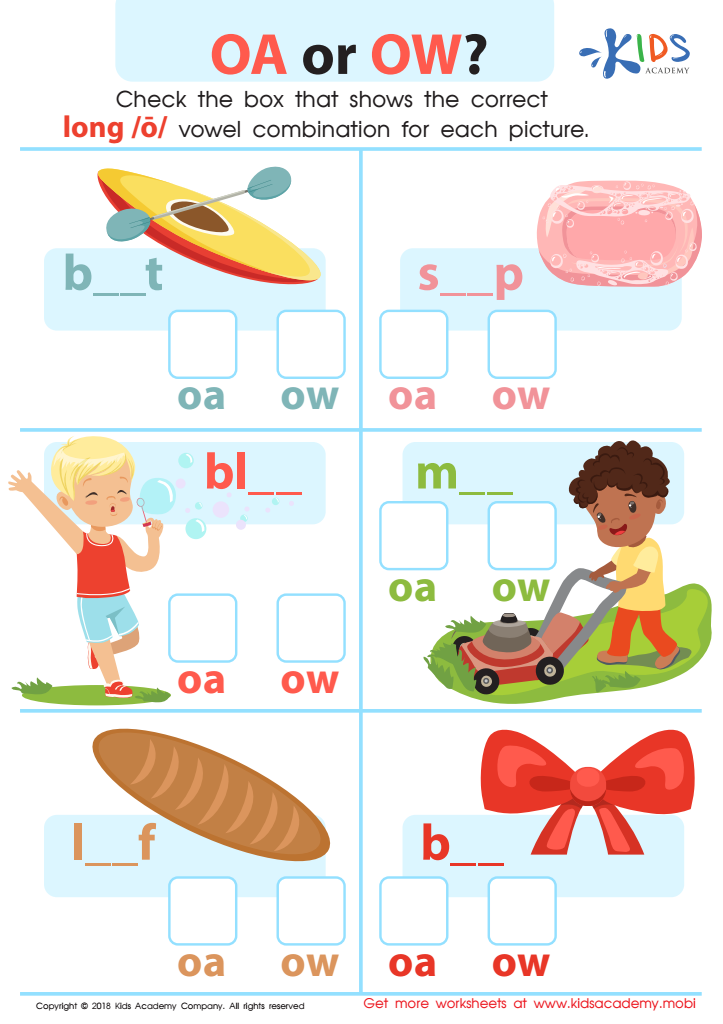
Reading: OA or OW Worksheet
This printable worksheet helps young and emergent readers with decoding words and understanding digraphs (two letters with one sound). It requires students to complete the spelling for each word based on the picture, focusing on /oa/ and /ow/ spellings. It's ideal for a reading classroom and for spelling practice.
Reading: OA or OW Worksheet
Worksheet
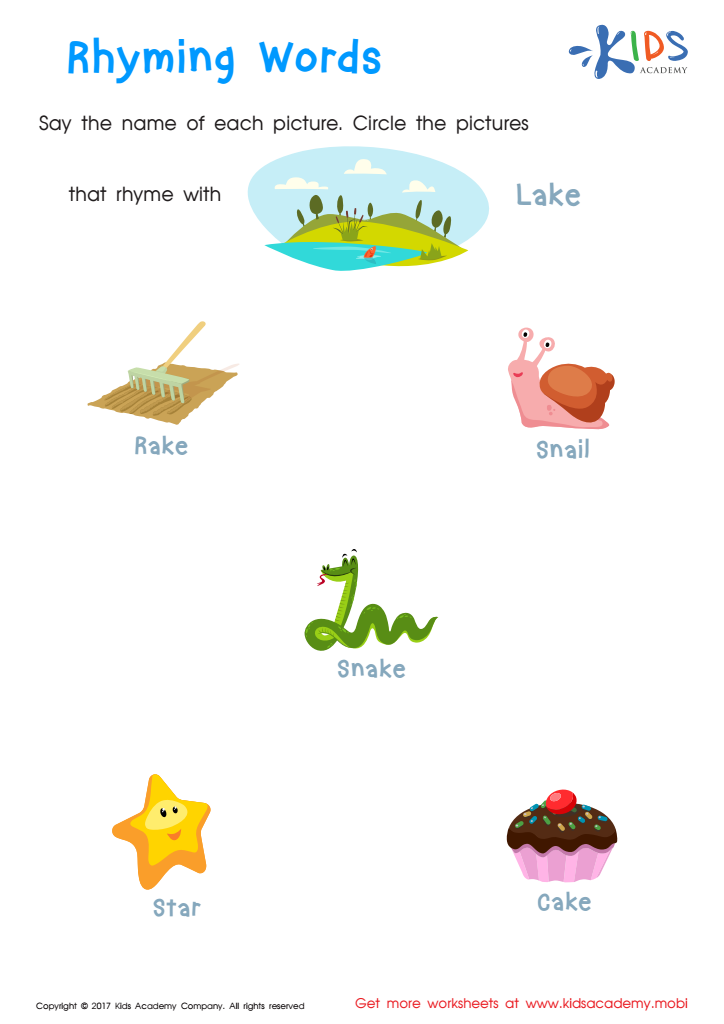
Rhyming Words Rhyming Worksheet
This worksheet is great for honing pre-reading skills. It helps kids make connections between pictures and written words, use problem-solving, and recognize sounds and words that rhyme. Have fun exploring rhyming words with your child, and they'll be rhyming in no time!
Rhyming Words Rhyming Worksheet
Worksheet

Long and Short U Worksheet
Revised: Spice up your lesson on long and short vowels with this fun printout! Kids read the words "tube" and "tub," then reinforce the sound by coloring in the words and pictures. It's a great way to make phonics class enjoyable!
Download (PDF)
 Assign to My Students
Assign to My Students
Long and Short U Worksheet
Worksheet
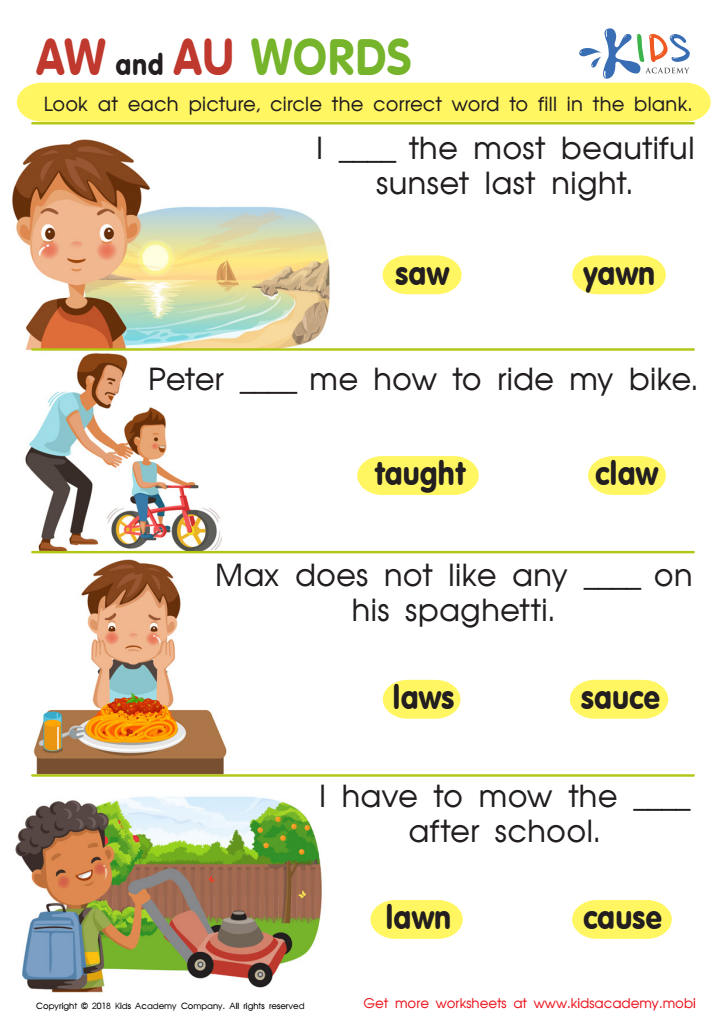
Reading: AW and AU Words Worksheet
This worksheet helps kids recognize that /au/ and /aw/ can make the same sound. Students read sentences and pick the correct word with one of the digraphs. Understanding digraphs improves decoding and reading fluency. Perfect for reading and phonics classes.
Reading: AW and AU Words Worksheet
Worksheet
Join Kids Academy for Free
Who is primarily going to use this learning content?






Sound recognition is a crucial aspect of a child's cognitive and language development, particularly around the age of 8, when academic learning intensifies. Parents and teachers should give priority to this skill for several reasons:
Firstly, effective sound recognition underpins reading comprehension and fluency. Children who recognize phonemes—the smallest units of sound in speech—quickly decode words and read more proficiently. As reading is foundational for learning other subjects, this skill impacts overall academic performance.
Secondly, sound recognition is vital for clear communication. Children with strong auditory skills can distinguish between similar-sounding words, enabling them to follow instructions accurately, participate confidently in conversations, and build stronger social skills.
Hearing impairments or difficulties in sound discrimination can lead to misunderstandings and impact educational outcomes. Early identification and intervention are essential to providing children with the support they need, whether through specialized teaching methods, speech therapy, or hearing aids.
Beyond academics, sound recognition plays a role in safety and life skills. Children who effectively interpret auditory information are better equipped to respond appropriately to warning sounds like alarms and car horns.
In summary, honing sound recognition at an early age sets a strong foundation for reading, communication, and overall cognitive progress, which are pivotal for a child’s academic success and everyday life skills.








