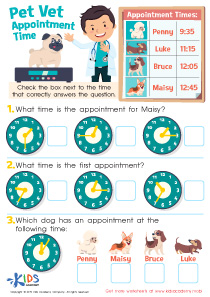
Comparing lengths Normal Grade 2 Math Worksheets
3 filtered results
Difficulty Level
Grade
Age
-
From - To
Subject
Activity
Standards
Explore our "Comparing Lengths" Grade 2 math worksheets, perfect for helping your child master measurement skills. Designed for young learners, these engaging activities teach students to compare the length of objects using different units, fostering critical thinking and problem-solving skills. Each worksheet provides fun, interactive exercises that allow children to measure, compare, and record data in a simple, relatable way. With colorful illustrations and easy-to-follow instructions, our worksheets make learning enjoyable and effective. Ideal for classroom use or home practice, these resources are essential for building a strong foundation in math. Download today and watch your child’s confidence soar!
Favorites
With answer key
Interactive
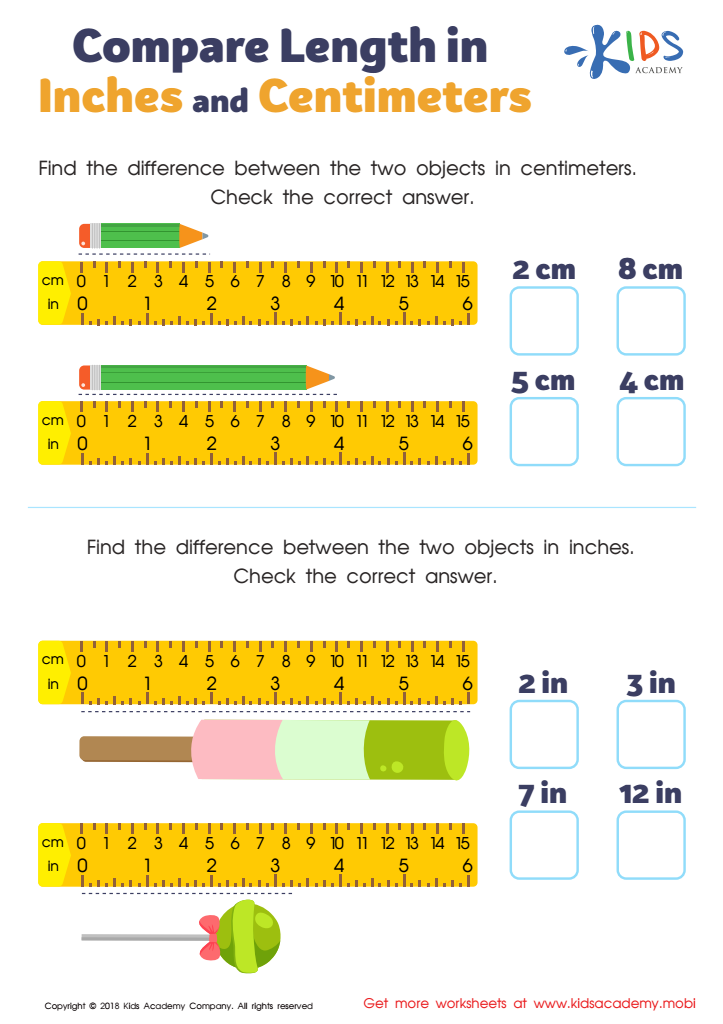
Compare Length in Inches and Centimeters Worksheet
This worksheet has your child measuring objects in both centimeters and inches. The first task requires measuring both objects in centimeters, then finding their difference. The second task is the same but in inches.
 Assign to My Students
Compare Length in Inches and Centimeters Worksheet
Worksheet
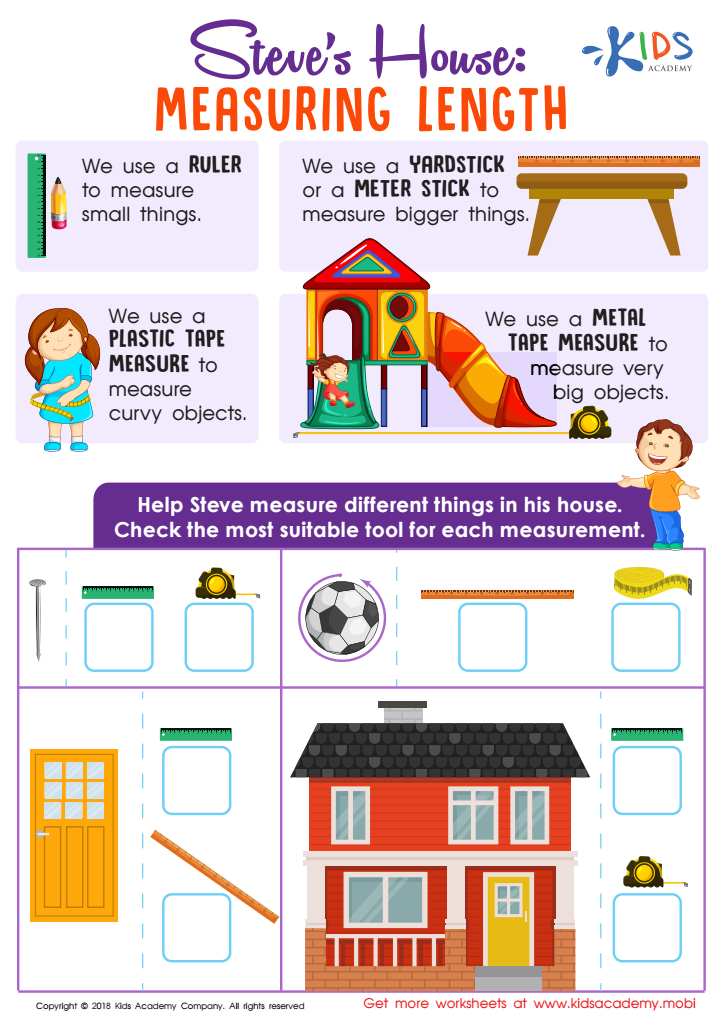
Steve's House: Measuring Length Worksheet
Introduce your kids to the various measuring tools and their uses. Explain how a ruler, plastic tape, yard stick, and metal tape measure are used to measure different objects. Guide them as they help Steve measure things in his home with the correct tool.
Steve's House: Measuring Length Worksheet
Worksheet
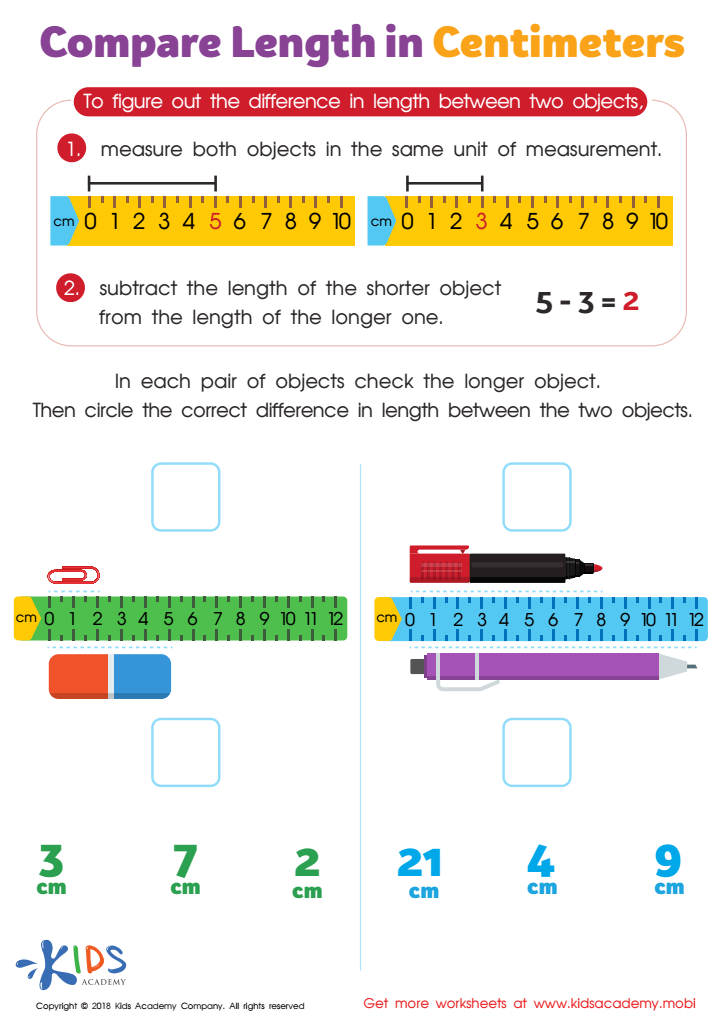
Compare Length in Centimeters Worksheet
To do this worksheet, your child needs to be able to measure accurately, add and subtract. They must measure both items and subtract the shorter from the longer to work out the difference in length.
Compare Length in Centimeters Worksheet
Worksheet
Join Kids Academy for Free
Who is primarily going to use this learning content?







Comparing lengths is a fundamental component of early grade mathematics that serves as a cornerstone for developing essential cognitive and analytical skills. For Grade 2 students, learning to compare lengths prepares a solid foundation for future mathematical concepts, such as measurement, geometry, and spatial awareness.
When children compare lengths, they practice critical thinking and problem-solving, as they must observe, gather, and analyze information to determine which length is longer or shorter. These activities enhance their observational skills and enable them to draw logical conclusions.
Moreover, proficiency in comparing lengths is crucial for real-world applications. It equips children with practical skills they can use in everyday situations, like determining if a piece of furniture will fit in a space or cutting materials accurately in crafts. These skills extend to diverse areas including science and engineering, where precise measurement is vital.
For parents and teachers, fostering an environment that emphasizes these skills extends beyond academic achievement. It builds confidence and encourages a growth mindset, as children learn to approach problems methodically and persistently. By valuing the act of comparing lengths at an early stage, parents and teachers are investing in a child’s holistic development, both academically and functionally for life.