
Reading Non-Fiction worksheets activities for 7-Year-Olds
1 filtered results
Difficulty Level
Grade
Age
-
From - To
Subject
Activity
Standards
Dive into our comprehensive collection of Reading Non-Fiction worksheets activities, designed to bolster students' abilities to navigate and understand the rich world of non-fiction texts. Perfect for educators seeking to enhance reading comprehension, critical thinking, and analytical skills, our activities cover a wide spectrum of themes and complexities. From identifying main ideas and key details to evaluating arguments and understanding text structures, our resources are tailored to engage and challenge learners at every level. Empower your students to become proficient non-fiction readers with our meticulously crafted worksheets, and watch as they develop a deeper appreciation and understanding of the real world through the written word.
Favorites
With answer key
Interactive
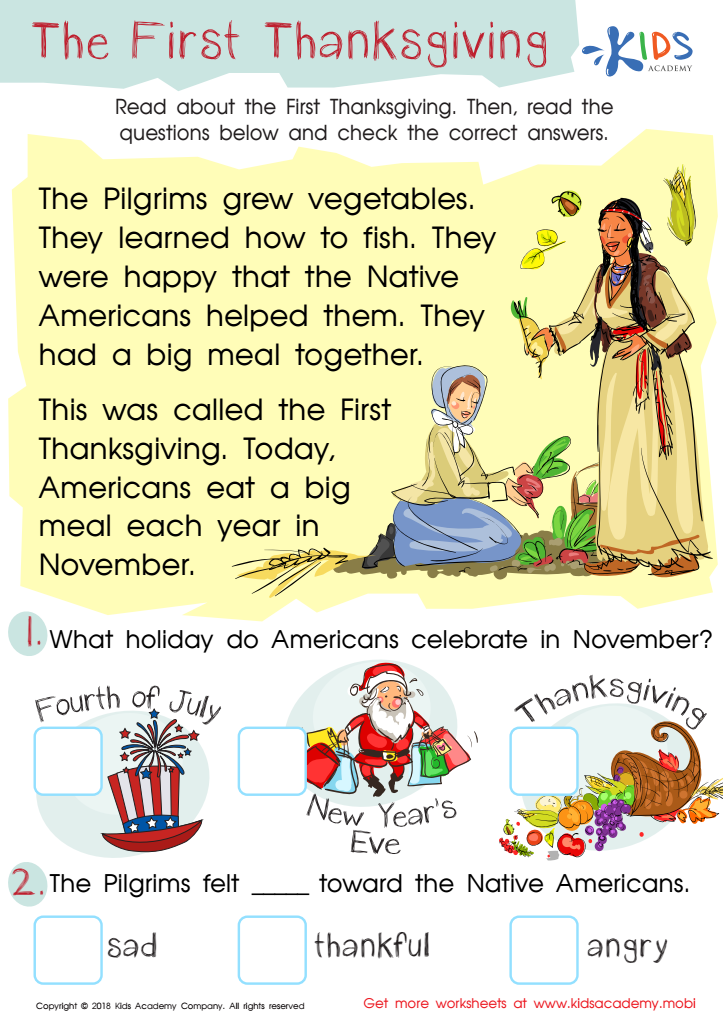
Assessment: First Thanksgiving Worksheet
When the Pilgrims arrived in America in 1620, they met the Native Americans and formed a pact to live in harmony. The Native Americans taught the Pilgrims how to survive in the new land, which helped them celebrate the First Thanksgiving. Read this text to your children and help them answer the questions below.
 Assign to My Students
Assessment: First Thanksgiving Worksheet
Worksheet
Learning Skills
Join Kids Academy for Free
Who is primarily going to use this learning content?








Reading Non-Fiction worksheets activities serve as an essential tool in the development of a wide range of skills for students of all ages. These activities are designed to enhance comprehension, expand vocabulary, and foster critical thinking skills, making them invaluable in the educational journey of any learner.
Firstly, Reading Non-Fiction worksheets activities are crucial in improving comprehension skills. As students engage with texts that provide factual information on a variety of topics, they learn to identify main ideas, understand cause and effect relationships, and distinguish between fact and opinion. These abilities are foundational for academic success and are honed through consistent practice with these worksheets.
Moreover, these activities are instrumental in vocabulary expansion. Non-fiction texts cover a broad spectrum of subjects, from science and history to technology and art, introducing students to domain-specific terminology and concepts. Through the structured exercises provided in worksheets, students encounter and learn new words in context, which is far more effective than rote memorization. This exposure not only enriches their vocabulary but also deepens their understanding of the world around them.
Additionally, Reading Non-Fiction worksheets activities cultivate critical thinking skills. They often include questions that require analysis, synthesis, and evaluation, challenging students to not just passively consume information but to engage with it actively. By analyzing arguments, evaluating evidence, and synthesizing information from various sources, students develop the ability to think critically and independently.
Furthermore, these worksheets are versatile and can be adapted to suit different learning styles and needs, making them accessible and beneficial for a diverse student population. Whether through group discussions, independent study, or interactive digital platforms, Reading Non-Fiction worksheets activities can be tailored to maximize engagement and learning outcomes.
In conclusion, Reading Non-Fiction worksheets activities are a powerful educational tool. They not only enhance comprehension, expand vocabulary, and promote critical thinking but also prepare students for lifelong learning and informed citizenship by equipping them with the skills needed to navigate the increasingly complex world of information.








