
Easy Addition & Subtraction worksheets activities for Ages 3-8
5 filtered results
Difficulty Level
Grade
Age
-
From - To
Subject
Activity
Standards
Explore our Easy Addition & Subtraction Worksheets tailored for children ages 3 to 8! These engaging activities make learning math fun and approachable, promoting foundational skills in a playful manner. Our worksheets are designed to cater to various learning styles and encourage independent problem-solving. Featuring colorful illustrations and interactive elements, kids will enjoy mastering basic arithmetic concepts while enhancing their cognitive skills. Perfect for at-home practice or classroom use, our resources are aligned with early learning standards, ensuring your child’s educational journey is both effective and enjoyable. Start building a strong math foundation with our fun and easy worksheets today!
Favorites
With answer key
Interactive
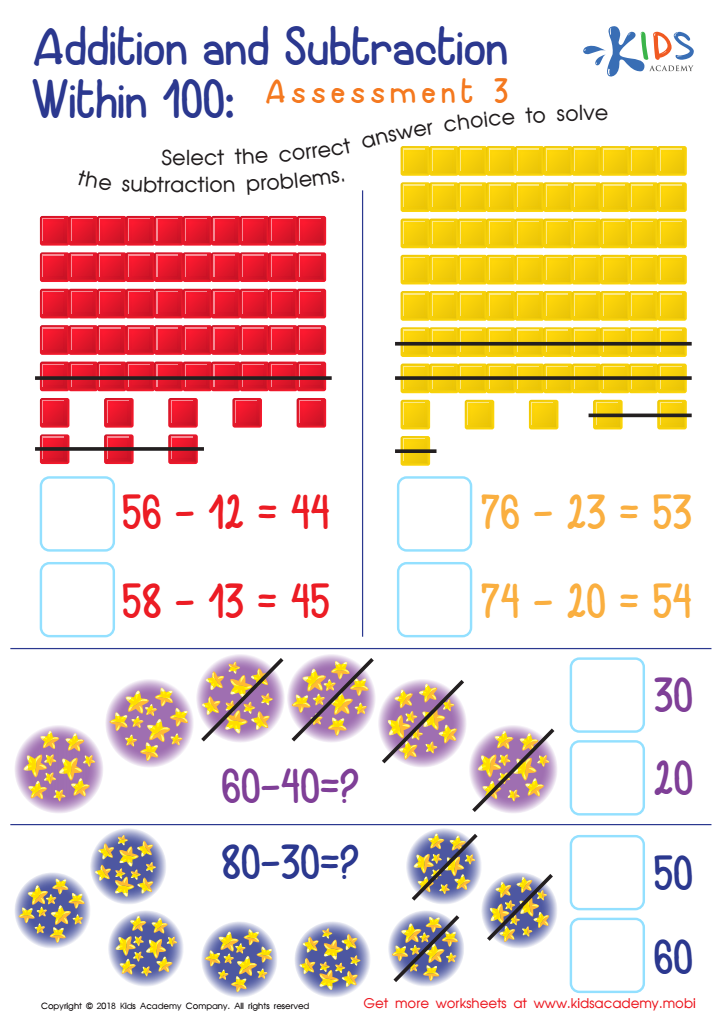
Addition and Subtraction Within 1: Assessment 3 Worksheet
Help your kids count the base ten blocks in the picture. Then, count how many have been marked off. Ask them to select the correct answer choice to solve the subtraction problems based on the blocks counted. 80 words
 Assign to My Students
Addition and Subtraction Within 1: Assessment 3 Worksheet
Worksheet
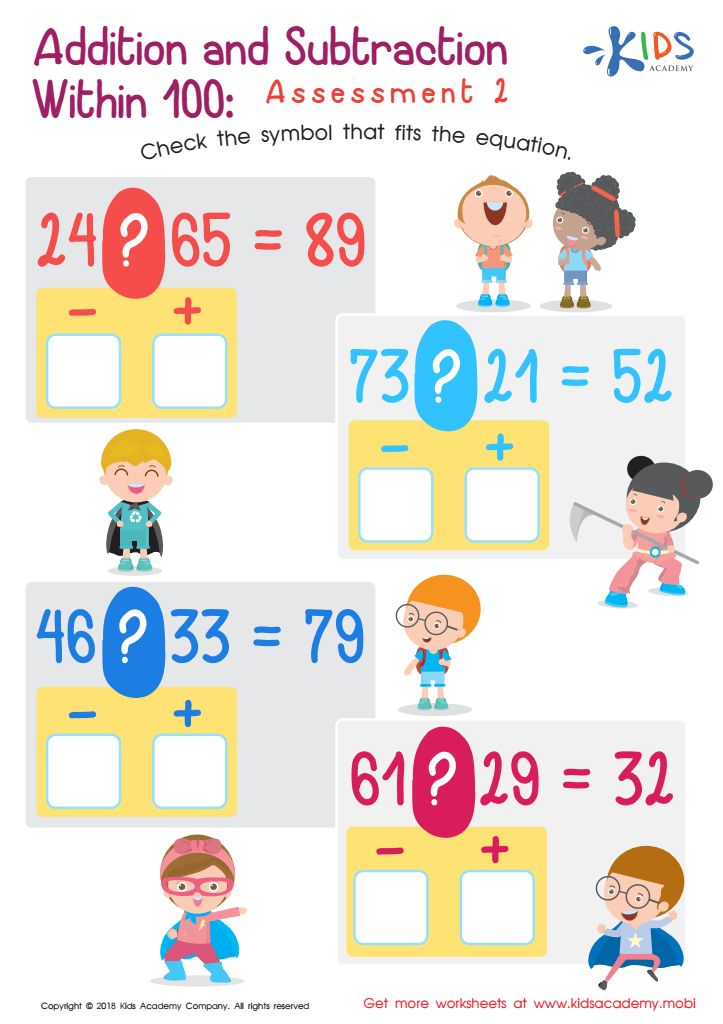
Addition and Subtraction Within 1: Assessment 2 Worksheet
This worksheet is a great tool to help your students learn addition and subtraction. It contains four equations in a printable pdf. Ask your students to review the equation and determine if the symbol between them is a '+' or '-'. Guide them in selecting the correct symbols for each equation.
Addition and Subtraction Within 1: Assessment 2 Worksheet
Worksheet
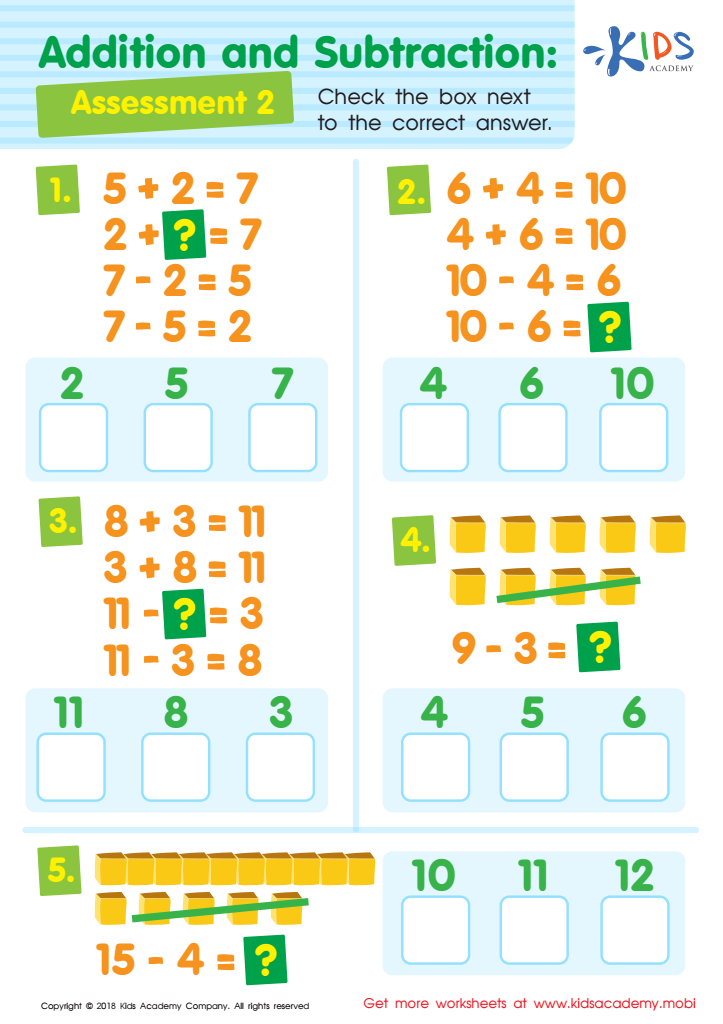
Addition and Subtraction Assessment 2 Worksheet
As your child grows, math problems become harder. To keep their brains active and provide extra help if needed, use this math worksheet. It'll help them become more familiar with equations. Go through each one carefully with your child and have them check the box next to the right answer.
Addition and Subtraction Assessment 2 Worksheet
Worksheet
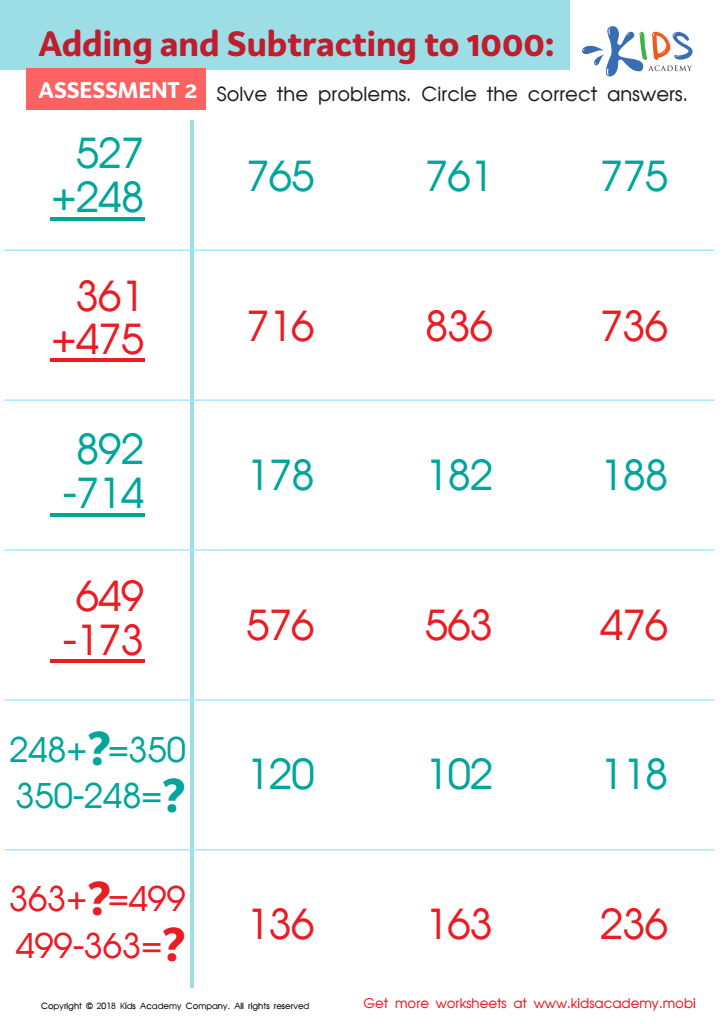
Adding and Subtracting to 1 Worksheet: Assessment 2
Test your child's addition and subtraction of 3-digit numbers with this assessment worksheet! They'll practice regrouping and pre-algebra skills to show their expertise. Have them work through the page and circle their answers, then see how many they got right to check their understanding and progress.
Adding and Subtracting to 1 Worksheet: Assessment 2
Worksheet
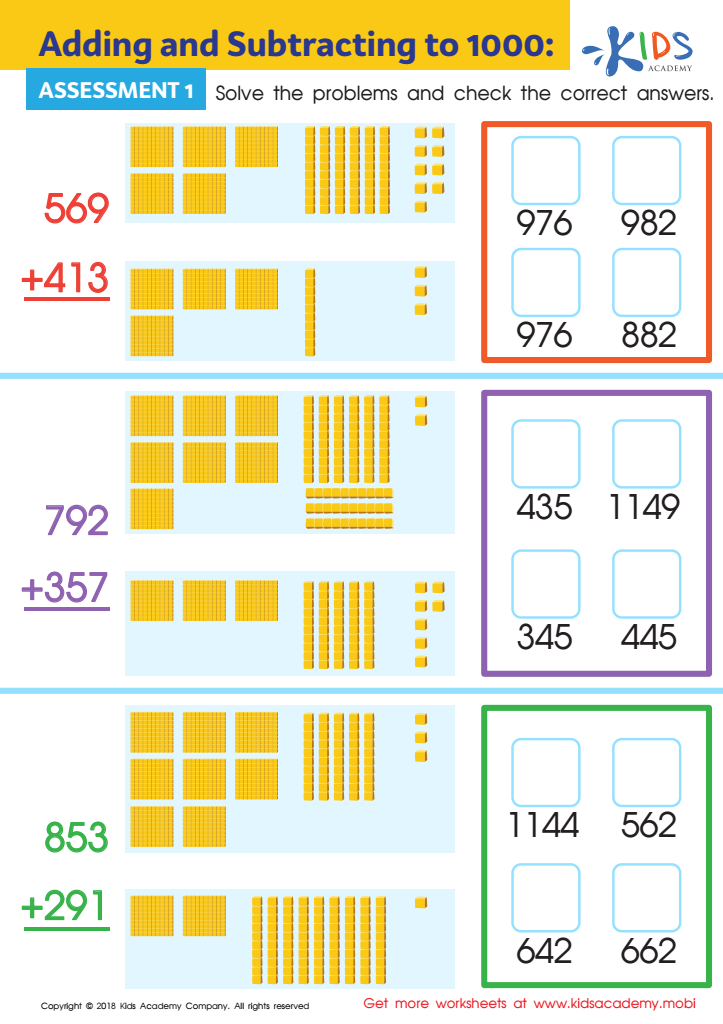
Adding and Subtracting to 1 Worksheet: Assessment 1
This assessment worksheet tests your child's addition skills. It has 3 3-digit problems with base ten blocks for visual aid. Encourage learners to use these visuals for better understanding. When they have solved the problems, they can check the box with the right answer. It's a quick and easy way to gauge numeracy development.
Adding and Subtracting to 1 Worksheet: Assessment 1
Worksheet
Join Kids Academy for Free
Who is primarily going to use this learning content?








Parents and teachers should prioritize Easy Addition & Subtraction activities for children aged 3-8 because these foundational skills are crucial for early mathematical development. During these formative years, children are at their most impressionable, and introducing them to basic arithmetic in a fun and engaging way can foster a positive attitude towards math.
Early exposure to addition and subtraction enhances children's problem-solving abilities and logical thinking. It also supports cognitive development, as children learn to recognize patterns and relationships between numbers. Furthermore, mastering these concepts at an early age builds confidence and prepares children for more complex mathematical operations in the future.
Easy activities, which can be as simple as counting objects or using educational games, help reinforce learning through play. This approach captures children's interest and makes learning feel less like a chore and more like an enjoyable challenge. By weaving math into everyday scenarios, parents and teachers can help children see the practical applications of math in real life.
Lastly, promoting early math skills sets children up for academic success, as proficient understanding of basic operations is key for subjects that will build upon these skills later in their educational journey. Thus, engaging children in these activities is vital to fostering a strong mathematical foundation.








