
Easy Tracing Numbers worksheets activities for Ages 8-9
1 filtered results
Difficulty Level
Grade
Age
-
From - To
Subject
Activity
Standards
Introducing our engaging Easy Tracing Numbers worksheets activities! Designed to captivate young learners' attention, these worksheets serve as the ideal educational tool for children beginning their journey into the fascinating world of numbers. Through our meticulously crafted activities, kids will develop fine motor skills, enhance number recognition, and master the art of writing numbers with ease and confidence. Our Easy Tracing Numbers worksheets are thoughtfully structured, offering a fun and interactive approach to learning that both parents and teachers will appreciate. Perfect for preschoolers and kindergarteners, these activities promise a solid foundation in numeracy, paving the way for future mathematical success.
Favorites
With answer key
Interactive
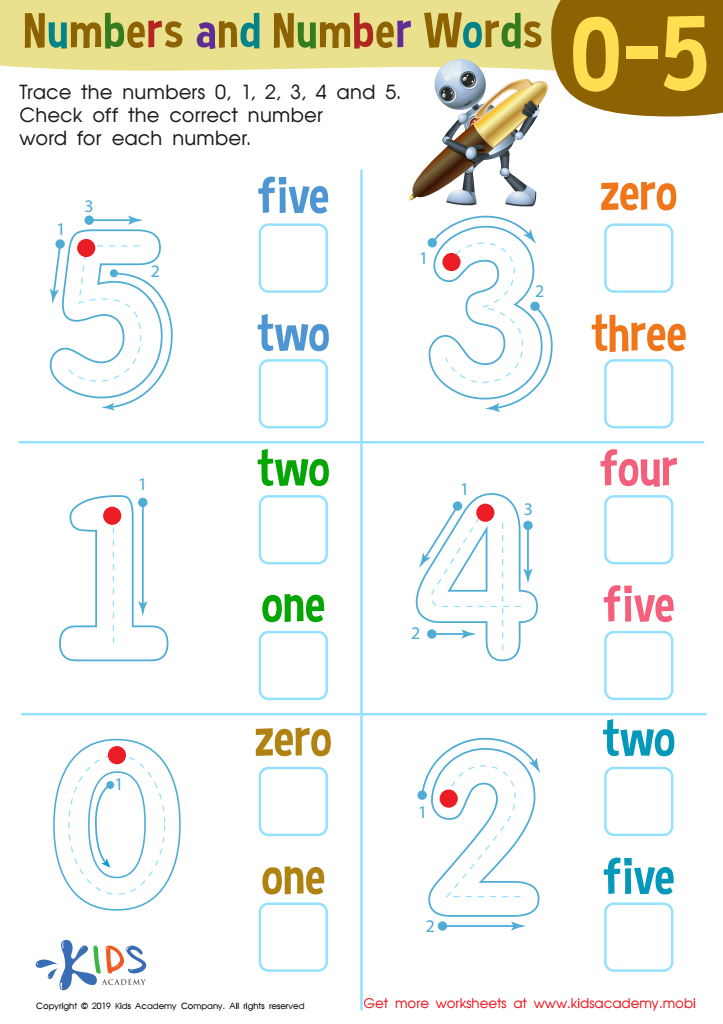
Numbers and Number Words Worksheet
Preschoolers can practice counting and recognizing numbers with this worksheet. Students trace the numbers zero through five and check the boxes next to each number to show the correct number word. Ideal for young kids, this printable helps them learn early math and number words.
 Assign to My Students
Numbers and Number Words Worksheet
Worksheet
Join Kids Academy for Free
Who is primarily going to use this learning content?








Easy Tracing Numbers worksheets activities are an invaluable tool for early childhood education, offering a multitude of benefits aimed at enhancing a child's learning experience during their formative years. These activities are designed to be both engaging and educational, providing a solid foundation for the development of essential skills in young learners.
First and foremost, Easy Tracing Numbers worksheets activities help children to familiarize themselves with the shapes and forms of numbers. This foundational knowledge is crucial as it lays the groundwork for more advanced mathematical concepts. By engaging in tracing activities, children learn to recognize and differentiate between numbers, a skill that is fundamental in their academic journey.
Moreover, these activities aid in the development of fine motor skills. As children grasp pencils and follow the outlines of numbers, they refine their hand-eye coordination and pencil control. This practice is not only beneficial for writing numbers but also improves their ability to write letters, thereby enhancing their overall writing capabilities.
Easy Tracing Numbers worksheets activities also serve as an excellent way for children to practice number sequence and order. By tracing numbers in sequence, children reinforce their understanding of number order, which is vital for counting, addition, subtraction, and other arithmetic operations. This sequential understanding helps build a solid math foundation, making future learning more accessible and enjoyable.
Furthermore, these worksheets are designed to be engaging, ensuring that learning remains a fun and exciting process. The sense of accomplishment children feel when successfully tracing numbers boosts their confidence and encourages a positive attitude towards learning. This increased self-esteem can lead to a more enthusiastic and active participation in classroom activities.
In conclusion, Easy Tracing Numbers worksheets activities are an essential component of early childhood education. They not only help children develop numeracy skills but also enhance fine motor skills, promote understanding of number sequences, and foster a positive learning attitude. By incorporating these activities into the learning curriculum, educators can provide children with a strong educational foundation, setting them up for success in their academic endeavors.








