
Normal Beginning Sounds worksheets activities for Ages 3-5
1 filtered results
Difficulty Level
Grade
Age
-
From - To
Subject
Activity
Standards
Introduce your young learners to the fascinating world of phonics with our Normal Beginning Sounds worksheets activities! Designed to captivate and educate, these worksheets are perfect for children starting their journey into reading and writing. Each activity is meticulously crafted to reinforce the recognition of initial sounds in a fun and engaging way. From vibrant illustrations to interactive challenges, our Normal Beginning Sounds worksheets activities offer a hands-on approach to mastering the basics of phonetics. Ideal for preschool and kindergarten students, these activities will build a strong foundation for future reading success. Dive into the world of sounds with us today!
Favorites
With answer key
Interactive
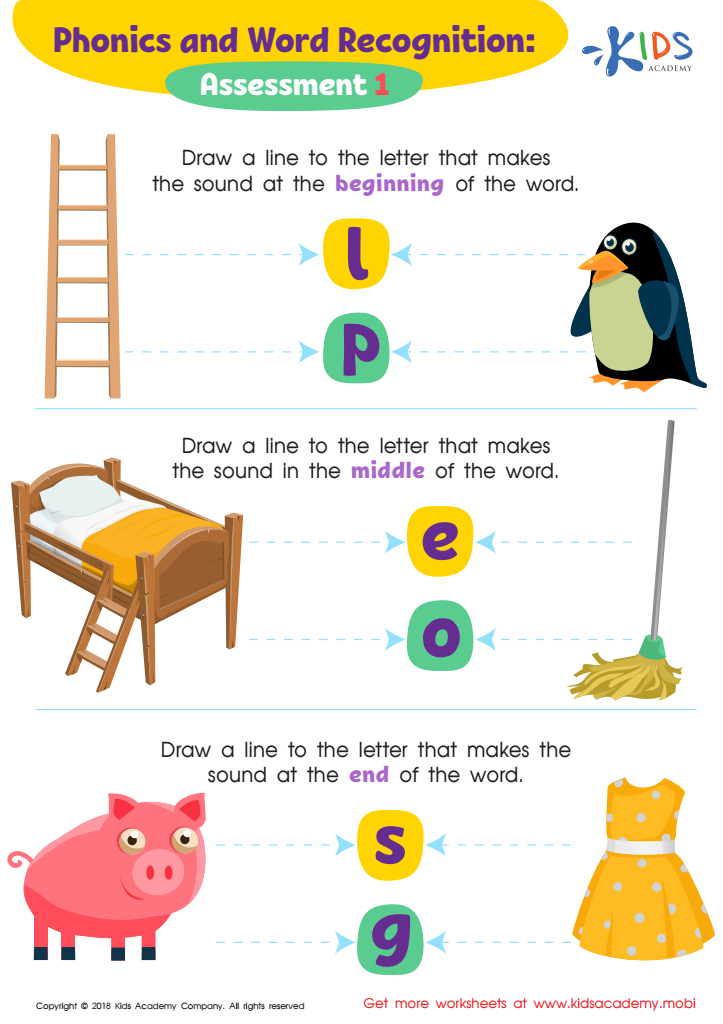
Phonics and Word Recognition: Assessment 1 ELA Worksheet
This fun worksheet tests your child's sound recognition skills for each part of a word. Ask your child to name each image and trace the line to match it with the corresponding letter. Listen for beginning sounds on 1st, middle sounds on 2nd, and ending sounds on 3rd. Encourage learning with this colorful and interactive activity!
 Assign to My Students
Phonics and Word Recognition: Assessment 1 ELA Worksheet
Worksheet
Learning Skills
Join Kids Academy for Free
Who is primarily going to use this learning content?








Normal Beginning Sounds worksheets activities play a crucial role in the foundational stage of literacy development among young learners. These activities are not merely a part of the curriculum but serve as essential building blocks for reading, writing, and language comprehension. There are several reasons why Normal Beginning Sounds worksheets activities are incredibly useful for children embarking on their educational journey.
Firstly, these activities introduce children to the alphabet in a structured yet engaging way. By focusing on the sounds each letter makes, as opposed to merely memorizing their names, children develop phonemic awareness—a critical skill in early literacy. Phonemic awareness, the ability to hear, identify, and manipulate individual sounds in spoken words, is a strong predictor of a child's reading success in later years. Normal Beginning Sounds worksheets activities make this abstract concept tangible and accessible.
Moreover, these worksheets foster a love for learning and curiosity about language. As children match letters to sounds and sounds to pictures, they begin to make connections between the spoken and written word. This not only enhances their vocabulary but also boosts their confidence in their ability to decode and understand new words. Such a positive association with learning from an early age is invaluable.
Additionally, Normal Beginning Sounds worksheets activities cater to various learning styles. Whether a child is a visual, auditory, or kinesthetic learner, these worksheets provide a platform for them to explore and learn in a way that best suits their individual needs. The hands-on nature of these activities also improves fine motor skills as children write, cut, paste, or color, making them multifaceted tools for early education.
In conclusion, Normal Beginning Sounds worksheets activities are a cornerstone of early literacy education. They lay the groundwork for reading and writing, instill confidence and curiosity in young learners, and accommodate diverse learning styles—all of which are fundamental for a child's success in school and beyond.








