
Normal Rhyming worksheets activities for 4-Year-Olds
1 filtered results
Difficulty Level
Grade
Age
-
From - To
Subject
Activity
Standards
Introducing our captivating Normal Rhyming Worksheets Activities, perfectly crafted for children eager to explore the enchanting world of rhymes. These engaging worksheets are designed to enhance your child's phonemic awareness, reading skills, and enjoyment for the rhythm of language. Through a series of fun-filled activities, learners will dive into matching rhyming words, completing rhymes, and creating their own rhyming pairs. Ideal for both classroom and home settings, our Normal Rhyming Worksheets Activities promise to deliver an enjoyable learning experience, empowering young minds to discover the magic of rhyming while fostering a love for reading and language. Dive into the adventure of rhymes today!
Favorites
With answer key
Interactive
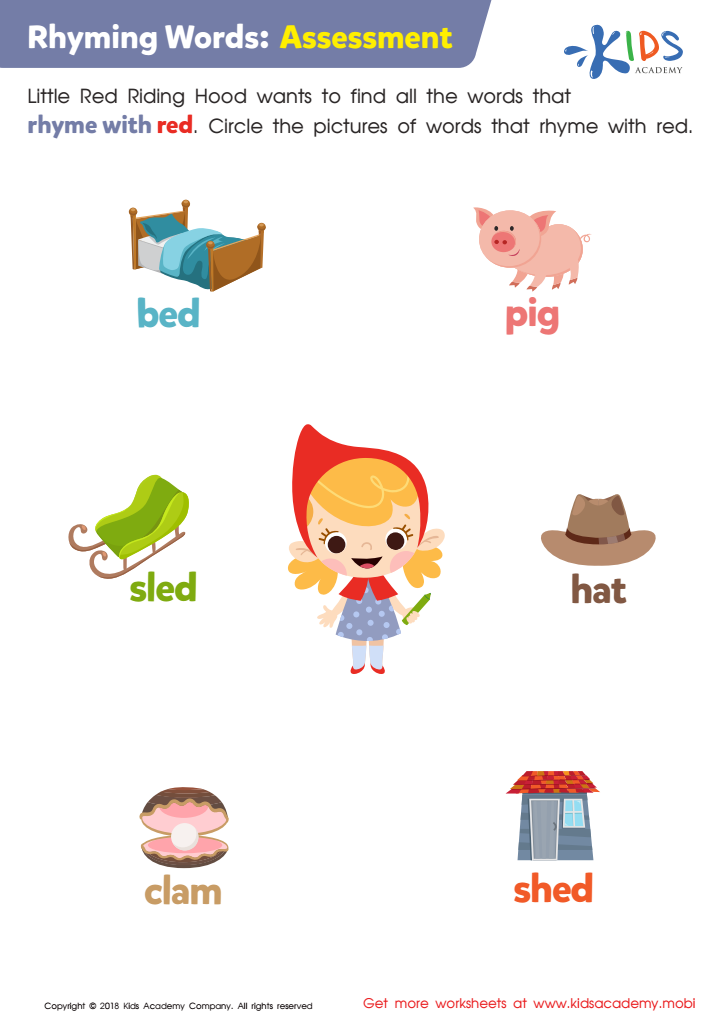
Rhyming Words: Assessment Worksheet
Help Little Red Riding Hood find rhyming words with "red". Download and print this worksheet. Have your child circle the rhyming words and pictures. Get them to say each word out loud and compare it to the word "red". When they're done, review the answers and talk about any words that don't rhyme.
 Assign to My Students
Rhyming Words: Assessment Worksheet
Worksheet
Learning Skills
Join Kids Academy for Free
Who is primarily going to use this learning content?







Normal Rhyming worksheets activities are a fundamental tool in the development of literacy skills among young learners. These activities offer a structured yet entertaining approach to understanding sounds, words, and language patterns. Engaging in normal rhyming worksheets activities not only enhances children's ability to recognize and produce sounds but also significantly contributes to their reading and spelling skills.
The brilliance of normal rhyming worksheets activities lies in their simplicity and effectiveness. Through repetitive exposure to words that sound alike, children begin to understand phonemic awareness, an essential skill in learning to read. Phonemic awareness is the ability to hear, identify, and manipulate individual sounds—phonemes—in spoken words. By participating in rhyming exercises, children naturally develop this skill, which is a precursor to successful reading and writing.
Moreover, normal rhyming worksheets activities introduce children to the rhythm and flow of language. This not only aids in memory retention but also in the enjoyment of reading and writing. When children find pleasure in language, their motivation to learn and engage with texts increases. This intrinsic motivation is crucial in fostering a lifelong love for reading and learning.
Additionally, these activities offer an excellent opportunity for vocabulary expansion. As children explore rhyming words, they encounter new words, their meanings, and how they fit into language structures. This exploration enriches their language and communication skills, setting a strong foundation for future learning.
In conclusion, normal rhyming worksheets activities are more than just a fun exercise. They are a vital educational tool that nurtures early literacy skills, phonemic awareness, vocabulary development, and a love for language. Integrating these activities into the learning curriculum ensures that children are well-equipped with the foundational skills necessary for reading and writing success.








