
Normal Building Vocabulary worksheets activities for Ages 8-9
1 filtered results
Difficulty Level
Grade
Age
-
From - To
Subject
Activity
Standards
Dive into our enriching Normal Building Vocabulary worksheets activities, designed to bolster your language skills with a robust architectural framework! Tailored for learners seeking to strengthen their foundation and expand their lexical repertoire, these activities offer engaging, interactive lessons across various themes. Each worksheet is crafted to introduce, practice, and reinforce vocabulary in context, making learning both effective and enjoyable. Whether you're a beginner or looking to polish your skills, our Normal Building Vocabulary worksheets are your go-to resource. Start building a more impressive vocabulary today and unlock new levels of language proficiency with every activity you complete!
Favorites
With answer key
Interactive
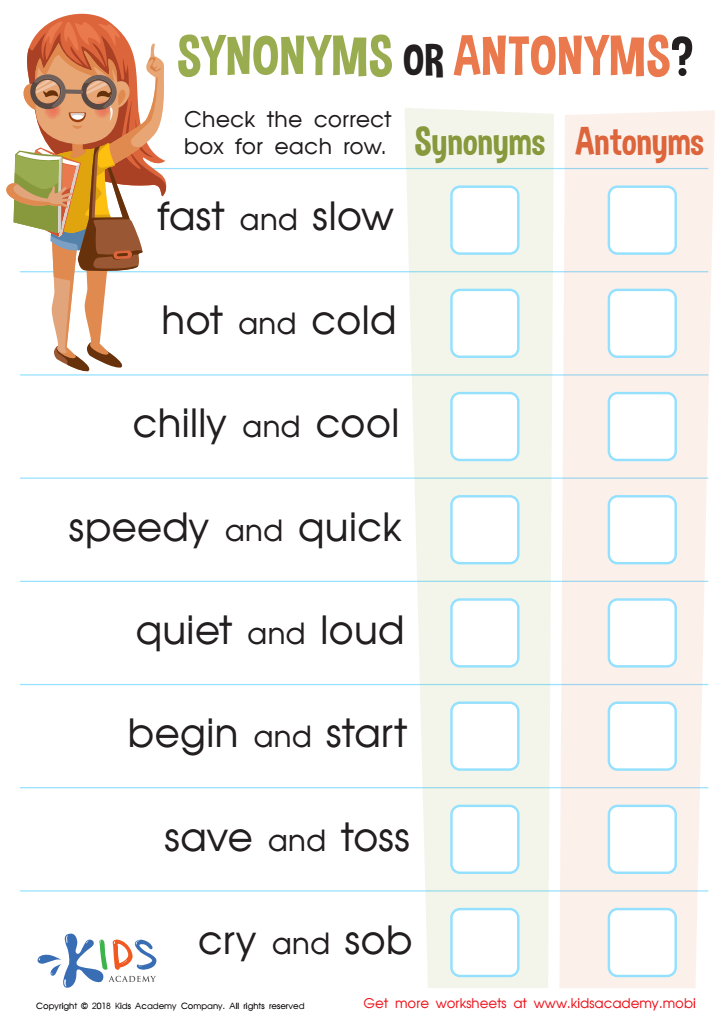
Synonyms or Antonyms: Assessment Worksheet
Test your child's knowledge with this fun worksheet! Ask them to read the words and select if they are synonyms or antonyms - e.g. 'happy' is a synonym and 'bad' is an antonym. For an extra challenge, ask them to provide two synonyms and two antonyms for each word.
 Assign to My Students
Synonyms or Antonyms: Assessment Worksheet
Worksheet
Join Kids Academy for Free
Who is primarily going to use this learning content?



.jpg)



Normal Building Vocabulary worksheets activities are an integral tool in the realm of language learning and development. These structured tasks are designed to enhance and expand an individual's lexicon, fostering both comprehension and expressive abilities. The usefulness of such activities stretches across various aspects of learning and communication, underscoring their significance in educational settings and beyond.
Firstly, Normal Building Vocabulary worksheets offer a systematic approach to learning new words. This structured methodology allows learners to gradually accumulate knowledge, ensuring that each new term is understood and retained. The activities often include definitions, synonyms, antonyms, and contextual usage, providing a comprehensive understanding of each new word. This multi-faceted approach not only aids in memorization but also deepens the learner's grasp of the language.
Moreover, these worksheets cater to diverse learning styles. Whether a learner is more responsive to visual, auditory, or kinesthetic learning methods, Normal Building Vocabulary worksheets can be tailored to suit individual preferences. For instance, visual learners can benefit from worksheets that incorporate images or color-coded sections, while kinesthetic learners might find fill-in-the-blanks or matching exercises more engaging.
Another significant advantage is the enhancement of critical thinking skills. Normal Building Vocabulary worksheets often include activities that require learners to apply new words in various contexts, encouraging them to think critically about word usage, connotations, and nuances. This not only solidifies their understanding of the vocabulary but also improves their ability to communicate effectively and creatively.
Furthermore, these worksheets support academic achievement and lifelong learning. A robust vocabulary is crucial for understanding complex texts, engaging in sophisticated discussions, and expressing ideas clearly and persuasively. By continuously expanding their vocabulary, learners are better equipped to succeed academically and navigate the world around them with confidence.
In conclusion, Normal Building Vocabulary worksheets activities are a valuable resource for anyone looking to enhance their language skills. Through structured learning, catering to diverse needs, fostering critical thinking, and supporting academic and personal growth, these activities play a crucial role in language development and empowerment.








