Money Word Problems Worksheets for Ages 5-8
3 filtered results
Difficulty Level
Grade
Age
-
From - To
Subject
Activity
Standards
Discover our engaging "Money Word Problems Worksheets" designed specifically for children ages 5 to 8! These worksheets help young learners develop essential math skills through realistic money scenarios, enhancing their understanding of counting, addition, and subtraction involving coins and bills. Each activity encourages critical thinking and problem-solving, making math fun and accessible. Perfect for classroom use or at-home practice, our worksheets promote early financial literacy while allowing children to relate math to everyday situations. Explore our variety of colorful, interactive worksheets and watch your child's confidence grow as they tackle money word problems with ease! Start learning today!
Favorites
With answer key
Interactive
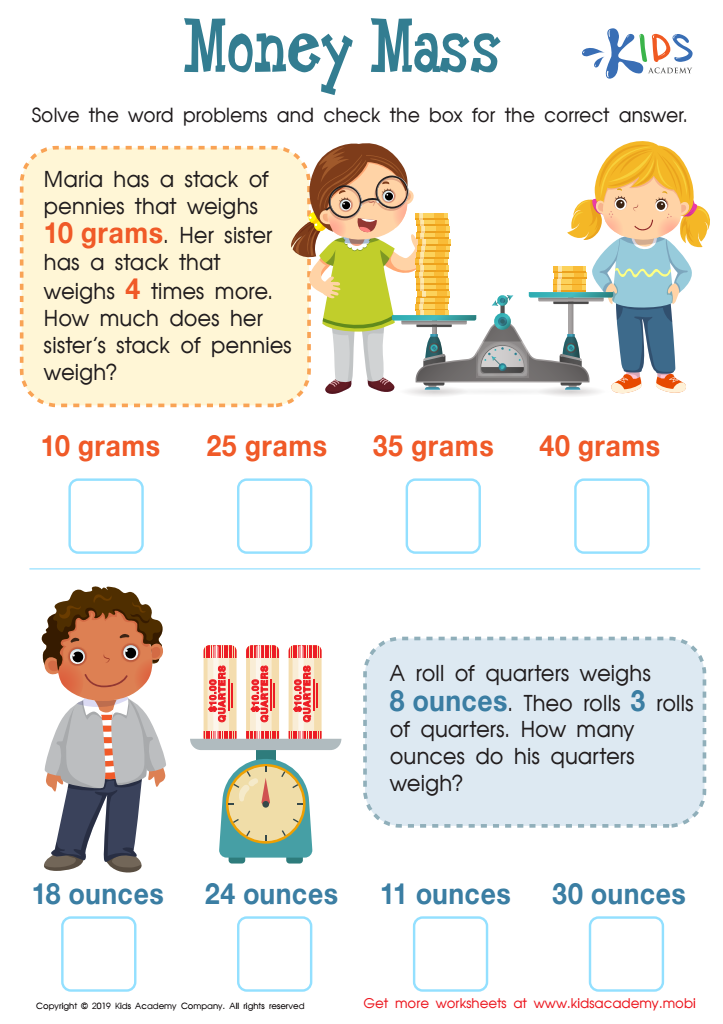
Money Mass Worksheet
By regularly working on math with your kids, they will become more confident. Ensure they understand the word problems in this printout, and help them solve it. Check the box for the correct answer of each to verify their work. With this practice, they will gradually get used to math and make progress.
 Assign to My Students
Money Mass Worksheet
Worksheet
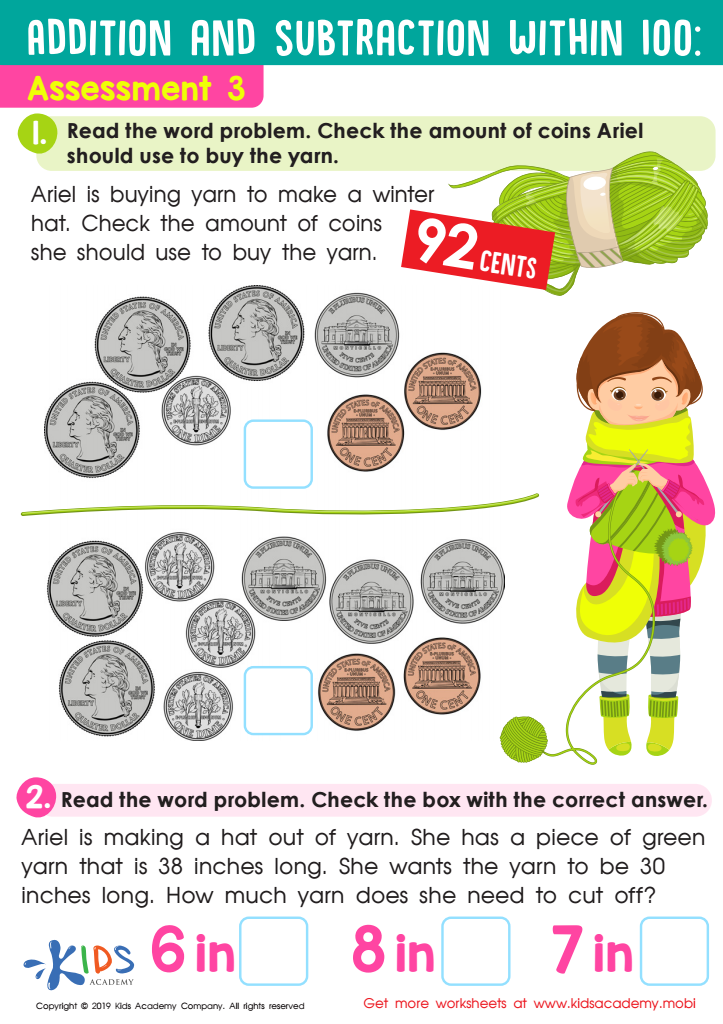
Assessment 3 Math Worksheet
Ariel needs to buy yarn. Do your kids know what yarn is? If they've seen you knit, they will. Help them solve the two word problems to figure out how many coins Ariel needs to buy it.
Assessment 3 Math Worksheet
Worksheet
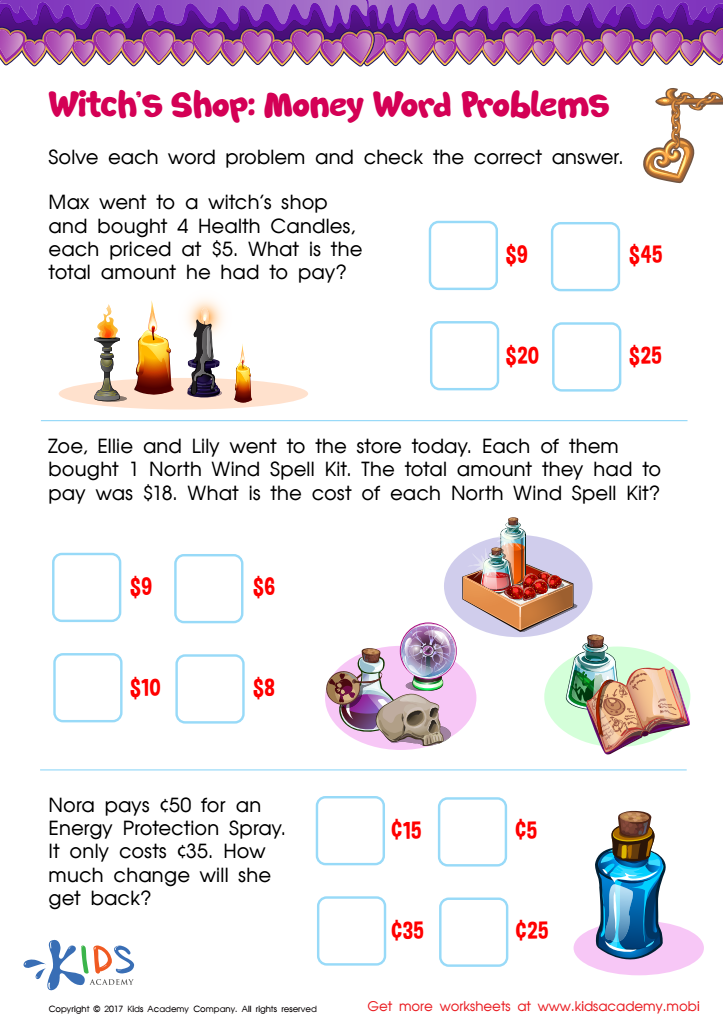
Money Word Problems Printable
Boost your 3rd grader's math skills with money word problems. This worksheet takes them to a witch's shop for a fun way to practice multiplication and division.
Money Word Problems Printable
Worksheet
Join Kids Academy for Free
Who is primarily going to use this learning content?








Money word problems are a crucial aspect of developing mathematical skills for children aged 5-8, as they intertwine basic addition, subtraction, and problem-solving abilities with real-world applications. From a young age, children start to understand money concepts, and word problems help them grasp these ideas in an engaging way.
By tackling money-related scenarios, kids learn how to recognize different coin values, make calculations, and comprehend the context behind financial transactions. This early exposure cultivates not only math skills but also critical thinking and reasoning abilities. Additionally, it lays the groundwork for financial literacy, which is essential as children grow older.
Moreover, money problems encourage conversation between parents, teachers, and children about budgeting, saving, and spending, fostering crucial life skills and enhancing their understanding of the world around them. It also presents an opportunity for cooperative learning, allowing adults to guide children toward developed problem-solving strategies.
Incorporating money word problems into everyday learning is important because it makes math accessible, relevant, and enjoyable. These foundational skills will equip children to navigate more complex financial concepts in adulthood, ultimately ensuring they become responsible and informed financial citizens. Thus, both parents and teachers play a vital role in this formative learning process.