Extra Challenge Rounding Worksheets for Ages 3-9
3 filtered results
Difficulty Level
Grade
Age
-
From - To
Subject
Activity
Standards
Discover our "Extra Challenge Rounding Worksheets for Ages 3-9," designed to enhance math skills through engaging activities. These worksheets provide an exciting way for young learners to master the concept of rounding numbers, reinforcing their understanding of place values. Tailored for children aged 3 to 9, our resources feature vibrant illustrations and varying levels of difficulty, making math fun and approachable. Each worksheet encourages critical thinking and problem-solving abilities, while promoting independent learning. Perfect for enhancing classroom lessons or for home practice, these worksheets give students the extra challenge they need to excel in rounding and build confidence in their math abilities.
Favorites
With answer key
Interactive
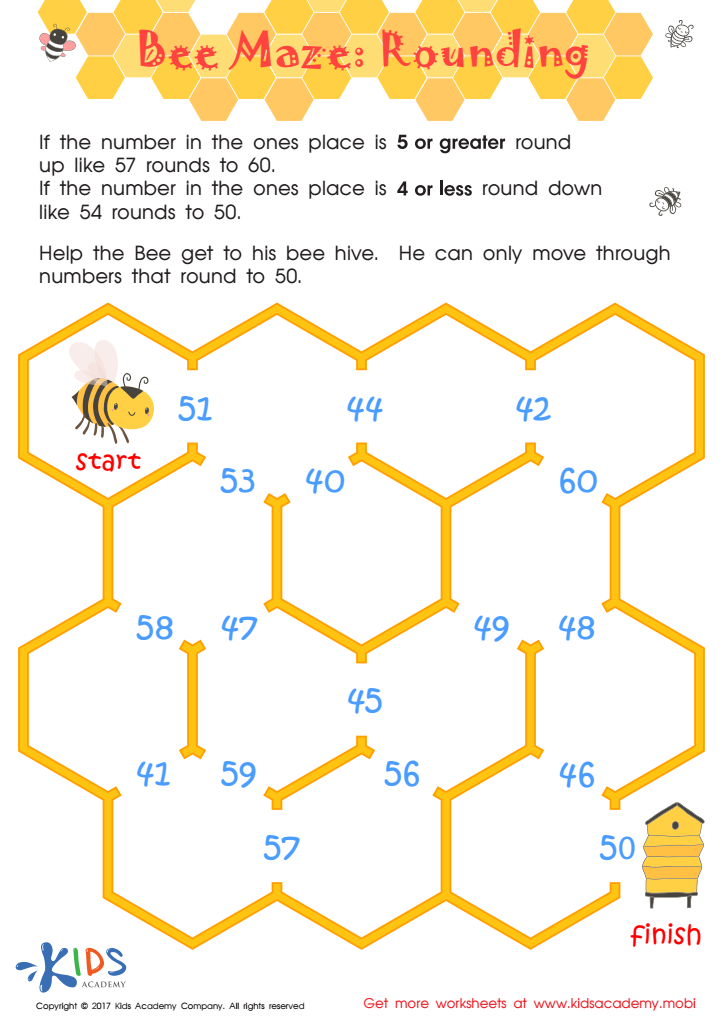
Bee Maze Worksheet
Help the bee find his way to the hive by rounding to the nearest 50!
Help the bee get to his hive with this fun, tricky rounding puzzle! This PDF worksheet challenges your child to round numbers up or down to 50. It reinforces the rules for rounding numbers and leads the bee through a maze. Get your child to help the bee reach the hive by rounding to 50!
 Assign to My Students
Bee Maze Worksheet
Worksheet
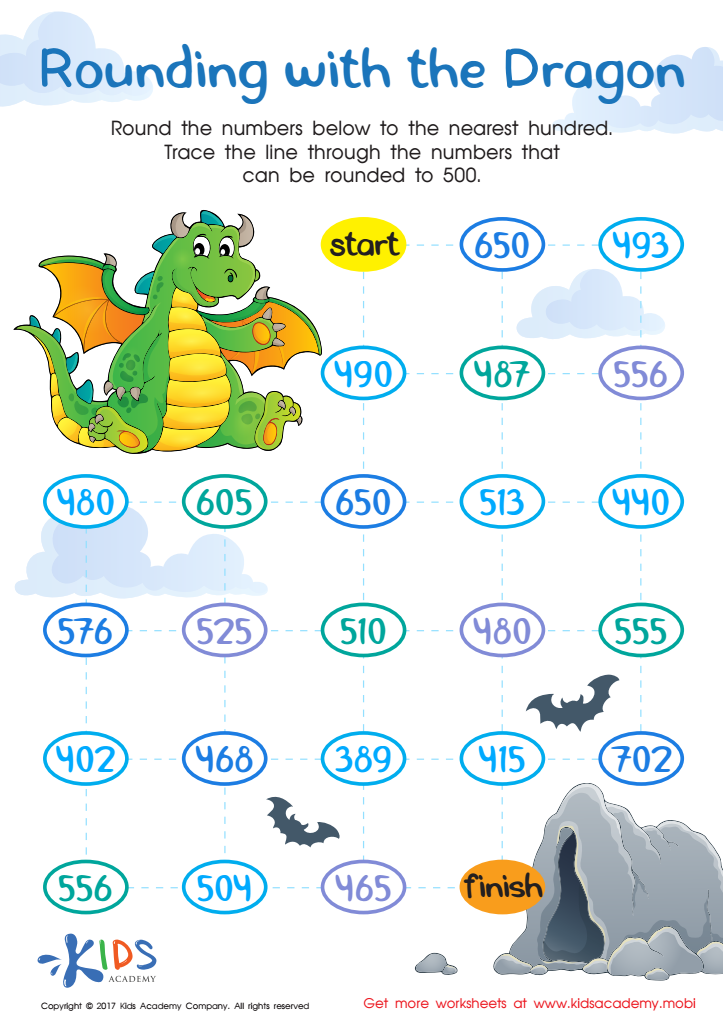
Rounding to the Nearest Hundred Worksheet
Your child will love helping the dragon find its cave! They'll practice rounding to the nearest hundred with this fun 3rd-grade worksheet. As they work through the maze, they must find answers that round to 500. Let the adventure begin!
Rounding to the Nearest Hundred Worksheet
Worksheet
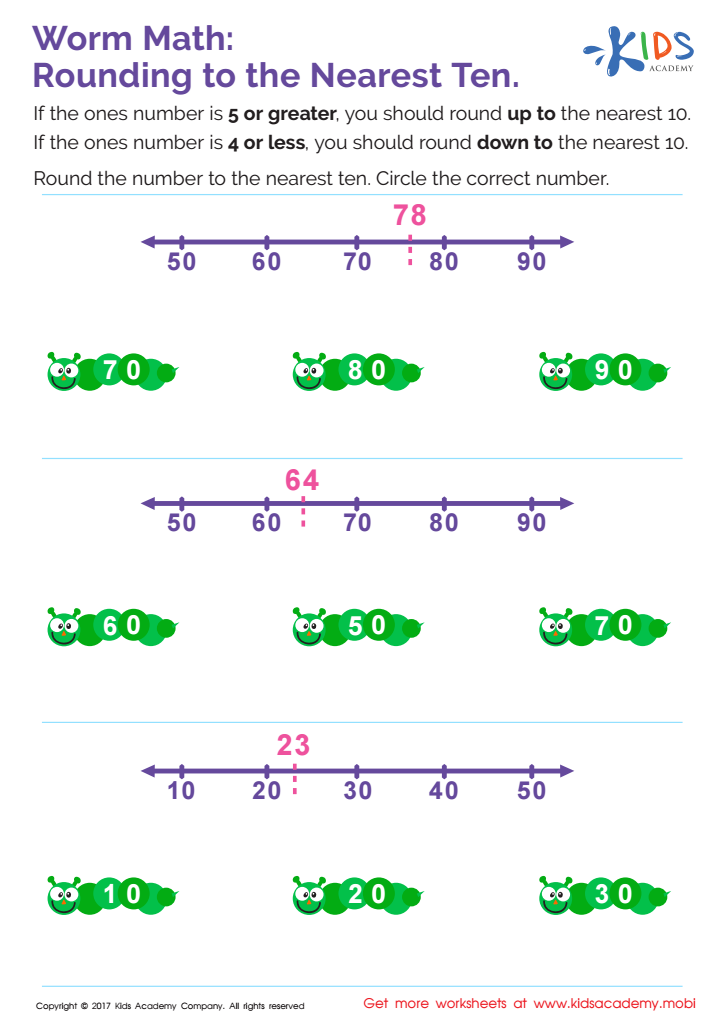
Rounding to the Nearest Ten Worksheet
Kids can learn the concept of rounding with this grade 3 worksheet! It comes with an easy explanation, a number line and even wiggly worms to make it fun. Get your child excited to round to the nearest ten and pick the correct answer!
Rounding to the Nearest Ten Worksheet
Worksheet
Join Kids Academy for Free
Who is primarily going to use this learning content?






Extra Challenge Rounding is an essential skill for children ages 3-9, as it lays the foundation for stronger mathematical understanding and problem-solving abilities. This technique involves rounding numbers up or down to the nearest ten or hundred, helping children simplify calculations, estimate outcomes, and enhance their numerical fluency.
For parents and teachers, fostering Extra Challenge Rounding allows children to gain confidence in their mathematical skills. This promotes a positive attitude towards math, reducing anxiety often associated with more complex calculations. When children master rounding, they develop critical thinking and analytical abilities that extend beyond arithmetic, preparing them for more advanced concepts in the future.
Moreover, incorporating Extra Challenge Rounding into the curriculum encourages playful learning. Engaging activities can make the concept fun and relatable, helping children see math as an enjoyable subject. This skill also aids in real-life scenarios, such as budgeting or measuring, demonstrating the practical application of math in daily life.
Ultimately, when adults prioritize Extra Challenge Rounding, they equip children with essential tools for academic success and lifelong learning, fostering resilience and offering a solid grounding for more advanced mathematical concepts down the road. This focus supports cognitive growth, enhances comprehension, and maximizes children's potential.