Extra Challenge Rhyming Worksheets for 3-Year-Olds
1 filtered results
Difficulty Level
Grade
Age
-
From - To
Subject
Activity
Standards
Unleash your child’s potential with our Extra Challenge Rhyming Worksheets specially designed for 3-Year-Olds! Perfect for little learners, these engaging activities are crafted to sharpen their rhyming skills in a fun and interactive way. Watch as your child explores the world of sounds through a series of captivating exercises that challenge their minds while entertaining them. Ideal for preschoolers keen on an extra challenge, these worksheets not only boost literacy and phonemic awareness but also foster a love for language. Dive into our collection and give your 3-year-old the head start they deserve in mastering the art of rhyming!
Favorites
With answer key
Interactive
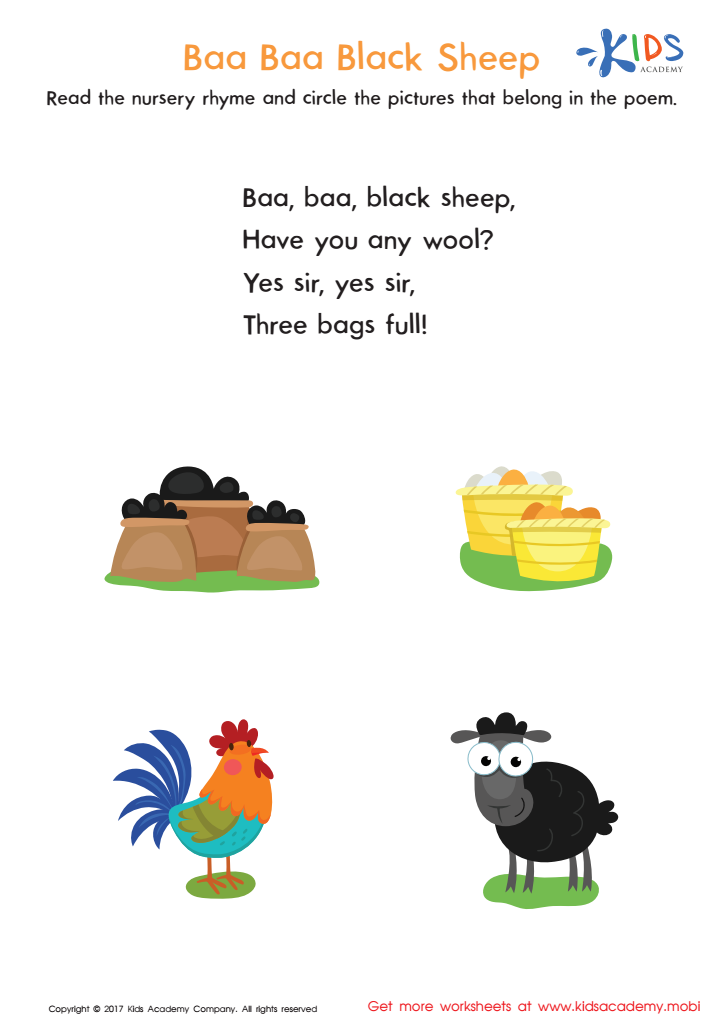
Baa Baa Black Sheep Printable
Jumpstart your child's reading skills with this printable Baa Baa Black Sheep worksheet! Recite the lines with them, then have them select the pictures associated with the poem to test comprehension. Fun and educational!
 Assign to My Students
Baa Baa Black Sheep Printable
Worksheet
Join Kids Academy for Free
Who is primarily going to use this learning content?








Extra Challenge Rhyming worksheets offer a unique and engaging way for 3-year-olds to delve into the world of language and phonics. At this critical age, children are just beginning to understand the structure and sounds of words, making it the perfect time to introduce activities that stimulate their phonological awareness. The Extra Challenge Rhyming for 3-Year-Olds worksheets are specifically designed to cater to this developmental stage, offering exercises that are both challenging and entertaining.
These worksheets do not merely focus on rhyming as a concept but also encourage children to listen carefully, differentiate between sounds, and recognize patterns, which are essential skills for reading readiness. By engaging with the rhyming exercises, young learners can enhance their vocabulary, boost their memory, and develop a love for language, all in a playful and supportive environment.
The beauty of the Extra Challenge Rhyming worksheets lies in their ability to adapt to each child’s learning pace, providing just the right level of difficulty to keep them motivated. This personalized approach ensures that 3-year-olds are not only learning effectively but are also enjoying the process, laying a solid foundation for their future academic success. In essence, these worksheets are a valuable tool for parents and educators looking to inspire and nurture a child’s early linguistic development.