Normal Money Word Problems Worksheets for 7-Year-Olds
1 filtered results
Difficulty Level
Grade
Age
-
From - To
Subject
Activity
Standards
Introduce your seven-year-old to the world of basic finances with our Normal Money Word Problems learning worksheets! Designed to engage young minds, these worksheets blend fun scenarios with real-world application, helping children understand and manage money through simple calculations and problem-solving exercises. Tailored specifically for their developmental stage, our worksheets will boost confidence in handling everyday financial situations, sharpen math skills, and lay a strong foundation for future financial literacy. Dive into our learning worksheets and watch your child master the basics of money management while enjoying every step of their learning journey!
Favorites
With answer key
Interactive
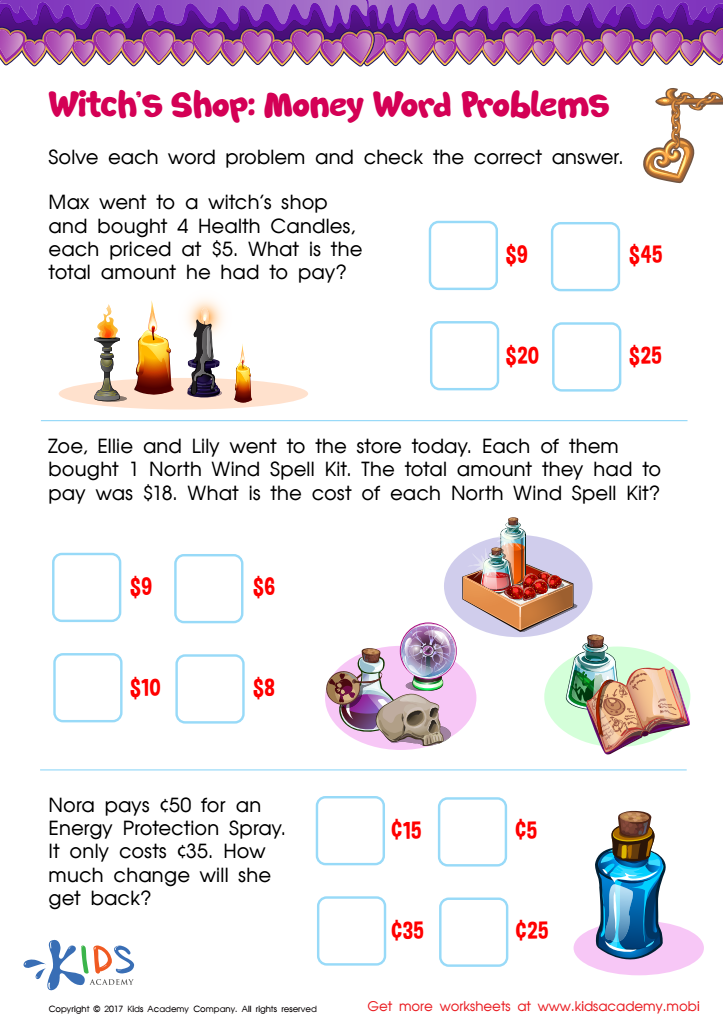
Money Word Problems Printable
Boost your 3rd grader's math skills with money word problems. This worksheet takes them to a witch's shop for a fun way to practice multiplication and division.
 Assign to My Students
Money Word Problems Printable
Worksheet
Learning Skills
Join Kids Academy for Free
Who is primarily going to use this learning content?








The Value of Learning Printables: Normal Worksheets on Money Word Problems for Seven-Year-Olds
In the formative years of childhood, particularly around the age of seven, the development of numerical skills is crucial. It is a time when children begin to understand more complex concepts and can apply logical thinking to solve problems. One of the most practical and essential skills they can learn at this stage is how to manage and understand money. This is where normal worksheets on money word problems, provided as learning printables, become invaluable educational tools.
Learning printables are specially designed worksheets that facilitate learning through structured exercises. These worksheets on money word problems are not just sheets of paper but gateways to understanding integral life skills. They present real-world scenarios where money is involved, prompting children to make thoughtful decisions and calculations. Here’s why these worksheets are particularly useful for seven-year-olds:
1. Enhancing Numerical Literacy: At seven, children are refining their ability to count, add, subtract, and even beginning to multiply and divide. Money word problems on learning printables integrate these mathematical operations in the context of money, thereby reinforcing arithmetic skills while introducing financial concepts.
2. Developing Problem-Solving Skills: Money word problems require children to read, comprehend the situation, and decide the mathematical operation needed to find a solution. This not only improves their math skills but also enhances critical thinking and problem-solving abilities. Each problem presents a unique challenge, encouraging children to think independently and creatively.
3. Introducing Money Management: Understanding money is critical for effective personal financial management later in life. Through these worksheets, children learn about prices, making change, budgeting, and the value of different denominations of money. Early exposure to these topics helps nurture financially savvy individuals.
4. Building Real-World Connections: Learning printables with money word problems depict everyday situations, such as shopping, saving, or planning small events. These scenarios make learning relatable and understandable, showing children the practical use of math in everyday life.
5. Enhancing Reading and Comprehension: Money word problems also aid in developing reading skills. Children must read and discern key information from the text to solve the problems correctly. This practice enhances comprehension skills, which are fundamental across all areas of education.
6. Encouraging Independent Learning: Learning printables are designed to be student-friendly, allowing children to work through them with minimal supervision. This fosters a sense of independence and confidence in their abilities to tackle challenges. As they maneuver through each problem, they learn to trust their reasoning and develop a proactive learning attitude.
7. Providing Instant Feedback and Trackable Progress: Many learning printables come with answer keys or are structured in a way that parents or teachers can easily review responses. This immediate feedback helps children understand their mistakes and learn the correct strategies, reinforcing learning through correction and repetition. Moreover, educators and parents can track progression over time, observing improvements in both math and money handling skills.
8. Engaging and Fun: Educators and worksheet designers often incorporate colorful graphics, interesting scenarios, and sometimes even small rewards like stickers or points within these printables. Such elements keep children engaged and make the learning process enjoyable rather than a chore. By turning abstract numbers and concepts into hands-on, visually appealing problems, children are more likely to be motivated and less likely to feel overwhelmed.
9. Adaptable to Individual Learning Paces: Every child learns at their own pace, and the structured yet flexible nature of learning printables accommodates this diversity. Whether a child grasps concepts quickly or needs a little extra time, these worksheets can be tackled at a comfortable pace, ensuring personalized learning experiences.
10. Promoting Family Involvement: Finally, these money word problems often encourage participation from family members, especially when children ask for help. This engagement promotes family bonding and allows parents to be actively involved in their child’s educational journey. It also gives parents insight into what their children are learning and how they are performing, opening up opportunities for supportive conversations and additional learning outside the worksheet.
In conclusion, learning printables focusing on money word problems are far more than just educational materials; they are foundational tools that equip seven-year-olds with essential life skills. They blend numerical education with practical financial literacy, wrapped in a format that nurtures independent and critical thinking. For young learners, these worksheets are not just about solving problems on paper—they are stepping stones to becoming competent, confident, and financially aware individuals. Whether in the classroom or at home, incorporating these learning printables can significantly benefit children’s educational and personal development, preparing them for the complexities of the real world.