
Math problem-solving Reading Worksheets
7 filtered results
Difficulty Level
Grade
Age
-
From - To
Subject
Activity
Standards
Unlock your child's potential with our Math Problem-Solving Reading Worksheets! Designed for young learners, these engaging worksheets seamlessly integrate reading comprehension and math problem-solving skills. Children will enjoy a variety of activities that challenge their critical thinking and sharpen their analytical skills. Our worksheets cover a range of topics, including counting, addition, subtraction, and word problems, tailored to develop both math proficiency and literacy. Perfect for in-class use or at-home practice, these resources are teacher-approved and aligned with educational standards. Help your child excel in math while fostering a love for reading with our fun and interactive worksheets.
Favorites
With answer key
Interactive
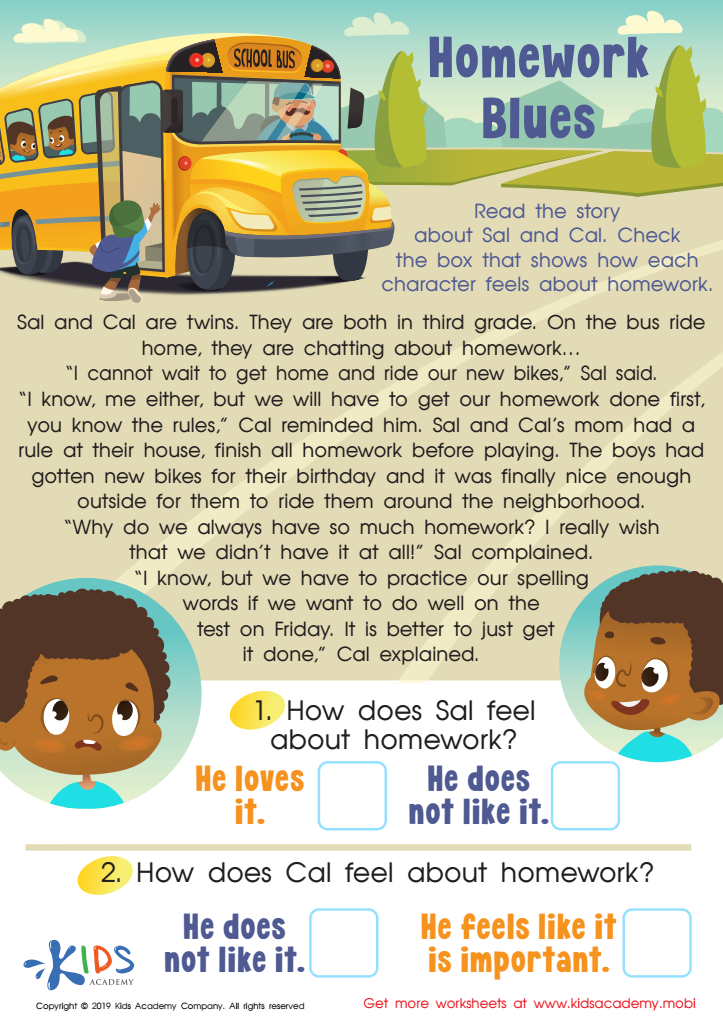
Homework Blues Worksheet
Cal and Sal don't love doing homework, just like your kids. Use this worksheet to help your children understand why homework is important. Read the passage together and then answer the questions at the bottom of the page. It's a fun way to learn together!
 Assign to My Students
Homework Blues Worksheet
Worksheet
Join Kids Academy for Free
Who is primarily going to use this learning content?







Math problem-solving reading is essential for a child’s holistic development and lays the groundwork for critical thinking skills that extend beyond the classroom. Both parents and teachers should care about this aspect because it directly influences a child's ability to understand, interpret, and solve real-world problems.
Firstly, math problem-solving reading enhances a child's comprehension and analytical skills. When children read math problems, they learn to identify the given data, discern hidden information, and recognize the question's demands. This practice sharpens their cognitive abilities and fosters a methodical approach to problem-solving.
Furthermore, proficiency in math literacy equips children with the competence to tackle complex subjects in higher education. Subjects like physics, engineering, and economics heavily rely on mathematical problem-solving abilities. Teaching children to read and solve math problems in their early years sets a strong foundation for such advanced studies.
Moreover, it also instills confidence. Children who are adept at solving math problems tend to perform better academically, contributing to a positive learning experience.
In conclusion, caring about math problem-solving reading is crucial. It significantly impacts academic success, equips children with lifelong skills, and builds confidence. By prioritizing this, parents and teachers can ensure that children have a solid foundation for future learning and critical thinking challenges.








