
Spatial awareness Physical Science Worksheets
4 filtered results
Difficulty Level
Grade
Age
-
From - To
Subject
Activity
Standards
Enhance your students' understanding of spatial awareness with our engaging Physical Science worksheets! Designed for early grades, these printables provide interactive activities that help children develop crucial skills in identifying shapes, directions, and distances. Our worksheets seamlessly integrate basic science concepts, allowing young learners to explore how objects relate to one another in space. With vibrant illustrations and user-friendly formats, these resources make learning fun and accessible. Perfect for classroom or home use, our spatial awareness worksheets are essential tools for fostering critical thinking and problem-solving abilities in budding scientists. Check them out to inspire curiosity and spatial reasoning in your children!
Favorites
With answer key
Interactive
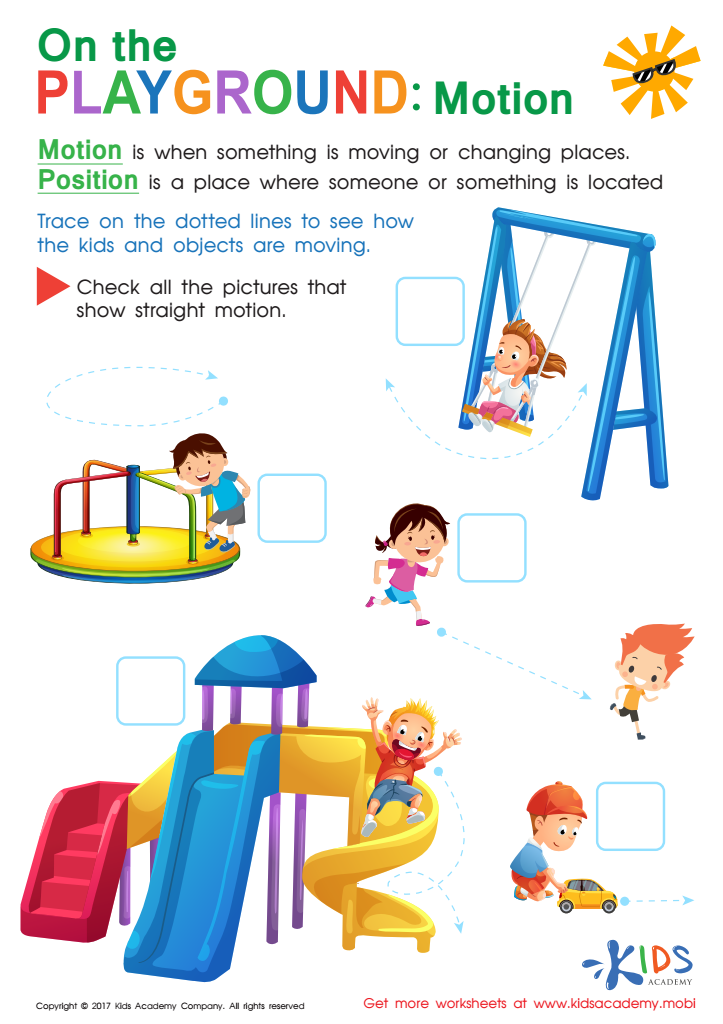
Position and Motion Worksheet
Take a trip to the park and explore motion and position with fun worksheets!
Take your child's science knowledge to a whole new level with Kids Academy's grade 2 position and motion worksheets! Explore motion and position with fun worksheets while taking a trip to the park. Strengthen their understanding of physics and how people and objects move through space.
 Assign to My Students
Position and Motion Worksheet
Worksheet
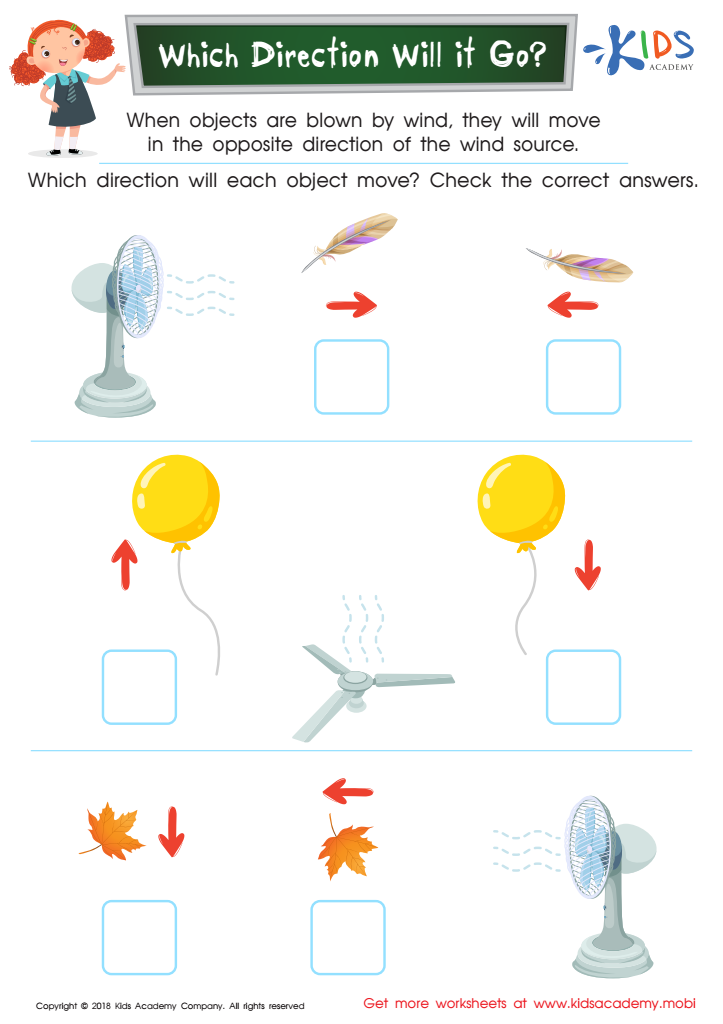
Which Direction Will it Go? Worksheet
Explain to your students: when objects are blown by wind, they will move in the opposite direction. In the worksheet, there are pictures of wind sources and objects being blown by the wind. Ask your child to identify and check the direction each object will move.
Which Direction Will it Go? Worksheet
Worksheet
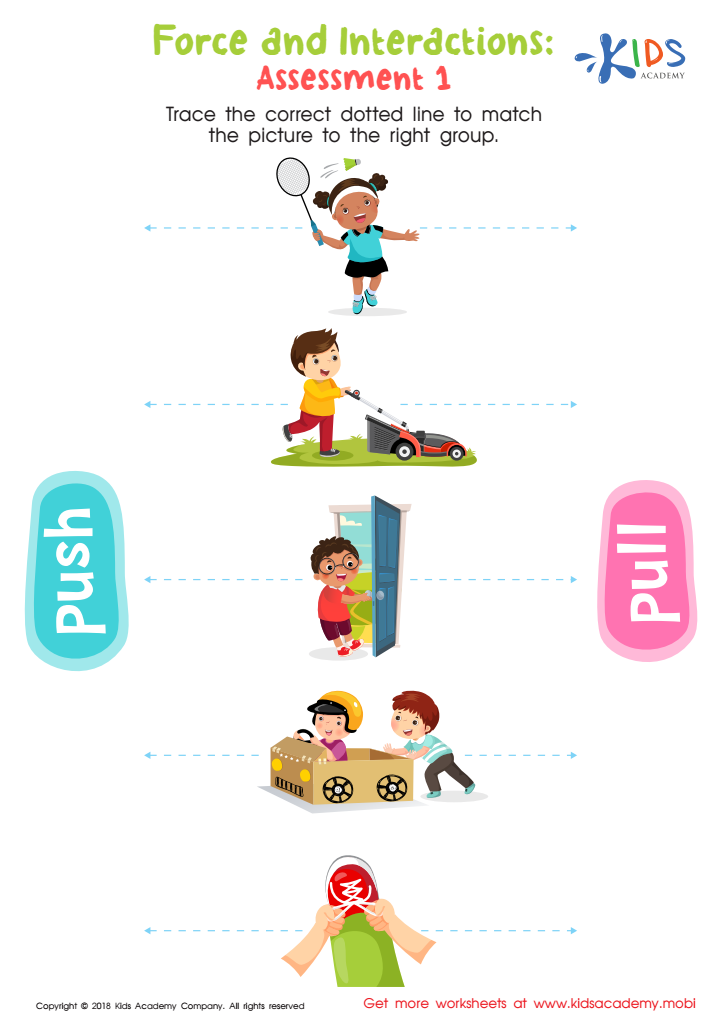
Force and Interactions: Assessment 2 Worksheet
Help your child see the difference between push and pull with this fun worksheet. Ask them to match each picture to the right group. The "push" is on the left and the "pull" is on the right. Assist them in tracing the activities and explain what it is the people are doing.
Force and Interactions: Assessment 2 Worksheet
Worksheet
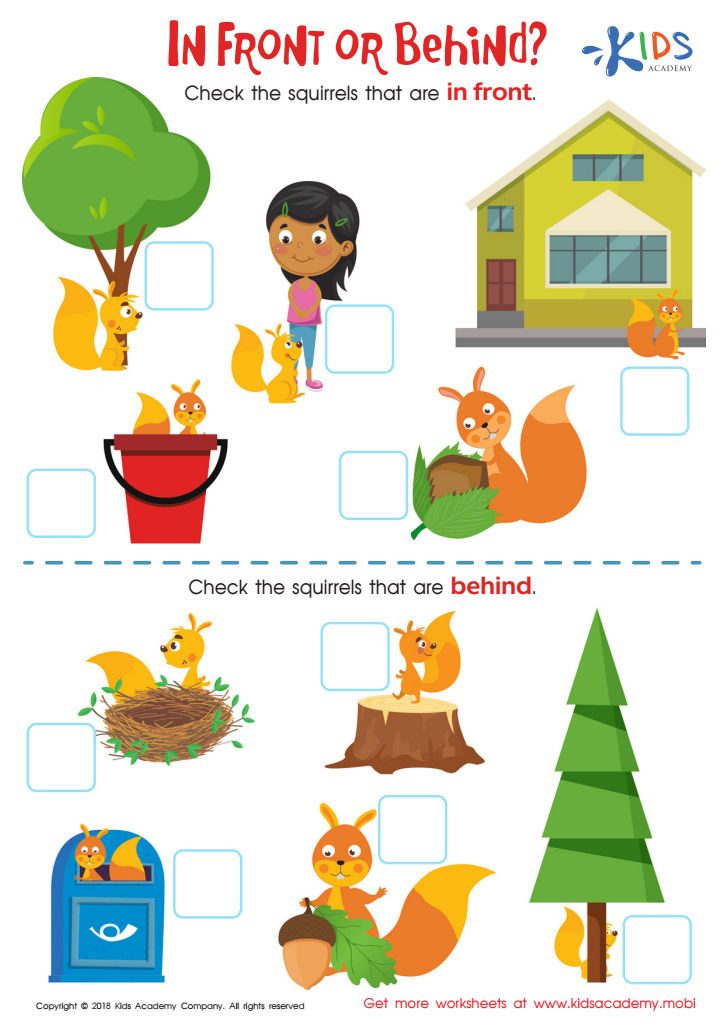
In Front or Behind: Part 2 Worksheet
Teach positional words "front" and "behind" with this fun worksheet! Students identify where the squirrel is in relation to the object - in front or behind. It's a great exercise to practice early geometry skills and understanding object movement.
In Front or Behind: Part 2 Worksheet
Worksheet
Join Kids Academy for Free
Who is primarily going to use this learning content?







Spatial awareness is a fundamental skill that plays a crucial role in a child's overall development, particularly within the realm of physical science. Parents and teachers should prioritize this skill for several reasons.
Firstly, spatial awareness is essential for understanding and interpreting the world around us. It allows children to visualize objects in three dimensions, which is vital in physical science disciplines like physics, chemistry, and engineering. This skill enables students to comprehend concepts such as gravity, force, and motion, serving as a foundation for future scientific learning.
Moreover, spatial reasoning is closely linked to problem-solving abilities. Children who excel in spatial awareness can tackle complex tasks more effectively, enhancing their critical thinking skills. This is particularly important in science, where experimentation and analysis are key.
Additionally, early interventions in developing spatial awareness can lead to improved academic performance in STEM (Science, Technology, Engineering, Mathematics) fields, addressing the widely acknowledged skills gap in these areas. Parents and teachers can contribute to this development through engaging activities, from puzzles and games to outdoor exploration.
In summary, fostering spatial awareness not only helps children excel in physical science but also equips them with essential skills for lifelong learning and success in a rapidly evolving world.







