Understand fractions Grade 3 Worksheets
5 filtered results
-
From - To
Explore our Grade 3 "Understand Fractions" worksheets designed to make mastering fractions fun and engaging for young learners. These worksheets offer diverse exercises that help children grasp key fraction concepts, from identifying and comparing fractions to understanding numerators and denominators. With colorful visuals and interactive activities, our printable resources transform complex ideas into easily understandable lessons. Perfect for classroom reinforcement or at-home practice, these worksheets ensure that third graders build a solid foundation in fractions. Make learning fractions enjoyable and effective with Kids Academy’s expertly crafted worksheets, tailored to inspire and educate young minds in an interactive way.
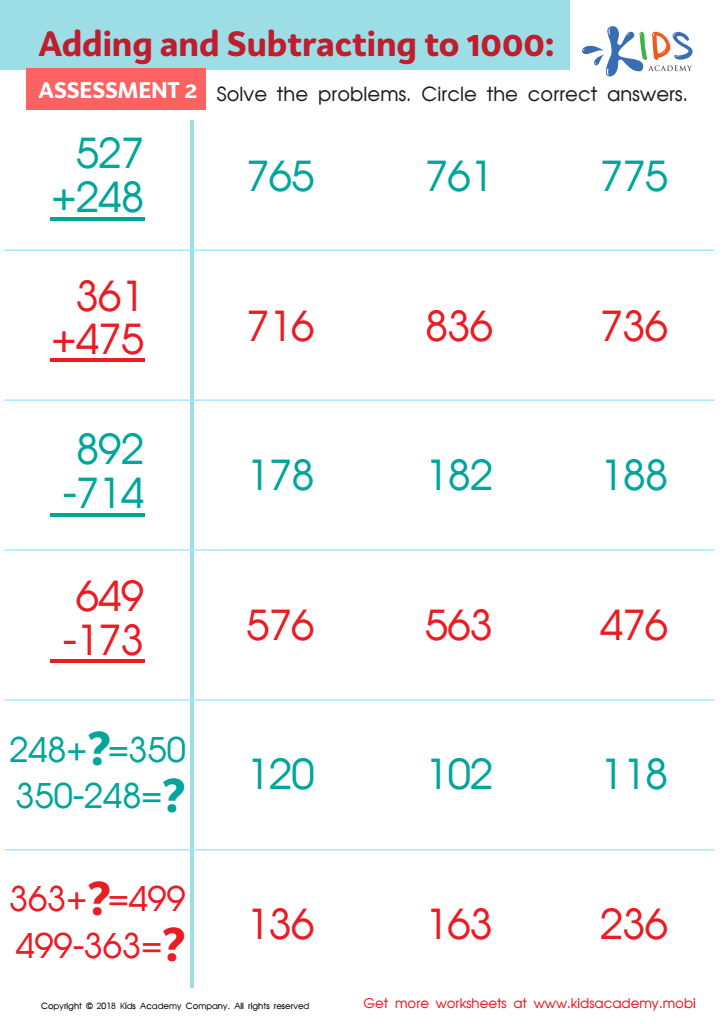
Adding and Subtracting to 1 Worksheet: Assessment 2
 Assign to My Students







Parents and teachers should place a strong emphasis on understanding fractions in Grade 3 because fractions form a foundational element of mathematical comprehension and everyday life skills. At this stage, children transition from simple arithmetic to more complex mathematical concepts, and fractions are essential for this progression. A solid comprehension of fractions enables students to tackle more advanced topics such as ratios, percentages, algebra, and geometry in higher grades.
Moreover, understanding fractions is crucial for real-life applications, from cooking and budgeting to dividing shares and understanding time. Without a firm grasp of fractions, children might struggle with these everyday activities. Teaching fractions at an early age helps develop critical thinking, problem-solving, and analytical skills, as students learn to visualize and manipulate parts of a whole. Parents' involvement in their children's learning builds confidence and reinforces classroom instruction. When teachers prioritize this concept, they help foster a positive attitude toward math, making it less intimidating and more accessible. By supporting students in mastering fractions, we build their mathematical literacy and prepare them for future academic and personal success, ensuring that they possess the tools needed for a wide range of practical and intellectual challenges.