Addition & Subtraction worksheets activities for Ages 7-9 - Page 2
26 filtered results
-
From - To
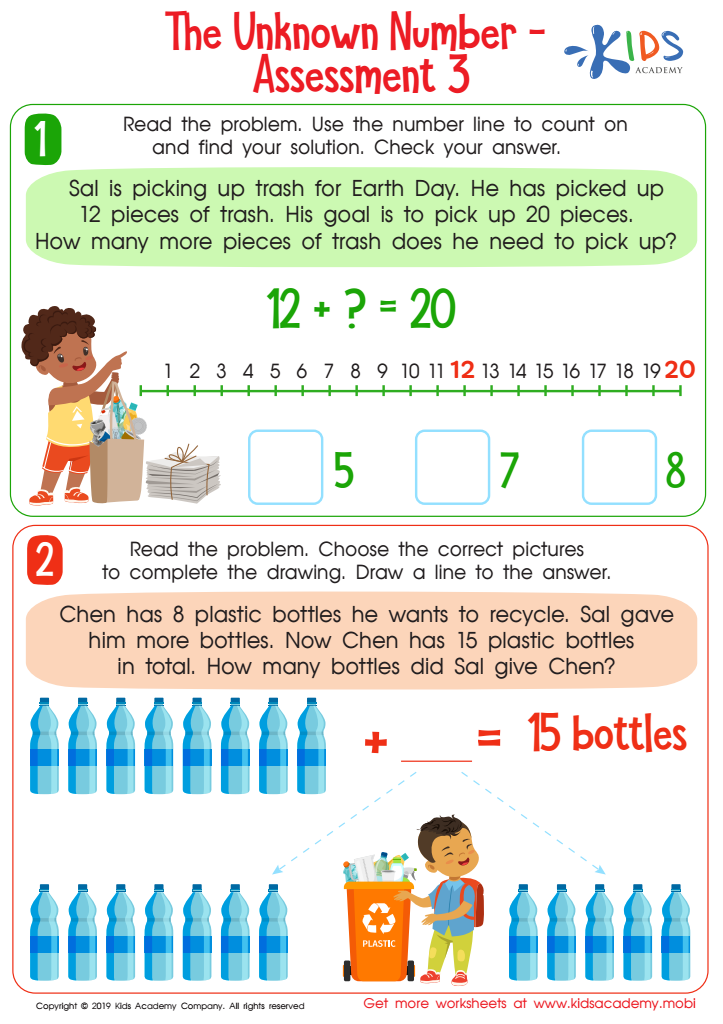
The Unknown Number - Assessment 3 Worksheet
 Assign to My Students
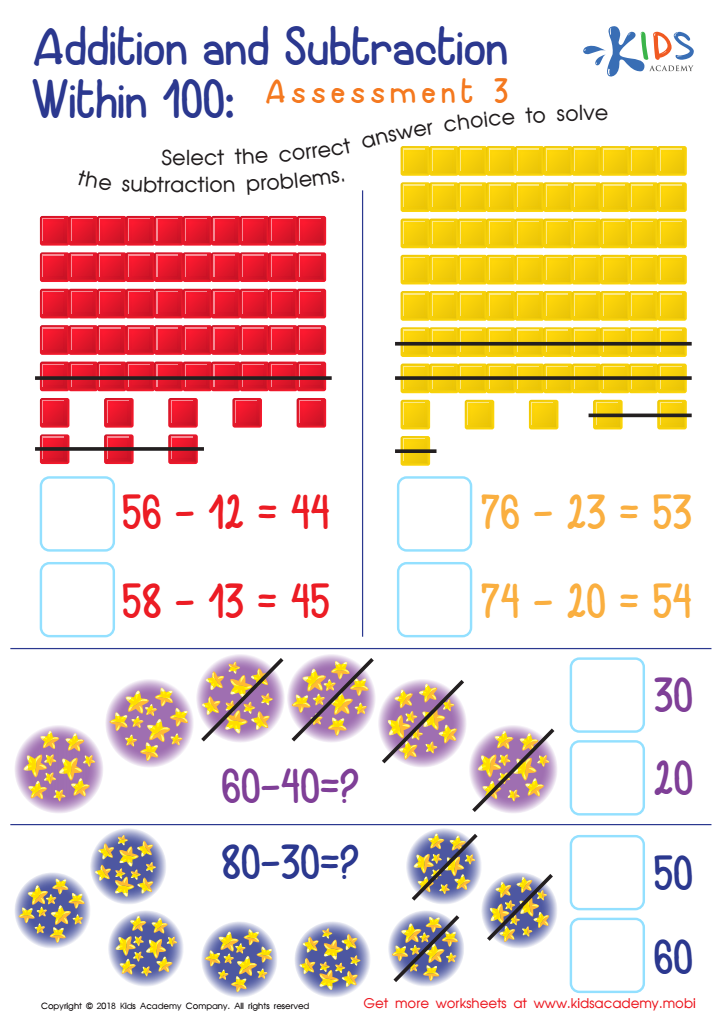
Addition and Subtraction Within 1: Assessment 3 Worksheet








Parents and teachers should prioritize addition and subtraction activities for children ages 7-9, as these early numeracy skills form the foundation for more complex mathematical concepts. At this developmental stage, children are transitioning from basic arithmetic to more abstract thinking, and solidifying their understanding of addition and subtraction is crucial for their overall math proficiency.
Engaging in activities that promote these skills enhances problem-solving abilities and boosts confidence in mathematical contexts. Children who master addition and subtraction are better prepared for multiplication, division, and even algebraic concepts in later grades. Additionally, these activities promote cognitive development, improving not just math skills but logical reasoning and critical thinking.
Interactive and playful approaches, such as games and hands-on manipulatives, can make learning enjoyable, keeping children engaged and motivated. Moreover, regular practice helps reinforce memory and builds a positive association with math, reducing anxiety.
Involving parents in these activities fosters strong home-school connections and adds an informal learning component, making math a part of everyday life. Ultimately, by investing time and effort in addition and subtraction activities, parents and teachers contribute to a child's lifelong mathematical journey and empower them to approach challenges with confidence.








