
Understanding measurements Measurement Worksheets for Ages 3-5
5 filtered results
Difficulty Level
Grade
Age
-
From - To
Subject
Activity
Standards
Discover an interactive way to introduce your toddlers to the fascinating world of measurements with our specially designed worksheets for ages 3-5! At Kids Academy, we offer engaging and colorful activities focused on understanding the basics of measurements. These printable resources will develop young learners' abilities to compare sizes, lengths, heights, and capacities in a fun, playful manner. Perfect for fostering early math skills, our worksheets encourage active learning and critical thinking, ensuring your child grasps fundamental concepts in an enjoyable and effective way. Start your child's educational journey in measurements today with Kids Academy!
Favorites
With answer key
Interactive
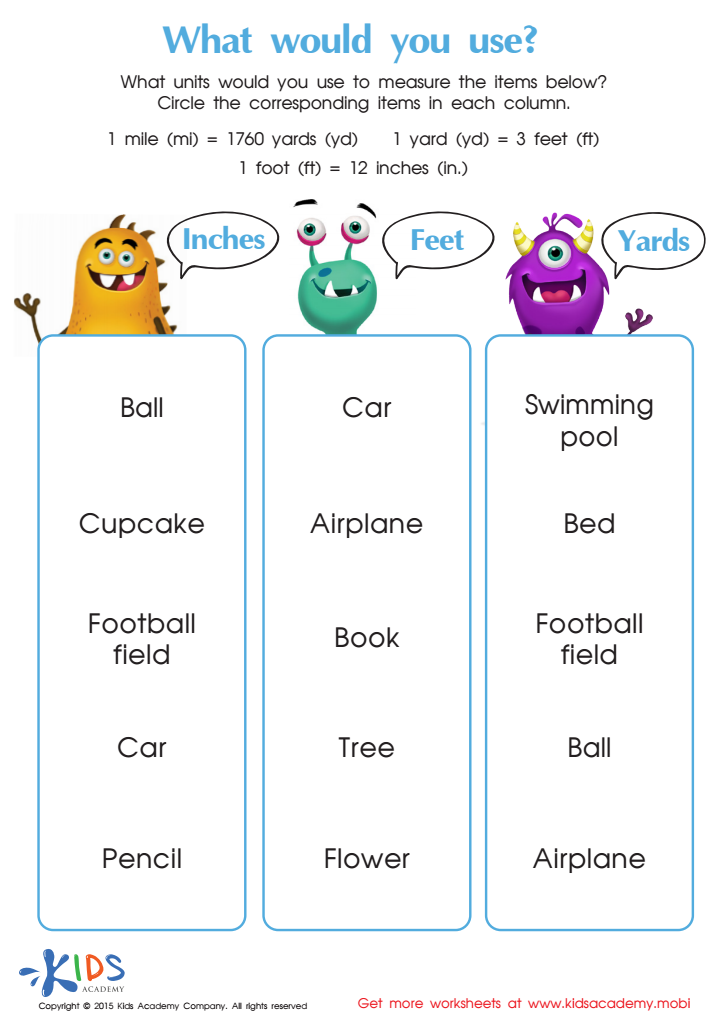
Learning about measuring objects in inches, feet and yards Worksheet
Download, cut and let your preschoolers learn and have fun estimating objects like pencils, airplanes and swimming pools in inches, feet and yards!
 Assign to My Students
Learning about measuring objects in inches, feet and yards Worksheet
Worksheet
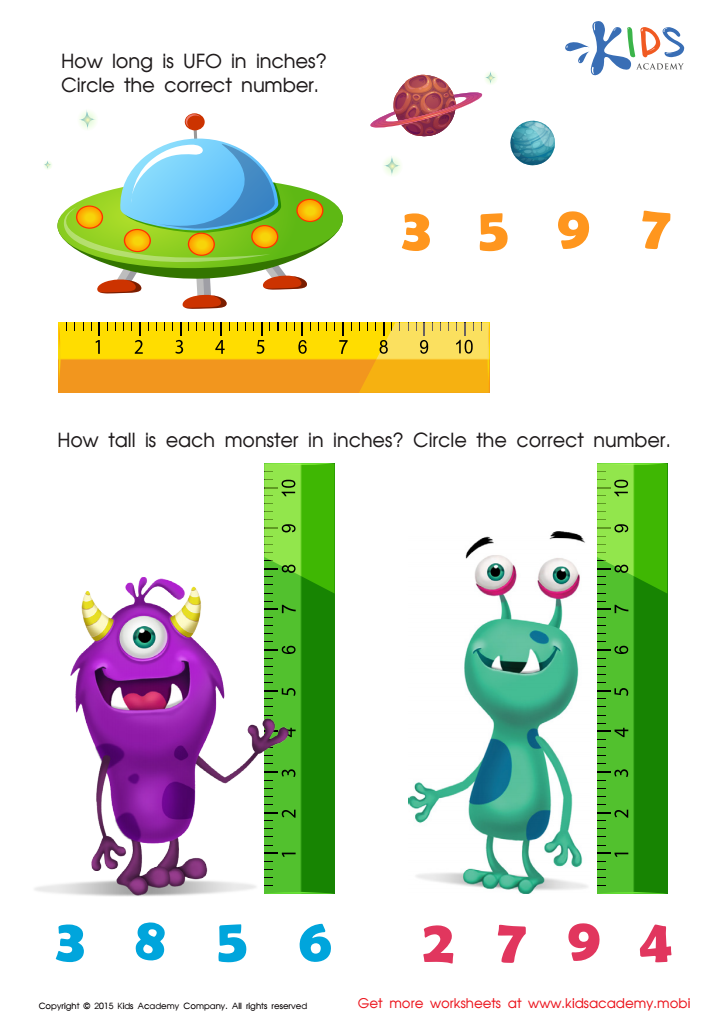
Measuring in Inches Worksheet
Look at the picture, can you measure the UFO & monsters? Write down how long each is. Which is tallest? Circle it. Get more free printable math worksheets for kindergarten at our website.
Measuring in Inches Worksheet
Worksheet
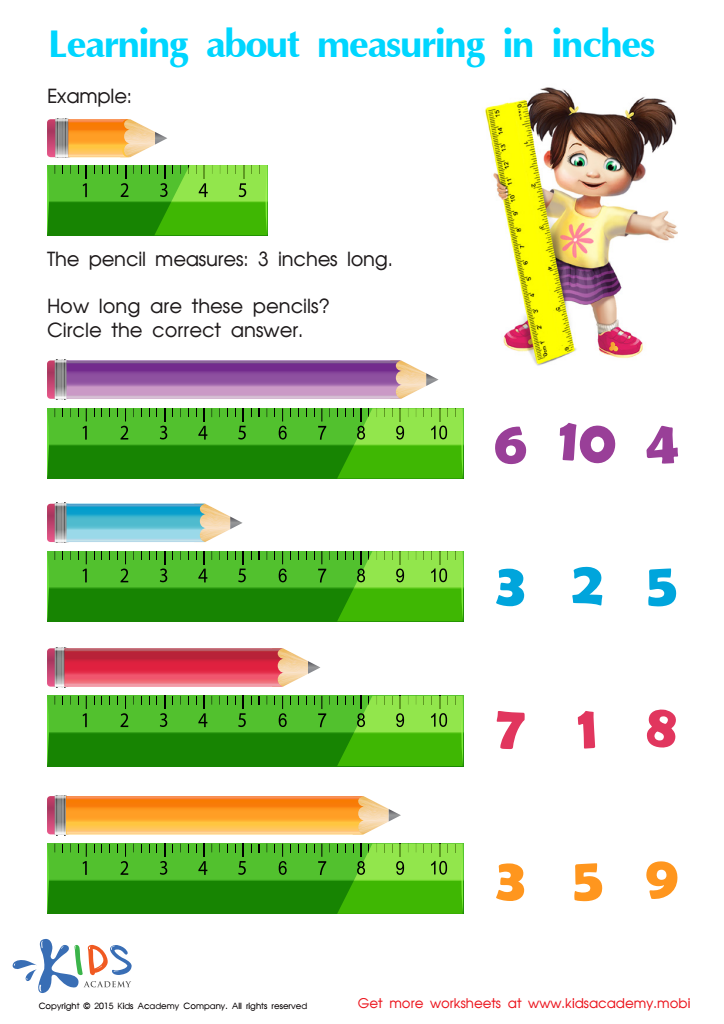
Learning About Measuring In Inches Printable
Print this free worksheet and measure pencils together with kids. See who finds the longest and the shortest! Enjoy learning math with your kids.
Learning About Measuring In Inches Printable
Worksheet
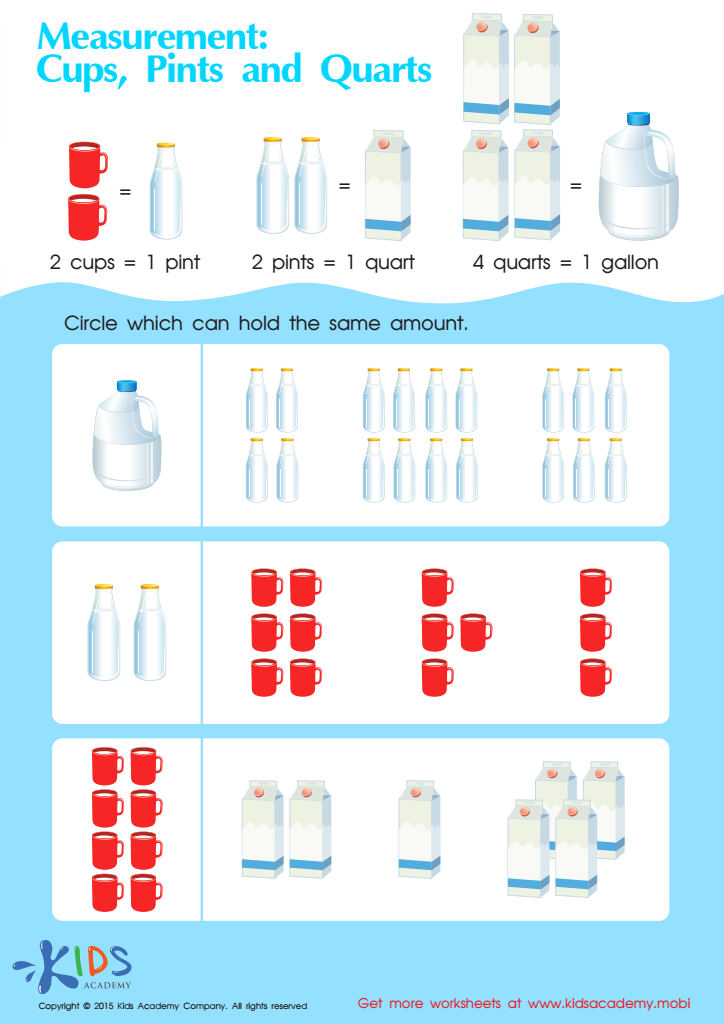
Cups, Pints and Quarts 2 Worksheet
Practice measuring liquids with our free math worksheets. Learn how many cups are in a quart and how many quarts are in a gallon. Accurately calculate the answers and write them in the provided spaces. Visit Kids Academy for a collection of free worksheets and make math fun!
Cups, Pints and Quarts 2 Worksheet
Worksheet
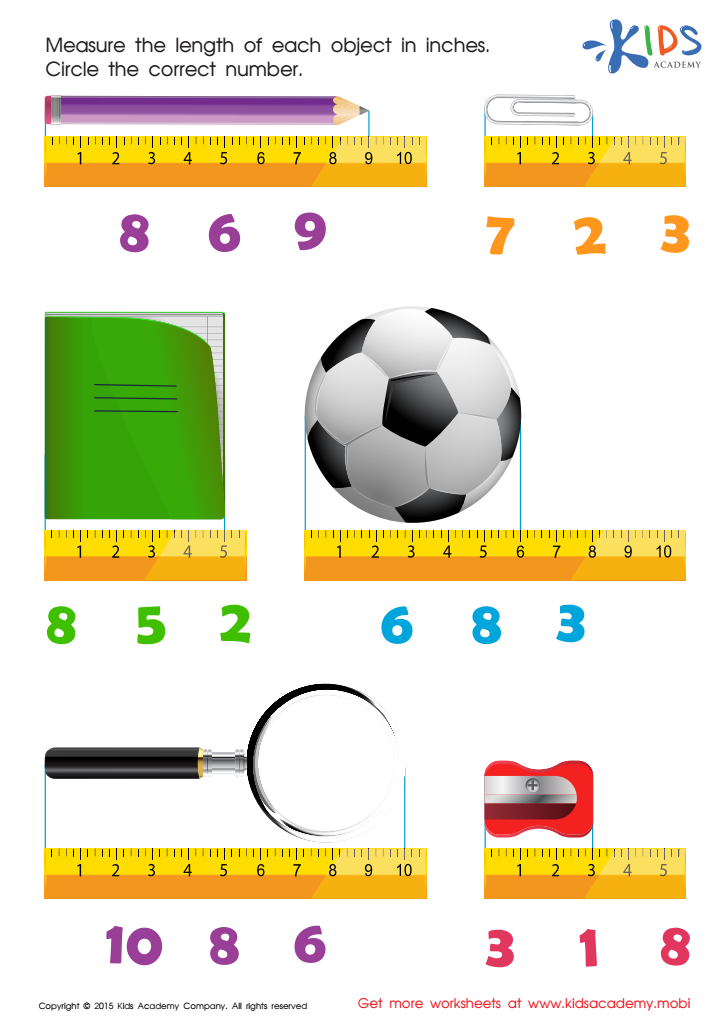
Learning measuring objects in inches Worksheet
Help your little learners gain confidence in using a ruler! Print out our free worksheet, cut out the inch ruler, and let them measure and record objects' width and length. Kids Academy has a variety of math worksheets to make learning math fun! Check out our website for more free printables!
Learning measuring objects in inches Worksheet
Worksheet
Join Kids Academy for Free
Who is primarily going to use this learning content?








Understanding measurements at an early age, particularly between the ages of 3-5, is pivotal in laying the foundation for critical mathematical and everyday life skills. For parents and teachers, encouraging young children to grasp basic measurement concepts fosters cognitive development, problem-solving abilities, and a sense of order and comprehension in their environment.
Measurements introduce children to comparisons and categorizations based on size, length, weight, and volume, which are crucial for nurturing logical and spatial reasoning. For instance, activities like comparing who is taller or measuring ingredients while cooking instill practical understanding in a fun, relatable manner. Such hands-on experiences enhance children's ability to think critically and systematically.
Furthermore, early exposure to measurement vocabularies, such as "inch," "foot," "shorter," "heavier," and "lighter," enriches children's language skills, expanding their descriptive and narrative capabilities. This is also beneficial for pre-literacy and numeracy skills in preparation for more formal education.
By caring about this aspect of development, parents and teachers support young minds in becoming more comfortable and confident in mathematical thinking. This makes future learning endeavors smoother as children progress through their academic paths, ultimately aiding in the development of proficient, curious, and capable learners. Enthusiastically nurturing an understanding of measurements helps children appreciate the world quantitatively and qualitatively.








