
Understanding punctuation Worksheets for Ages 3-7
4 filtered results
Difficulty Level
Grade
Age
-
From - To
Subject
Activity
Standards
Welcome to our "Understanding Punctuation Worksheets" page designed for children ages 3-7. Our engaging and interactive worksheets make learning punctuation fun and enjoyable! Young learners will be introduced to the fundamentals of punctuation through colorful activities that promote recognition of periods, commas, question marks, and exclamation points. These worksheets are thoughtfully crafted to enhance reading and writing skills while cultivating a strong foundation in language arts. Each activity is age-appropriate, encouraging kids to enhance their literacy skills in an enjoyable way. Perfect for classroom use or at-home learning, our worksheets will inspire creativity and a love for language!
Favorites
With answer key
Interactive
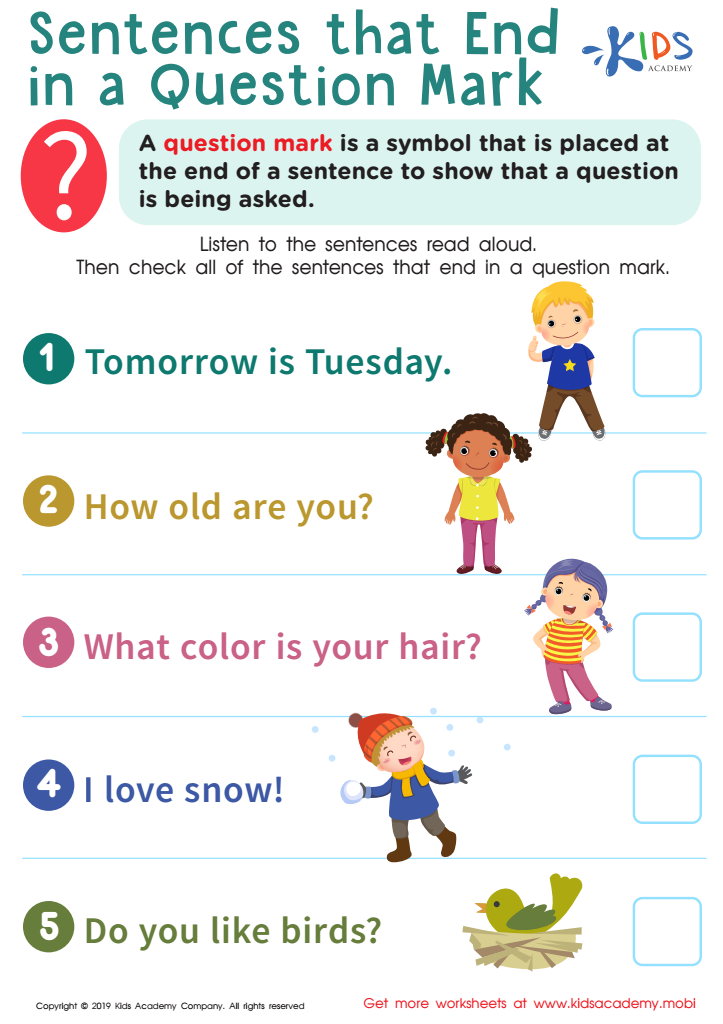
Sentences That End in an Question Mark Worksheet
Teach your students about the four most common punctuation marks - period, comma, question mark, and exclamation mark - with this worksheet. Show them how to use the question mark to indicate a sentence is a question. Then, have them check all sentences that end in a question mark.
 Assign to My Students
Sentences That End in an Question Mark Worksheet
Worksheet
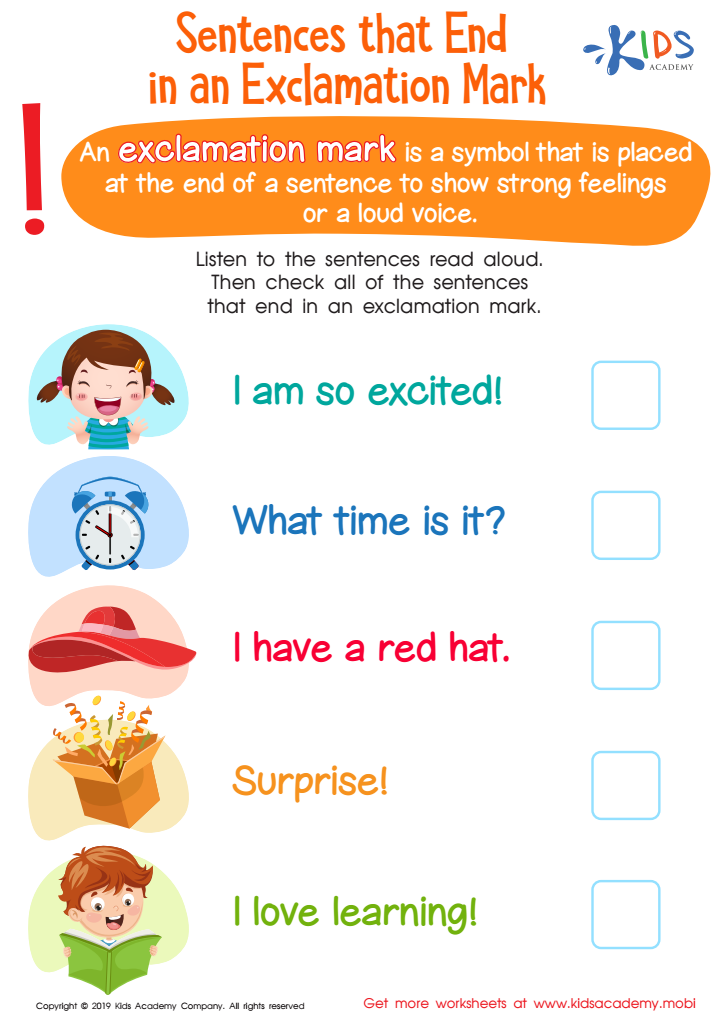
Sentences That End in an Exclamation Mark Worksheet
This worksheet is a great way to brush up kids' punctuation skills. Period, comma, question mark and exclamation mark are the first four punctuation marks they should learn. Exclamation marks show strong emotion or a noise. Use this printout to teach and test kids' understanding of exclamation marks.
Sentences That End in an Exclamation Mark Worksheet
Worksheet
Join Kids Academy for Free
Who is primarily going to use this learning content?






Understanding punctuation is crucial for children aged 3-7 as it lays the foundation for effective communication and literacy skills. Punctuation marks, such as periods, commas, and question marks, play a vital role in helping young learners convey meaning in their spoken and written language. With early exposure to punctuation, children develop an awareness of how their words connect and how tone and pauses affect understanding.
For parents and teachers, emphasizing punctuation can significantly enhance a child's reading abilities. When children recognize punctuation, they can decipher the rhythm of sentences, improve comprehension, and even enhance their storytelling skills. An understanding of punctuation also assists in differentiating between questions, statements, and exclamations, fostering confidence during conversations and in writing activities.
Moreover, instilling a strong grasp of punctuation at a young age encourages meticulousness and attention to detail—skills essential for academic success. Early mastery of these elements empowers children not only in language arts but across subjects where clear communication is needed. Ultimately, by prioritizing punctuation education, parents and teachers aid children's overall development as articulate thinkers and effective communicators, which will benefit them throughout their educational journey and beyond.








