Improve comprehension Addition Worksheets for Ages 3-7
3 filtered results
-
From - To
Enhance your child's understanding of addition with our “Improve Comprehension Addition Worksheets” tailored for ages 3-7. These engaging printable resources focus on building fundamental math skills through fun activities that promote comprehension and critical thinking. Packed with colorful illustrations and interactive problems, our worksheets cater to different learning styles, encouraging kids to visualize addition concepts. Designed to foster a strong mathematical foundation, these worksheets will transform your little learners’ approach to math while keeping them entertained. Access our variety of worksheets today and watch your child flourish in their mathematical journey with improved comprehension and confidence in addition!
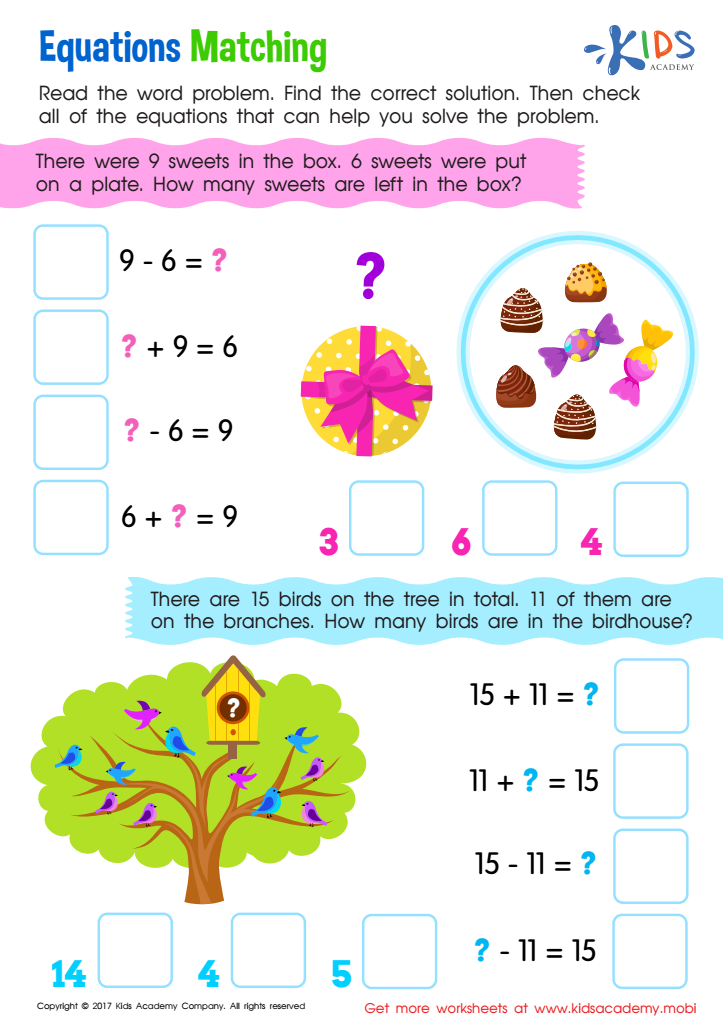
Equations Matching Word Problems Worksheet
 Assign to My Students


.jpg)





Improving comprehension and addition skills in children aged 3-7 is critical for their academic and personal development. At this formative stage, children develop foundational skills that influence future learning. Comprehension abilities enable young learners to understand and interpret information, fostering critical thinking and effective communication. By enhancing comprehension, parents and teachers help children connect concepts across disciplines, leading to a more holistic understanding of the world around them.
In addition, mastering basic addition is essential for building numerical fluency. Early math skills are predictive of later success in mathematics, and a strong foundation in addition lays the groundwork for more complex arithmetic and problem-solving abilities. Engaging children in playful, hands-on activities can make learning fun and relatable, encouraging a positive attitude toward math.
Moreover, these skills promote confidence and self-efficacy. Children who feel competent in their abilities are more willing to participate in classroom discussions and activities, which enhances engagement and collaborative learning. By prioritizing comprehension and addition, parents and teachers empower children with the tools needed for lifelong learning and instill a love for education that can last well beyond the early years. Ultimately, supporting these skills helps nurture well-rounded and capable individuals.








