
Understanding forces Science Worksheets for Ages 3-7
3 filtered results
Difficulty Level
Grade
Age
-
From - To
Subject
Activity
Standards
Unlock your child's curiosity with our "Understanding Forces Science Worksheets" designed specifically for ages 3-7. These engaging printables make foundational physics concepts accessible and fun! Children will explore how different forces like push and pull affect how objects move, encouraging critical thinking and problem-solving skills. Vibrant illustrations and age-appropriate activities captivate young minds, making complex ideas simple. Perfect for use at home or in the classroom, these worksheets align with educational standards and support hands-on learning experiences. Help your child build a strong science foundation while fostering a love for discovery and experimentation. Get started today!
Favorites
With answer key
Interactive
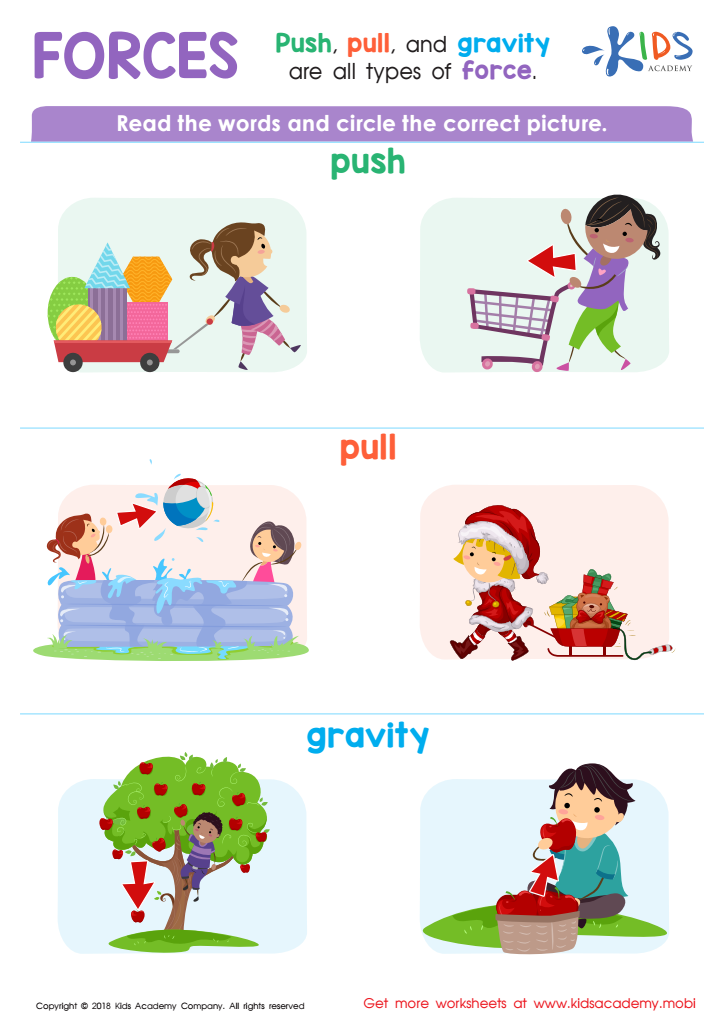
Forces Worksheet
Teach your child about forces! Ask them to identify which of six pictures shows push, pull or gravity. Read the words beside each picture and have them circle the correct one. It's a great way to learn about forces; push, pull and gravity!
 Assign to My Students
Forces Worksheet
Worksheet
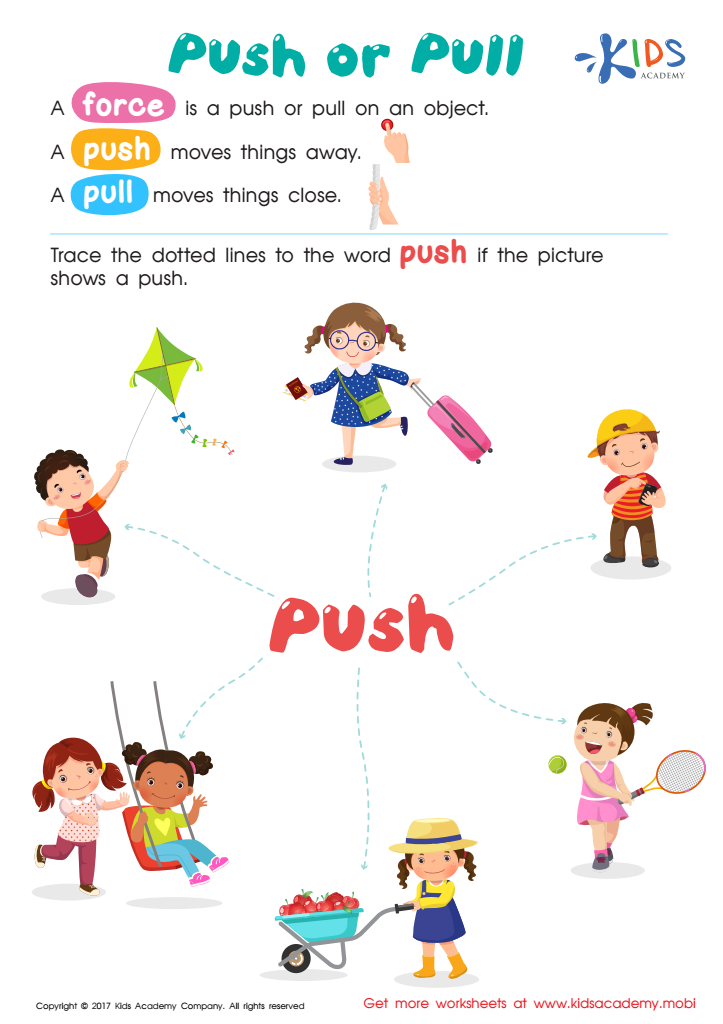
Push or Pull Worksheet
and which involve pulling! With this fun worksheet, your child will learn about force and its simple application in everyday activities. Get them started with Push or Pull! (80 words)
Push or Pull Worksheet
Worksheet
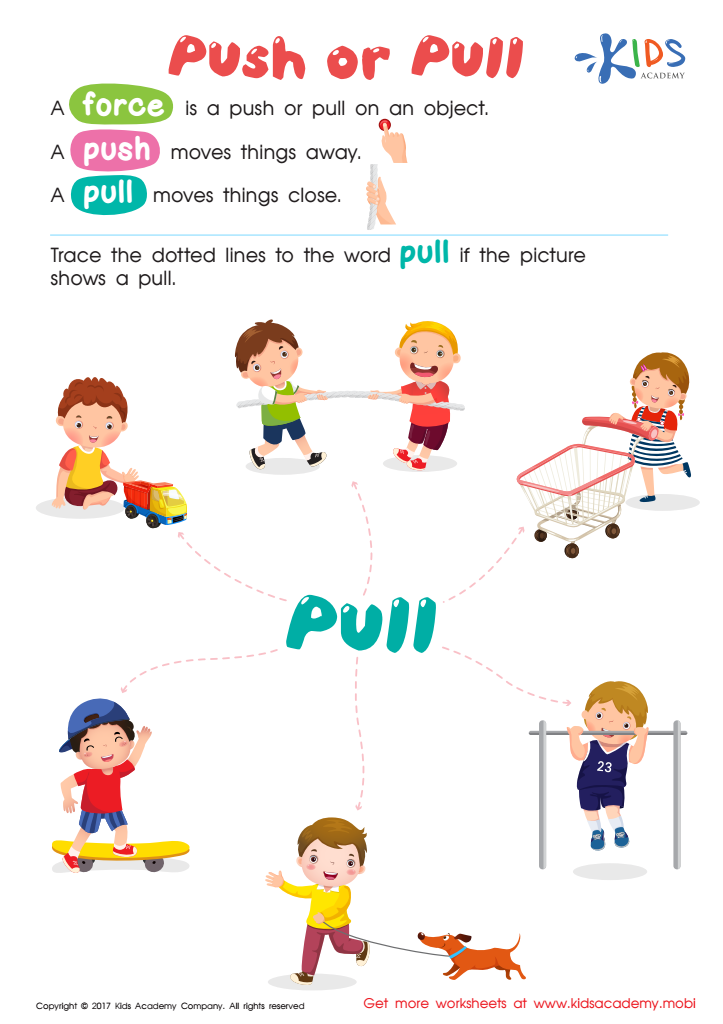
Pull or Push Worksheet
With this fun worksheet, they'll explore physics by sorting objects into categories according to their mode of motion. It's a great way to get them interested in science.
Pull or Push Worksheet
Worksheet
Join Kids Academy for Free
Who is primarily going to use this learning content?






Parents and teachers play a crucial role in fostering young children's understanding of scientific concepts, including forces, which is important for several key reasons. Introducing children ages 3-7 to the idea of forces—such as pushes and pulls—helps them appreciate how the world around them works. Understanding forces aids in developing critical thinking and problem-solving skills by encouraging young minds to ask questions, observe outcomes, and make predictions.
At this tender age, children's brains are incredibly receptive to new information. Simple, hands-on activities, like pushing a toy car or pulling a wagon, make abstract concepts more tangible. Early engagement with such activities builds a solid foundation for more complex scientific learning in later years. Moreover, discussing forces in everyday life, like what makes swings move or how a bicycle works, allows children to relate science to their surroundings, making the learning process more meaningful and interesting.
Fostering an early love for science also enhances vocabulary development and communication skills as children learn to describe their observations. More importantly, it nurtures curiosity and innovation, qualities that are essential for lifelong learning and adaptation. Thus, understanding forces equips young children with foundational competencies that extend far beyond the science classroom.







