
Basic Math Skills Reading Worksheets for 3-Year-Olds
3 filtered results
Difficulty Level
Grade
Age
-
From - To
Subject
Activity
Standards
Our "Basic Math Skills Reading Worksheets for 3-Year-Olds" offer a fun and engaging way to introduce early math concepts to toddlers. Designed with vibrant illustrations and simple activities, these worksheets cover number recognition, basic counting, and fundamental shapes. Each worksheet aims to foster a love for learning while enhancing your child's cognitive abilities and fine motor skills. Perfect for parents and educators alike, our resources support developmental milestones and prepare your little mathematicians for future academic success. Explore our worksheets to start nurturing your child's mathematical journey today!
Favorites
With answer key
Interactive
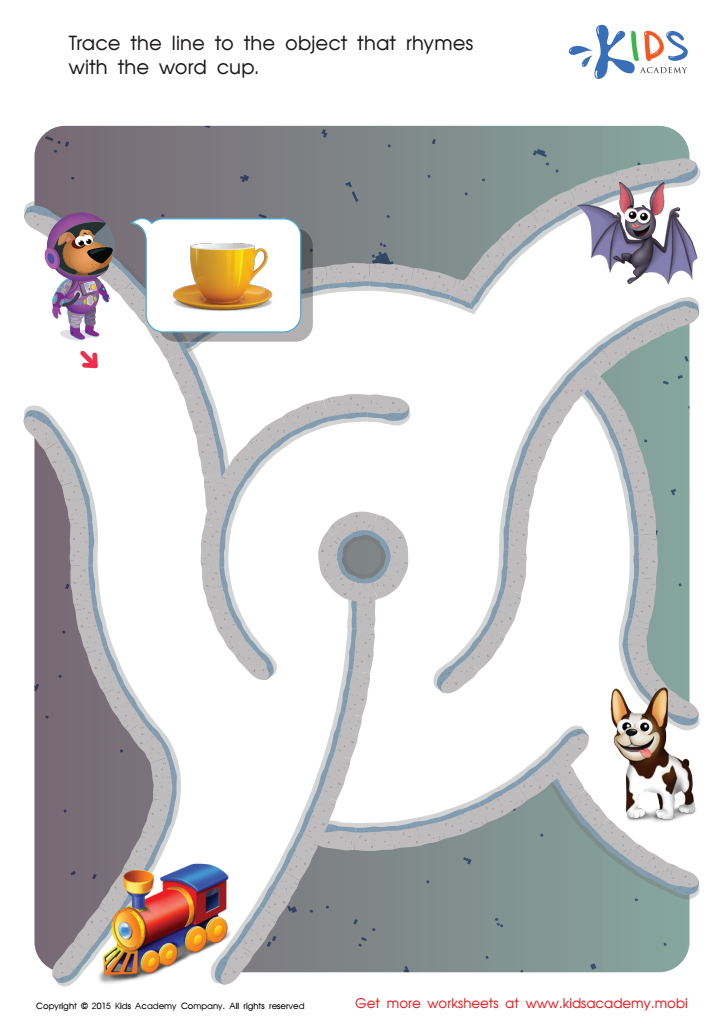
Cup Rhyming Words Worksheet
Kids Academy offers funny worksheets to help kids practice their vocabulary. Try the new one with the dog, matching objects to their rhyming words! Explore more activities and worksheets to learn English Language words and phrases.
 Assign to My Students
Cup Rhyming Words Worksheet
Worksheet
Join Kids Academy for Free
Who is primarily going to use this learning content?








Fostering basic math and reading skills in 3-year-olds is foundational for several crucial reasons. Early exposure to numbers, counting, and simple arithmetic enhances cognitive development, which is critical for later academic success. At this age, children's brains are exceptionally receptive to learning new information, allowing them to quickly and efficiently grasp fundamental concepts.
Developing reading skills early sets the stage for literacy, comprehension, and a lifelong love of learning. Importantly, early math and reading proficiency can boost children's confidence and curiosity, fostering a positive attitude towards school and education. Children who have early math skills are shown to have better outcomes in various areas of life, including problem-solving and analytical thinking.
Furthermore, establishing these skills at an early age can help identify learning difficulties or developmental delays, enabling timely intervention and support. Early detection and response can significantly improve a child's educational trajectory, ensuring they receive the necessary resources and attention they need to succeed.
For parents and teachers, investing time in teaching basic math and reading can also build strong bonds with children, creating an educationally enriching environment both at home and school. Thus, nurturing basic math and reading skills in 3-year-olds lays the groundwork for lifelong learning and success.








