
Understanding measurements Measurement Worksheets for Ages 4-5
5 filtered results
Difficulty Level
Grade
Age
-
From - To
Subject
Activity
Standards
Discover engaging and interactive Measurement Worksheets for Ages 4-5 designed to develop young learners' understanding of measurement concepts. These fun, colorful worksheets help kids learn to compare lengths, heights, weights, and volumes using everyday objects, fostering essential math skills. Each activity is tailored to capture children's curiosity and enhance their problem-solving abilities. Encourage hands-on learning with exercises that make measurement relatable and enjoyable. Perfect for preschoolers, these worksheets lay a strong foundation for future math success. Join us at Kids Academy and make learning measurements a delightful adventure for your child.
Favorites
With answer key
Interactive
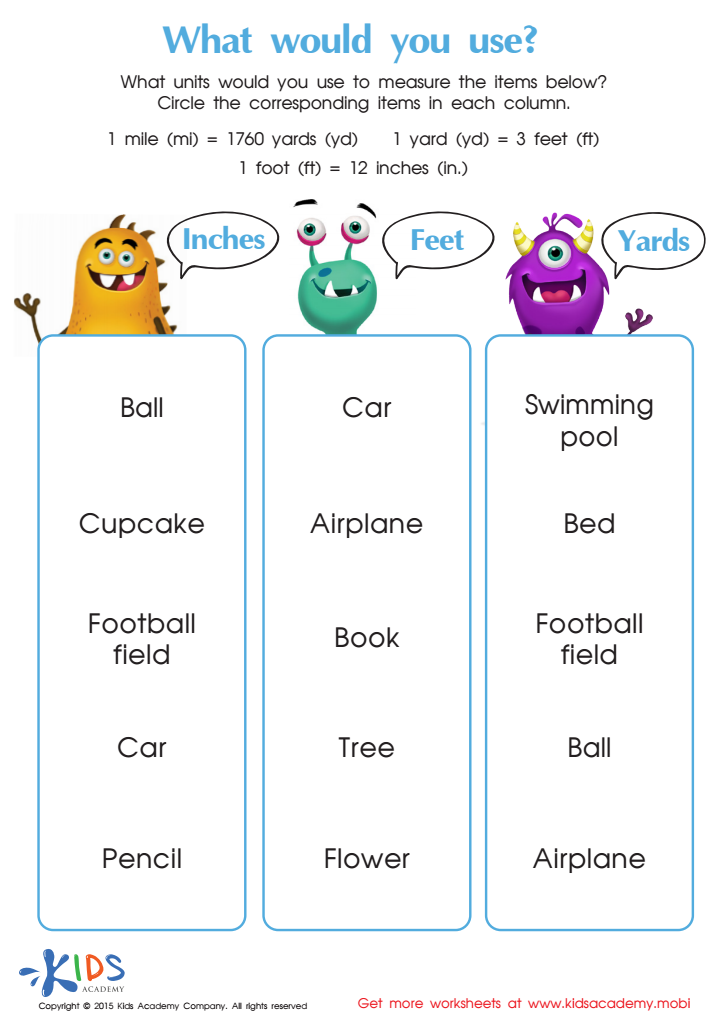
Learning about measuring objects in inches, feet and yards Worksheet
Download, cut and let your preschoolers learn and have fun estimating objects like pencils, airplanes and swimming pools in inches, feet and yards!
 Assign to My Students
Learning about measuring objects in inches, feet and yards Worksheet
Worksheet
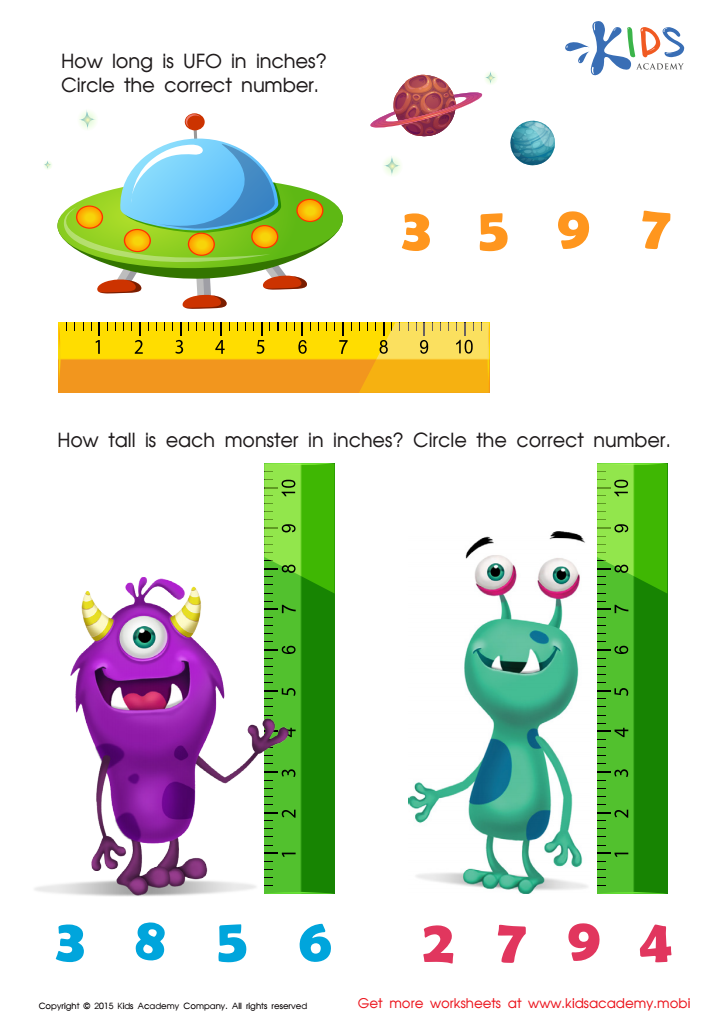
Measuring in Inches Worksheet
Look at the picture, can you measure the UFO & monsters? Write down how long each is. Which is tallest? Circle it. Get more free printable math worksheets for kindergarten at our website.
Measuring in Inches Worksheet
Worksheet
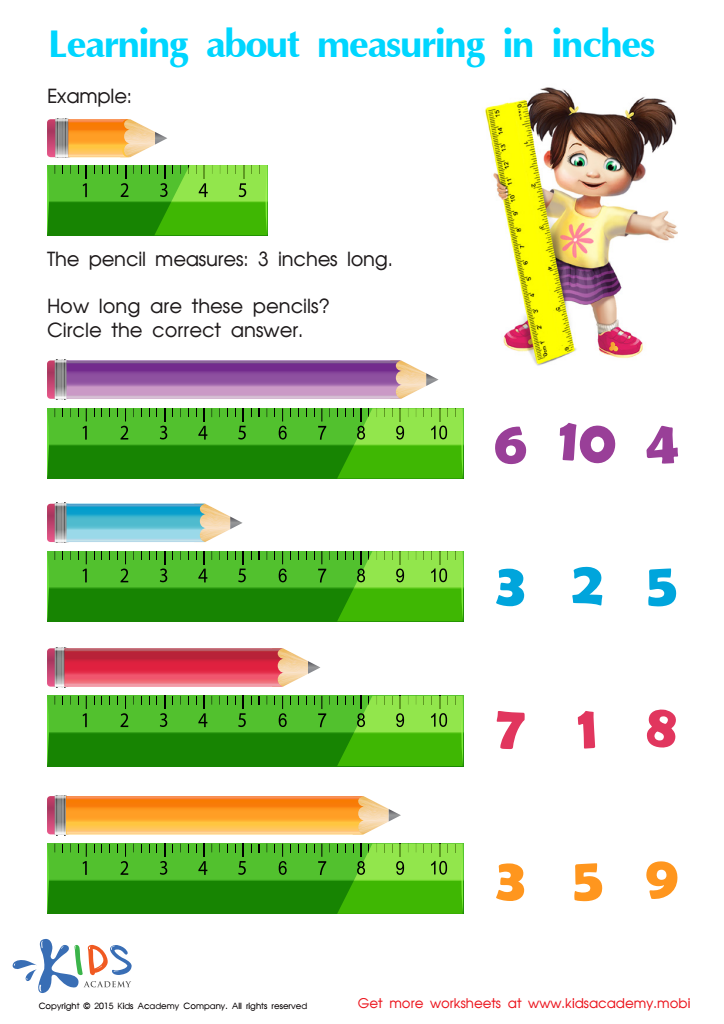
Learning About Measuring In Inches Printable
Print this free worksheet and measure pencils together with kids. See who finds the longest and the shortest! Enjoy learning math with your kids.
Learning About Measuring In Inches Printable
Worksheet
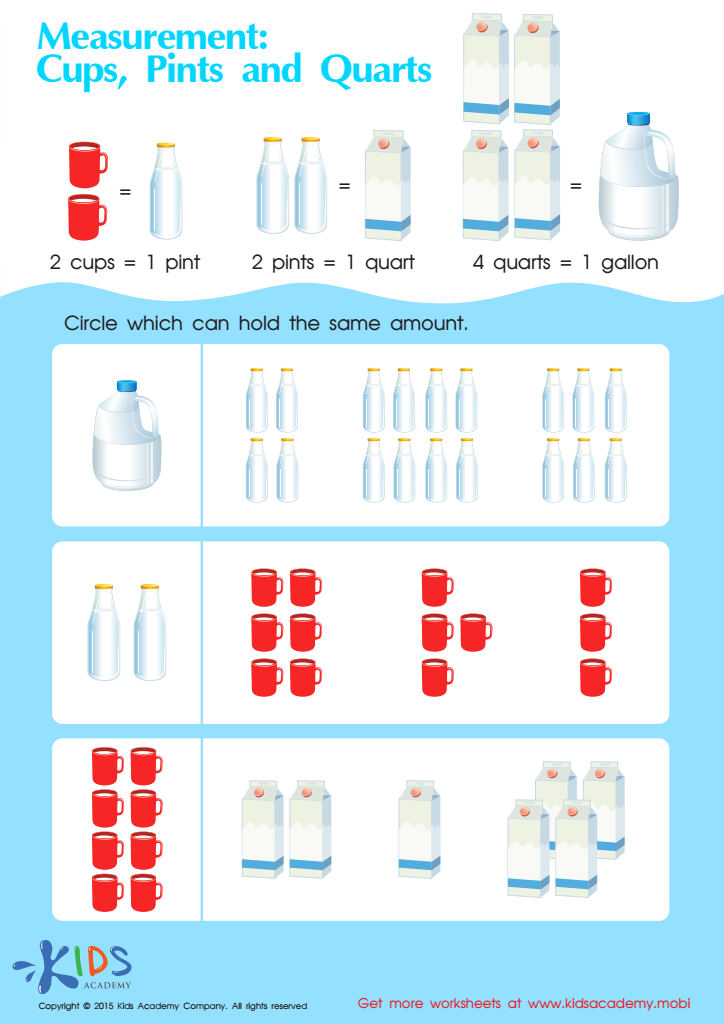
Cups, Pints and Quarts 2 Worksheet
Practice measuring liquids with our free math worksheets. Learn how many cups are in a quart and how many quarts are in a gallon. Accurately calculate the answers and write them in the provided spaces. Visit Kids Academy for a collection of free worksheets and make math fun!
Cups, Pints and Quarts 2 Worksheet
Worksheet
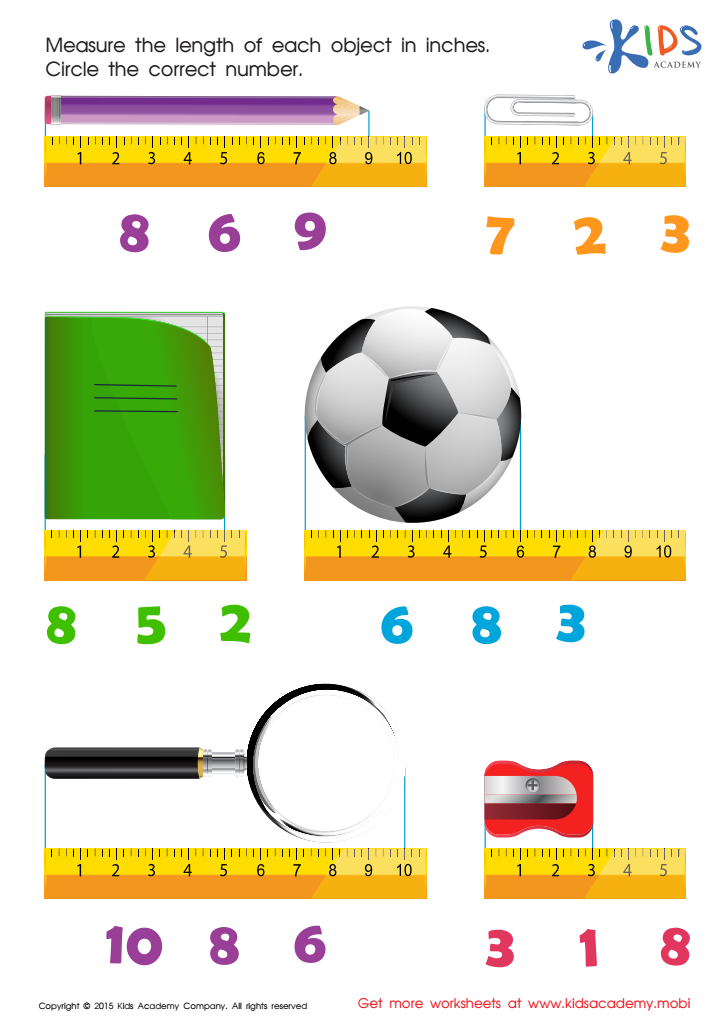
Learning measuring objects in inches Worksheet
Help your little learners gain confidence in using a ruler! Print out our free worksheet, cut out the inch ruler, and let them measure and record objects' width and length. Kids Academy has a variety of math worksheets to make learning math fun! Check out our website for more free printables!
Learning measuring objects in inches Worksheet
Worksheet
Join Kids Academy for Free
Who is primarily going to use this learning content?








Understanding measurements at ages 4-5 is essential for a child's cognitive and practical development. Firstly, measurement concepts emerge naturally in young children's curiosity about the world. They often ask questions about the size, length, weight, and quantity of objects, which are foundational to problem-solving and critical thinking. By fostering an understanding of measurements early on, parents and teachers help children develop reasoning skills that are crucial for later academic success.
Learning measurements also enhances a child's vocabulary and mathematical language. When children describe objects as "bigger," "smaller," "heavier," or "lighter," they not only learn the concepts of measurements but also improve their ability to communicate and describe the world around them.
Furthermore, measurement skills are part of everyday life activities, such as baking with a parent, building with blocks, or even dressing up by choosing the right size shoes and clothes. Recognizing and using measurements help children gain confidence in performing these activities independently and effectively.
Lastly, early exposure to measurement lays a strong foundation for future mathematics learning, including arithmetic, geometry, and science. Thus, nurturing measurement skills in young children can ignite a passion for STEM (Science, Technology, Engineering, and Mathematics) subjects later in their educational journey. Parents and teachers can give children tools to understand the world and set the stage for lifelong learning.








