Develop problem-solving abilities Numbers Worksheets for Ages 4-6
3 filtered results
-
From - To
Boost your child's problem-solving skills with our engaging "Numbers Worksheets for Ages 4-6." Designed specifically for young learners, these worksheets offer fun and interactive activities that facilitate the mastery of foundational math concepts. With vibrant illustrations and age-appropriate challenges, kids can enhance their counting, recognition, and reasoning abilities while developing critical thinking skills. Encourage logical thinking and promote a love for numbers through our carefully curated exercises, perfect for home or classroom use. Join us at Kids Academy, where learning is an adventure, and give your little one the tools to succeed in their mathematical journey!
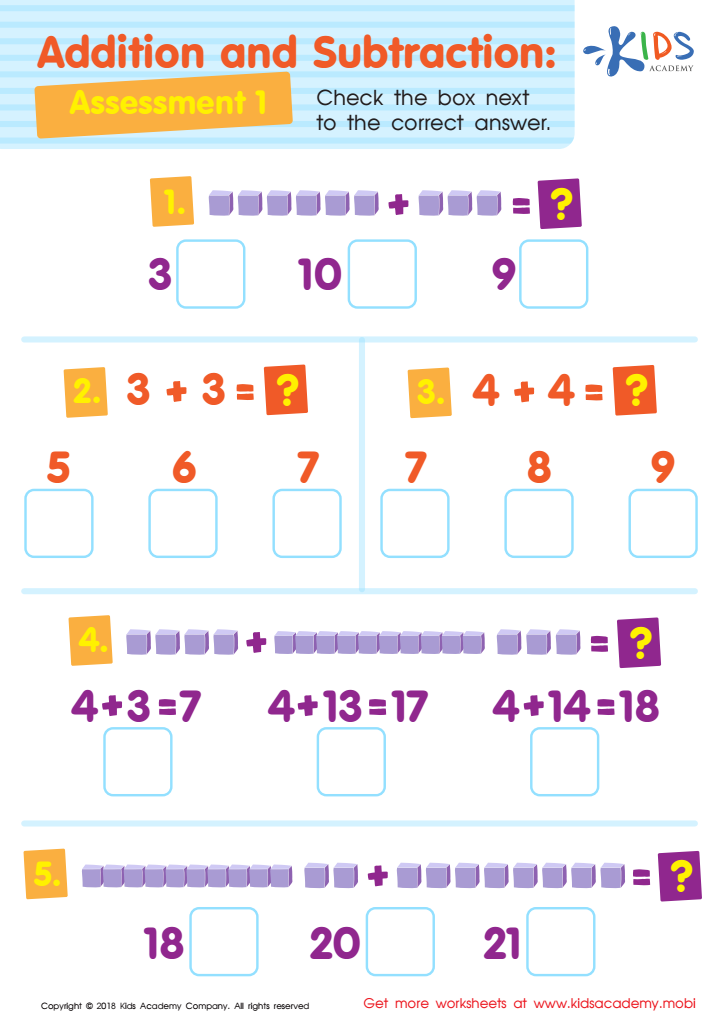
Addition and Subtraction Assessment 1 Worksheet
 Assign to My Students
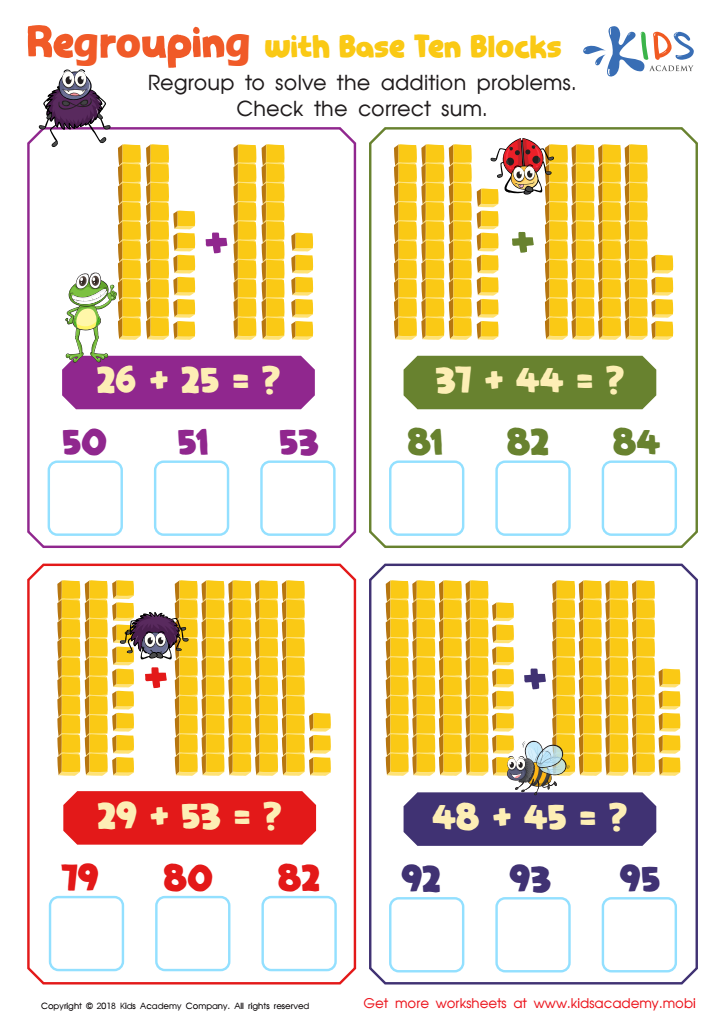
Regrouping With Base Ten Blocks Worksheet
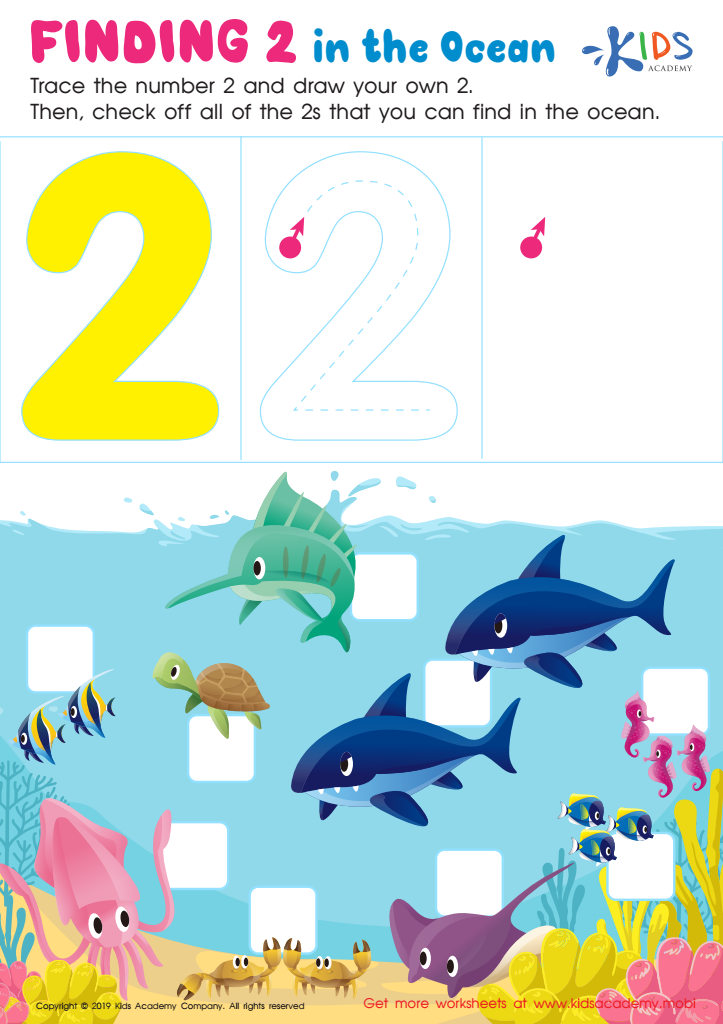
Finding 2: In the Ocean Worksheet








Parents and teachers should prioritize developing problem-solving abilities in children aged 4-6 because these skills form the foundation for critical thinking and cognitive development that are vital for lifelong learning. At this age, children's brains are highly adaptable, making it an ideal time to introduce challenges that enhance logical reasoning. Engaging in problem-solving activities not only encourages creativity but also promotes resilience as children learn to navigate obstacles.
Furthermore, early problem-solving experiences contribute to improved mathematical understanding. By exploring numbers through hands-on activities, such as puzzles or simple math games, children can better grasp concepts like counting, addition, and subtraction in a playful context. This approach not only makes learning enjoyable but also connects mathematical ideas to real-life situations, fostering deeper comprehension.
Moreover, nurturing these abilities equips children with essential social skills. Collaborative problem-solving promotes teamwork and communication, teaching them how to articulate their thoughts and consider others’ perspectives. Ultimately, by prioritizing problem-solving from a young age, parents and teachers can empower children to become independent thinkers, ready to tackle challenges with confidence and curiosity as they progress through their educational journey and beyond.








