
Comparing shapes Math Worksheets for Ages 4-7
6 filtered results
Difficulty Level
Grade
Age
-
From - To
Subject
Activity
Standards
Introduce young learners to the exciting world of geometry with our "Comparing Shapes Math Worksheets for Ages 4-7". These engaging and educational worksheets are designed to help children identify, compare, and describe basic geometric shapes. Each activity is aligned with early learning standards and aims to boost skills in critical thinking, visual differentiation, and spatial awareness. Perfect for preschool to first grade, our worksheets make learning fun with colorful visuals and interactive tasks that capture kids' imaginations. Download now and give your child a head start in mastering essential math concepts through playful exploration and hands-on practice.
Favorites
With answer key
Interactive
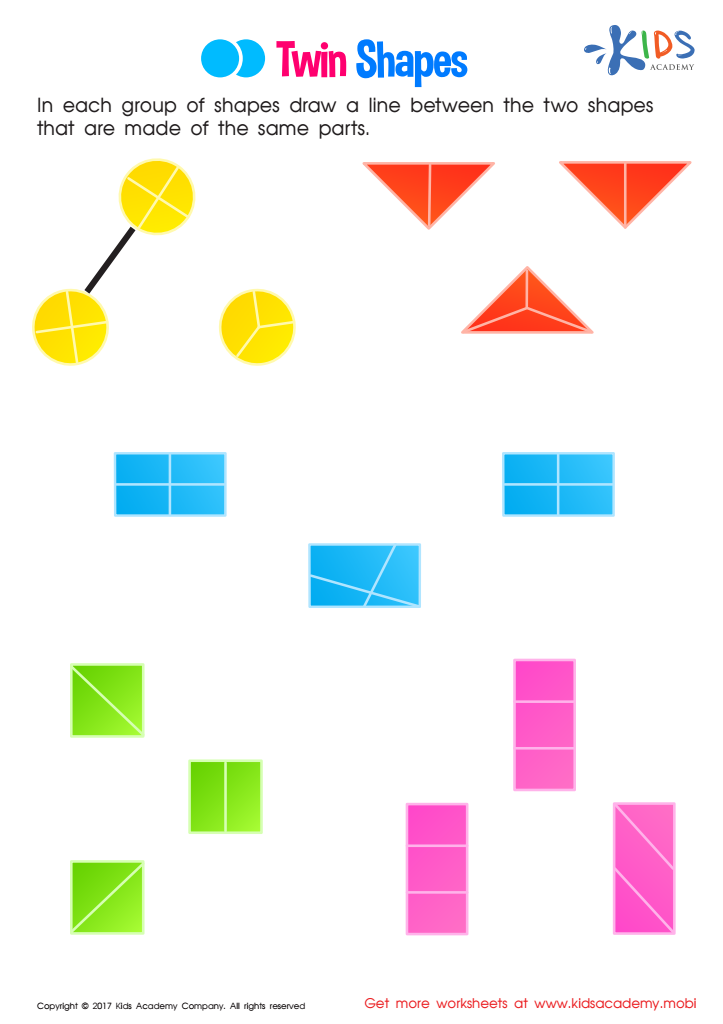
Twin Shapes Worksheet
Your students' goal in this worksheet is to find the twin shapes: drawing a line between two shapes made of the same parts. Likely, the first shapes encountered were circles, triangles, rectangles and squares - examples of which are seen frequently in everyday life. Encourage them to apply what they know and work out which is the twin shape!
 Assign to My Students
Twin Shapes Worksheet
Worksheet
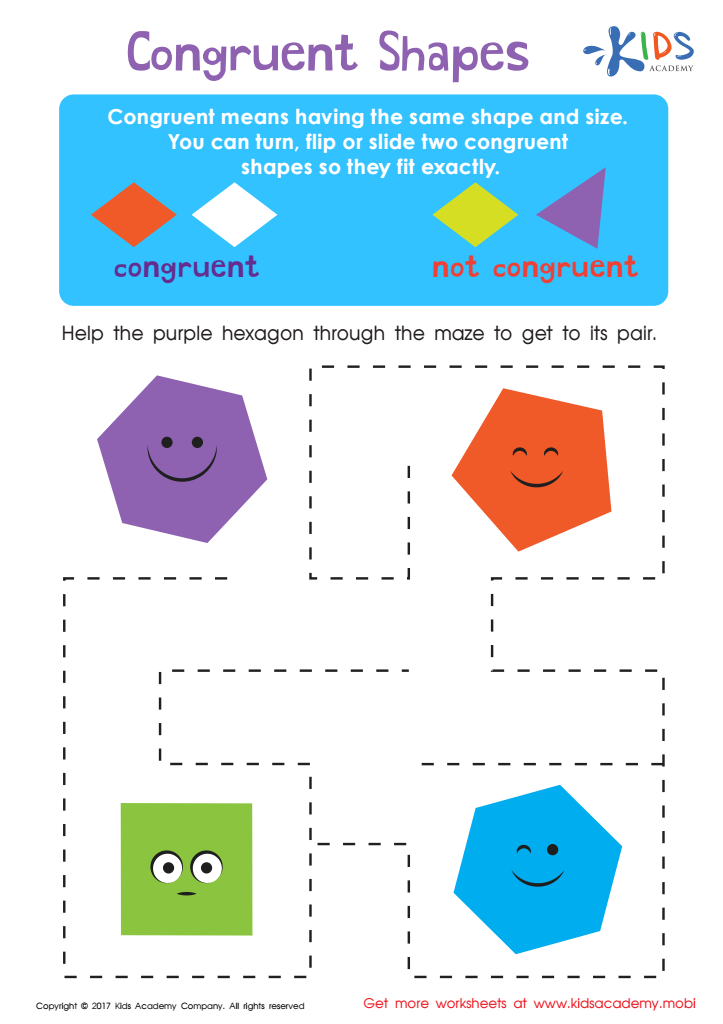
Congruent Shapes Worksheet
Help your child find the twin of the purple hexagon! This congruent shapes worksheet is great for increasing vocabulary while challenging mental rotation skills.
Congruent Shapes Worksheet
Worksheet
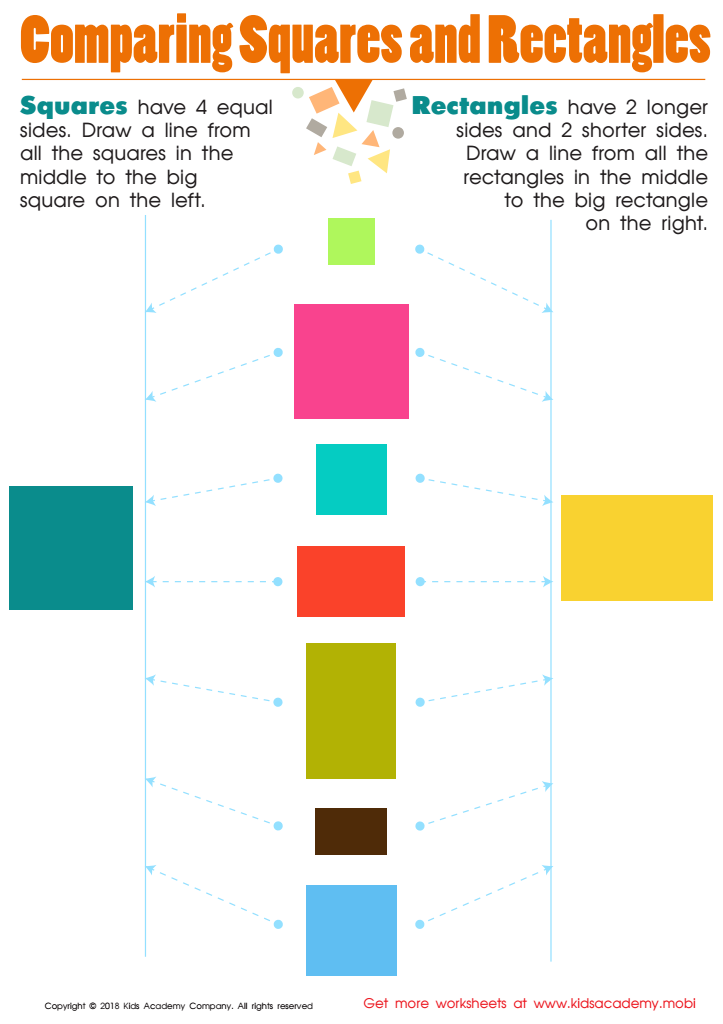
Comparing Squares Rectangles Worksheet
Help your little learner distinguish rectangles from squares with this fun geometry worksheet from Kids Academy! Read the definitions at the top, use the shapes on either side as a guide, then trace over the dotted line to match the rectangles and squares!
Comparing Squares Rectangles Worksheet
Worksheet
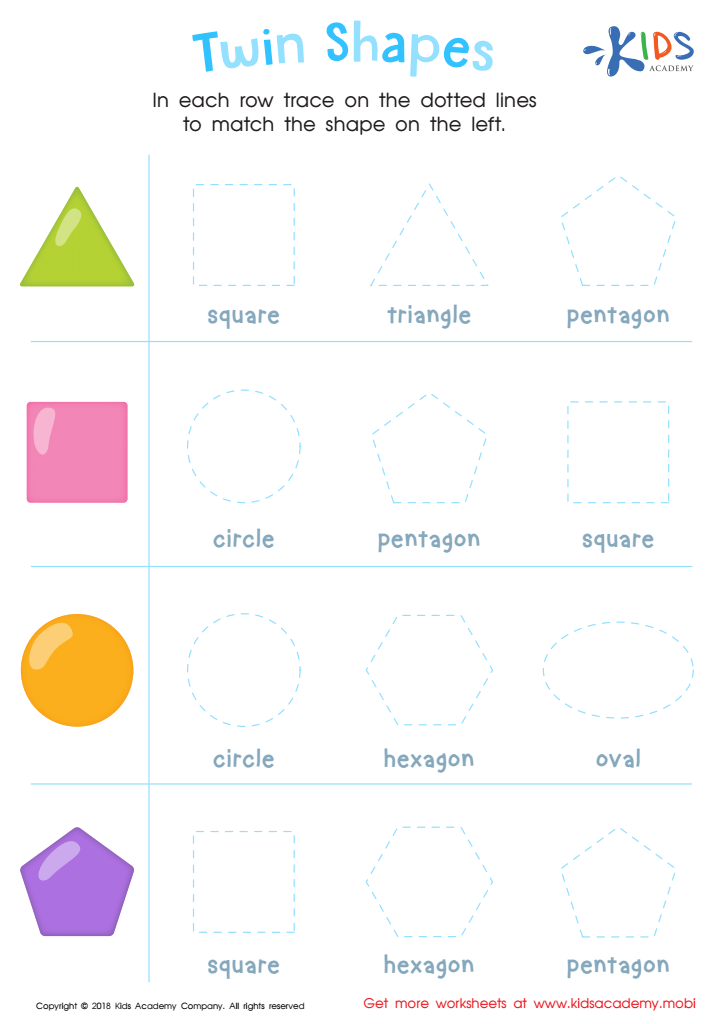
Twin Shapes Dot-to-Dot Worksheet
Test your child's ability to copy with this worksheet. Ask them to find and name the four shapes on the left. Then, they must match each with the dotted lines on the right. Help your child with all four shapes in this fun exercise.
Twin Shapes Dot-to-Dot Worksheet
Worksheet
Join Kids Academy for Free
Who is primarily going to use this learning content?







Comparing shapes is a foundational math skill vital for children ages 4-7 as it establishes the groundwork for higher-level mathematical thinking and spatial awareness. When parents and teachers emphasize comparing shapes, children learn to observe, differentiate, and categorize visual information, which fosters cognitive development.
Understanding shapes and their properties enhances problem-solving skills, as recognizing patterns and forms is crucial in both mathematics and daily life. Through comparing shapes, children also develop language skills, employing terms like "circle," "square," "larger," "smaller," "sides," and "corners," which enriches their vocabulary and communication abilities.
Moreover, activities involving shape comparison inherently involve concepts of geometry, measurement, and data analysis. For instance, sorting objects by shapes lays the foundation for understanding graphs and charts in future education. Recognizing shapes within various contexts helps children apply mathematical concepts to real-world scenarios, from understanding layouts and map reading to engaging in art and design.
Finally, these activities promote critical thinking and attention to detail, key skills for academic achievement across subjects. By prioritizing shape comparison in early childhood, parents and teachers equip children with essential tools for success in a variety of future learning situations, nurturing a positive attitude towards mathematics and boosting overall school readiness.








