
Time recognition Math Worksheets for Ages 4-7
6 filtered results
Difficulty Level
Grade
Age
-
From - To
Subject
Activity
Standards
Discover our engaging "Time Recognition Math Worksheets for Ages 4-7," designed to make learning to tell time fun and interactive for young learners. Perfect for preschoolers and early elementary students, these worksheets feature colorful clocks, relatable scenarios, and simple exercises that build foundational time-telling skills. Our activities cover everything from recognizing hours and minutes to understanding daily routines, boosting both confidence and competence in reading analog and digital clocks. With age-appropriate challenges and clear instructions, these printables are ideal for home or classroom use, ensuring that your child enjoys mastering the essential skill of telling time.
Favorites
With answer key
Interactive
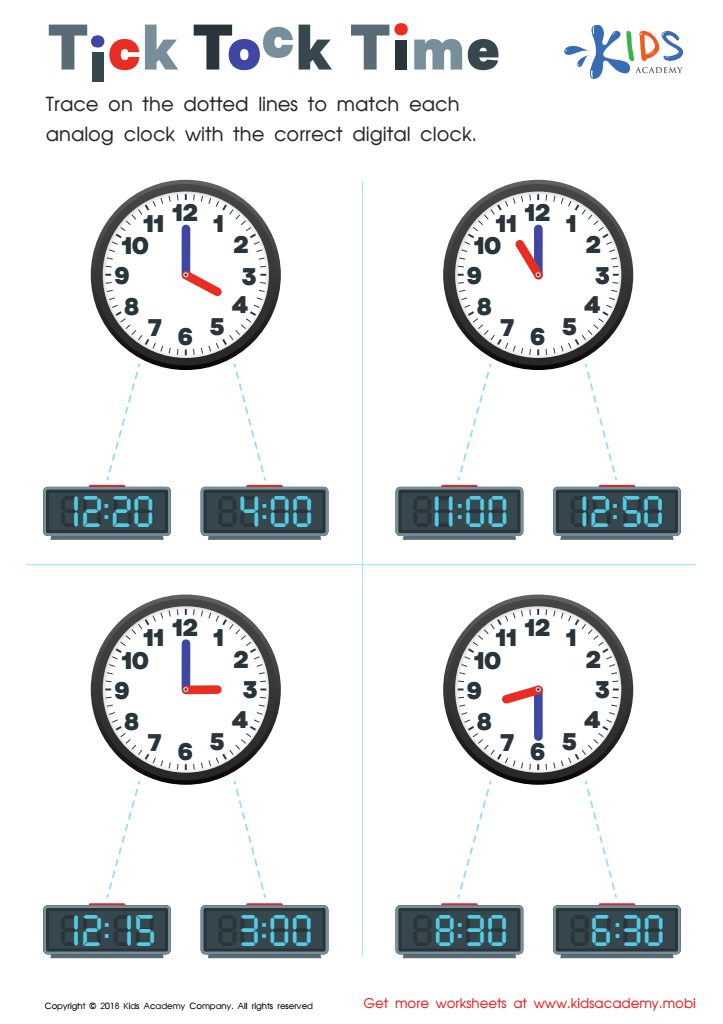
Tick Tock Time Worksheet
Trace the dotted lines on this worksheet to match analog and digital clocks! It's a great way to help your kids learn time-telling. They'll get better at converting analog to digital, and vice versa. Get your children to try it - it's a fun way to practice!
 Assign to My Students
Tick Tock Time Worksheet
Worksheet
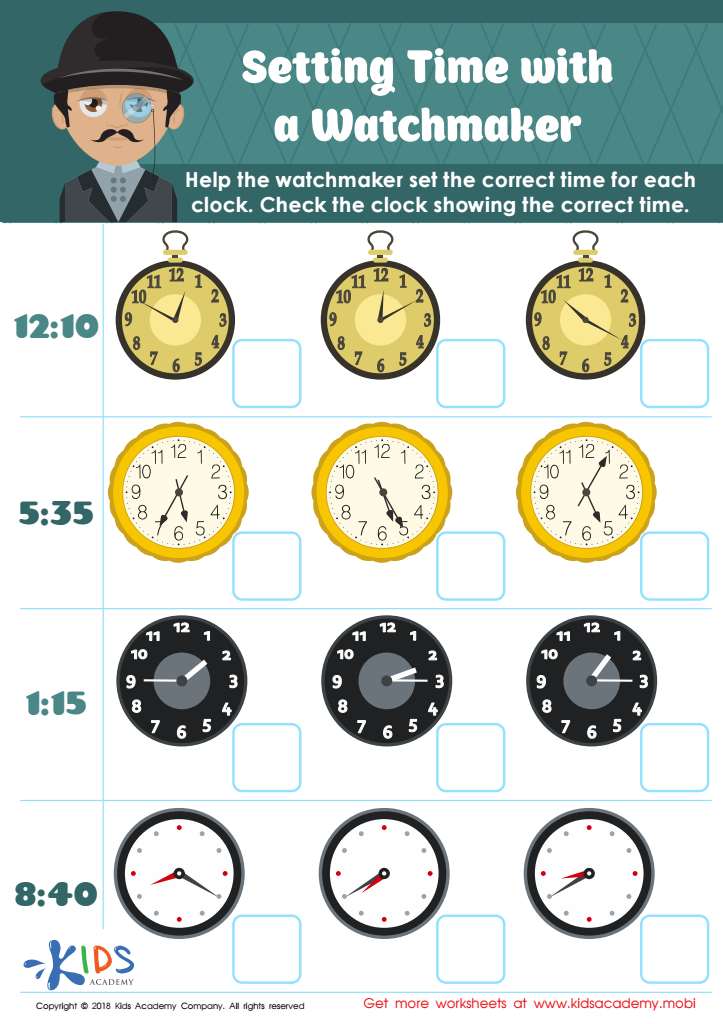
Setting Time with Watchmaker Worksheet
Can your kids tell the time? If so, this worksheet should be easy. Help them set the time for each clock: look at the time written on the left side and find the clock on the right side that matches.
Setting Time with Watchmaker Worksheet
Worksheet
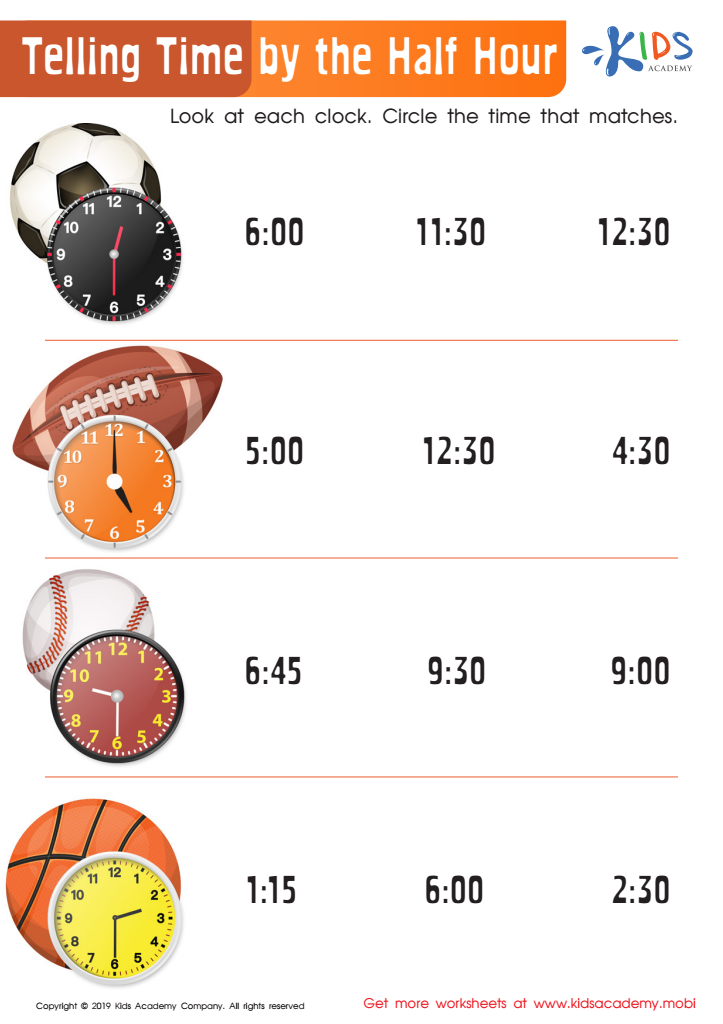
Telling Time by the Half Hour Worksheet
Teach kids to tell time with this worksheet! Four clocks are labeled with different times; help your child circle the right one. It's a great way to teach them to read analog and digital clocks, watches, and written times. Easy and fun learning!
Telling Time by the Half Hour Worksheet
Worksheet
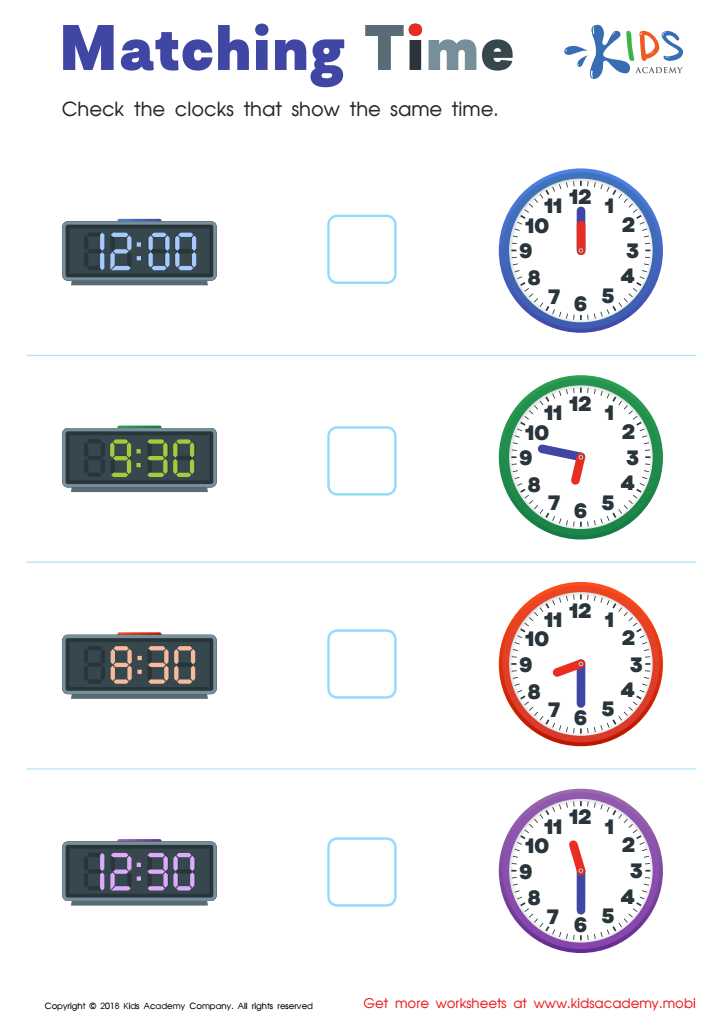
Matching Time Worksheet
Teach your child to read time in both digital and analog formats with this helpful printout. They'll identify clocks that match in both formats and check them off. Colorful and engaging, it's a great way to help your child understand the concept of time-telling.
Matching Time Worksheet
Worksheet
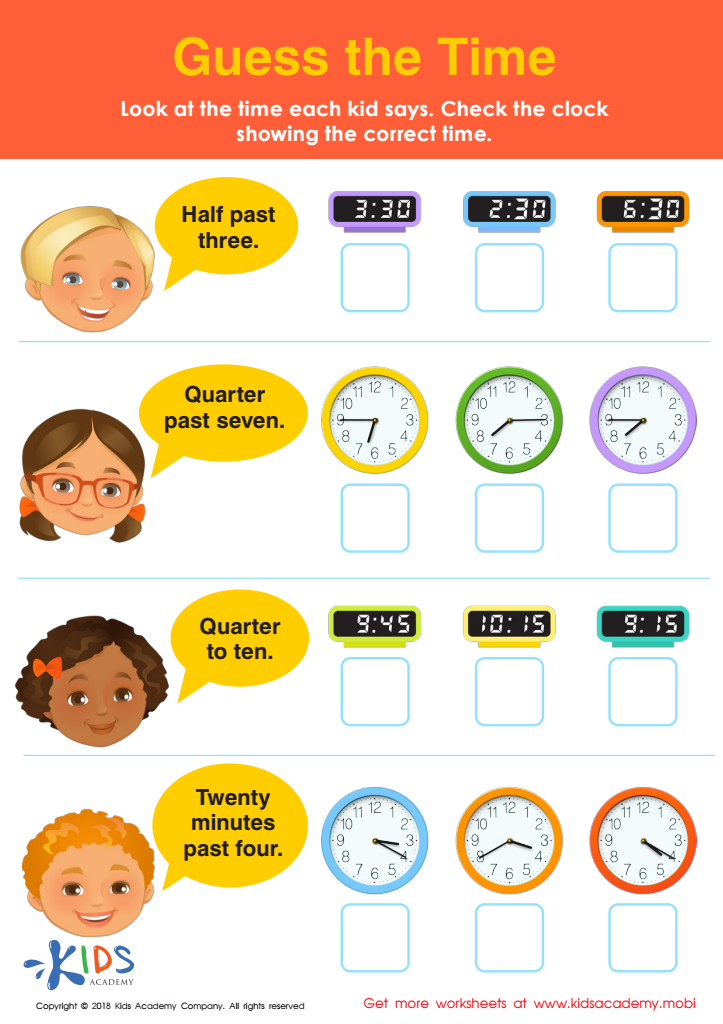
Guess the Time Worksheet
Help students tell the time accurately with this fun exercise. Read the time each person says and find the corresponding clock. Check the options on the left and have students guess the right time. This worksheet is sure to sharpen their time-telling skills.
Guess the Time Worksheet
Worksheet
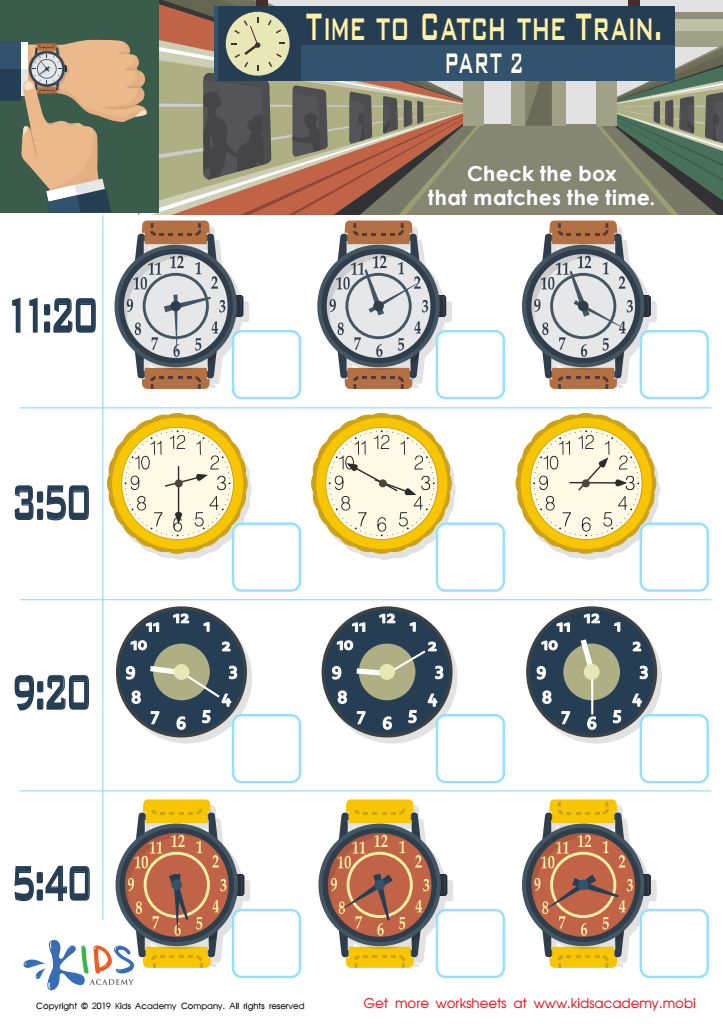
Time to Catch the Train Part 2 Worksheet
Teach your kids the importance of telling time and how to do it. Explain that there are multiple ways to show the time, such as written on the left side or watches in the picture. Guide them to check the box that matches the time. Knowing the time is essential to get things done and create order. Ensure your kids understand this and they will reap the benefits.
Time to Catch the Train Part 2 Worksheet
Worksheet
Join Kids Academy for Free
Who is primarily going to use this learning content?






First and foremost, time recognition skills are pivotal for young children's cognitive and practical development. Children ages 4-7 are at a critical stage in their learning journey where foundational concepts are established. By understanding how to read a clock and interpret time, they develop a sense of sequence, routine, and structure, which is essential for their daily activities.
Math-related time recognition also strengthens logical thinking and numerical skills. Recognizing hours and minutes requires children to practice counting by fives, understand number sequencing, and grasp the concept of time intervals, all of which are foundational mathematical skills. These concepts parallel early arithmetic skills and problem-solving abilities, laying the groundwork for more advanced math learning.
Moreover, time-telling ability cultivates independence and responsibility. Knowing how to read time enables children to manage their own schedules, understand the concept of deadlines, and adhere to daily routines like bedtime and mealtime. This fosters a sense of autonomy and competence as they learn to navigate their environment.
Additionally, teaching time through clocks and schedules makes learning interactive and practical. Many children are visual and kinetic learners, so handling an analog clock's moving parts or following a daily timeline can make abstract concepts more tangible.
Overall, prioritizing time recognition in early childhood math enriches both educational and personal development, offering long-lasting benefits that extend beyond the classroom.








