Boost critical thinking Worksheets for Ages 4-8
5 filtered results
-
From - To
Discover our engaging "Boost Critical Thinking Worksheets" designed specifically for children aged 4-8. These thoughtfully crafted worksheets challenge young learners to enhance their analytical and problem-solving skills through fun activities. Explore a variety of topics, including shape recognition, pattern identification, and simple logic puzzles that inspire creativity while promoting cognitive development. Our resources support early childhood education by fostering curiosity and independent thinking, ideal for both at-home learning and classroom environments. Encourage your child’s critical thinking abilities and set the foundation for lifelong learning with our interactive worksheets that captivate their imagination and ignite their love of learning!

 Assign to My Students
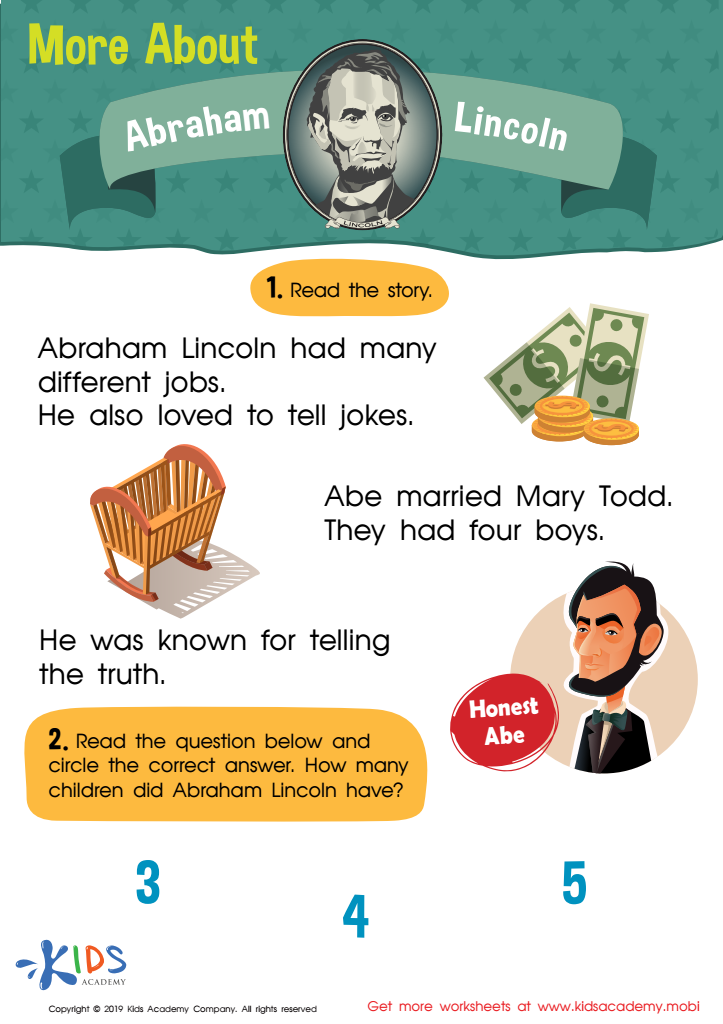
More About Abraham Lincoln Worksheet







Boosting critical thinking skills in children aged 4-8 is essential for their cognitive development and future success. At this early age, children are naturally curious and eager to explore the world around them. Encouraging critical thinking nurtures this curiosity, allowing them to ask questions, explore relationships, and solve problems independently.
First, critical thinking fosters creativity. When children learn to think critically, they experiment with different solutions and express their ideas freely. This creativity can lead to innovation in their future academic and professional endeavors. Second, critical thinking enhances decision-making skills. By evaluating options and outcomes, children become adept at making informed choices, which is crucial in our complex world.
Moreover, critical thinking aids in social and emotional development. It empowers children to understand different perspectives, fostering empathy and collaboration. Teachers and parents play a vital role in this development by providing an environment where questioning is encouraged, and exploration is valued. Engaging children in discussions, offering opportunities for hands-on learning, and presenting real-life problems cultivates their analytical skills.
In summary, enhancing critical thinking in young children equips them with tools that will serve them throughout life, shaping them into independent thinkers and confident problem solvers.








