
Enhance fine motor skills Worksheets for Ages 4-8
6 filtered results
Difficulty Level
Grade
Age
-
From - To
Subject
Activity
Standards
Discover our engaging "Enhance Fine Motor Skills Worksheets" designed for children ages 4-8. These worksheets offer fun and interactive activities that help young learners develop essential fine motor skills through tracing, cutting, and coloring exercises. Perfect for early educators and parents, our resources promote hand-eye coordination, dexterity, and control, ensuring a strong foundation for future writing and self-help tasks. Each worksheet is carefully crafted to keep children entertained while honing their skills. Explore our collection today to support your child’s growth and confidence in fine motor abilities, setting them up for success in their educational journey!
Favorites
With answer key
Interactive
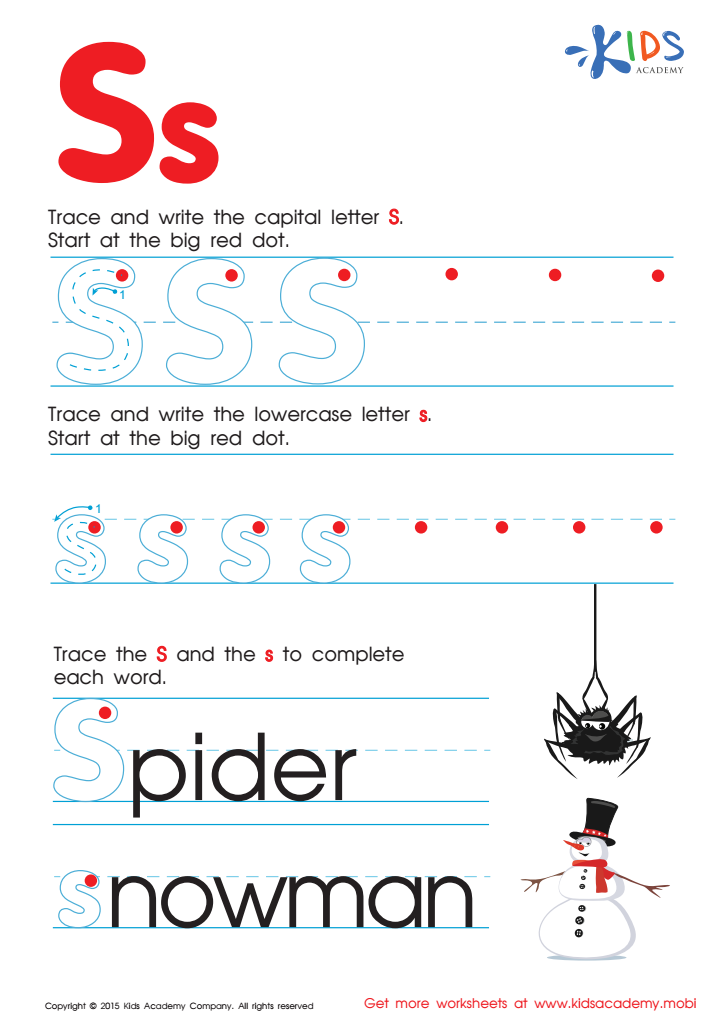
Letter S Tracing Page
Trace and write the capital and lowercase "S" on this ABC worksheet for kindergarten. Start with the big red dot and be careful. When you finish, help the spider and snowman in the pictures restore their words with the capital and lowercase letters. Continue learning the alphabet with Kids Academy.
 Assign to My Students
Letter S Tracing Page
Worksheet

Join Kids Academy for Free
Who is primarily going to use this learning content?








Enhancing fine motor skills in children aged 4-8 is crucial for their overall development and academic success. Fine motor skills involve the coordination of small muscles in the hands and fingers, which are essential for tasks such as writing, cutting, and buttoning clothing. For parents and teachers, fostering these skills not only aids in the development of dexterity but also builds the foundation for greater independence in daily activities.
Kids with strong fine motor skills are better equipped to handle classroom tasks, which boosts their confidence and engagement in learning. Improved fine motor abilities facilitate smoother transitions to more complex tasks, enabling children to master writing, art projects, and practical life skills. Furthermore, engaging in fine motor activities can provide important sensory experiences that stimulate cognitive growth, creativity, and problem-solving skills.
Additionally, fine motor skill development often requires patience and concentration, important social-emotional skills that benefit teamwork and peer interactions. Given the digital age we live in, developing these skills is critical in striking a balance between technology use and traditional hands-on experiences, ensuring children are well-prepared to navigate both worlds. Therefore, prioritizing fine motor skill activities is a valuable investment in every child's lifelong journey of learning and self-sufficiency.








