Solve word problems Worksheets for Ages 4-8
3 filtered results
-
From - To
Discover our engaging "Solve Word Problems" worksheets designed specifically for children aged 4-8. These vibrant and interactive worksheets help young learners develop critical thinking and problem-solving skills through fun, age-appropriate scenarios. Each worksheet encourages students to read, comprehend, and solve various word problems that reinforce basic math concepts, including addition, subtraction, and simple reasoning. Ideal for classroom use or at-home learning, our resources are tailored to make mastering word problems enjoyable. Equip your child with the skills they need for academic success while fostering a love for learning. Explore our collection today and watch your child's confidence and enthusiasm grow!
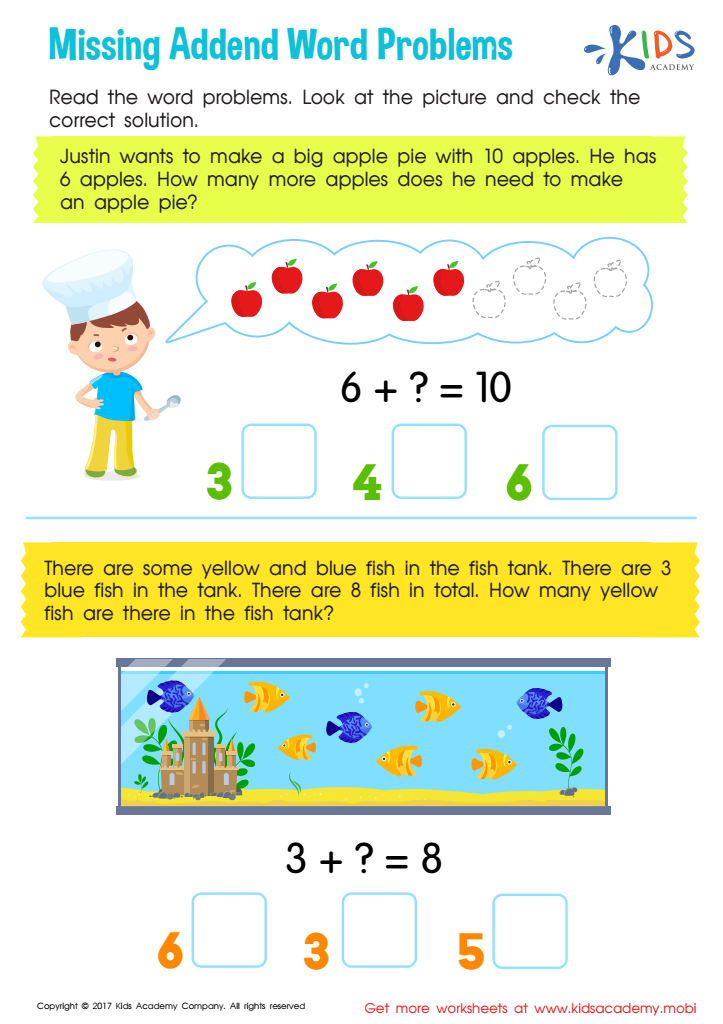
Missing Addend Word Problems Worksheet
 Assign to My Students








Parents and teachers should prioritize solving word problems for children aged 4-8 as it not only enhances mathematical skills but also lays the groundwork for critical thinking and problem-solving abilities. At this age, children are naturally curious and eager to understand how the world works. Word problems encourage them to apply mathematical concepts to real-life situations, making math more relatable and engaging.
By working through word problems, children learn to decipher language, identify key details, and formulate mathematical representations of situations. This process boosts their comprehension skills, as they practice translating words into numbers and operations. Furthermore, solving word problems nurtures socio-emotional skills by teaching perseverance, patience, and the importance of making mistakes as part of the learning journey.
Encouraging this kind of thinking at an early age prepares children for more complex mathematical concepts in the future and fosters a positive attitude toward math. Ultimately, by focusing on word problems, parents and teachers help children build a strong foundation not only in math but also in critical life skills that extend beyond the classroom. Investing time in these activities is essential for promoting overall cognitive development in young learners.








