Sorting and categorizing Worksheets for Ages 4-8
3 filtered results
-
From - To
Explore our engaging "Sorting and Categorizing Worksheets" for ages 4-8, designed to enhance children’s critical thinking and organizational skills. These worksheets encourage young learners to group items based on various attributes such as color, size, shape, or category. Fun and interactive activities make learning enjoyable as kids develop their ability to notice similarities and differences. Perfect for teachers and parents, these printable resources effectively support early childhood education, promoting essential cognitive skills. Boost your child's learning journey with our thoughtfully crafted worksheets that inspire creativity and logical reasoning while fostering a strong foundation for future academic success.
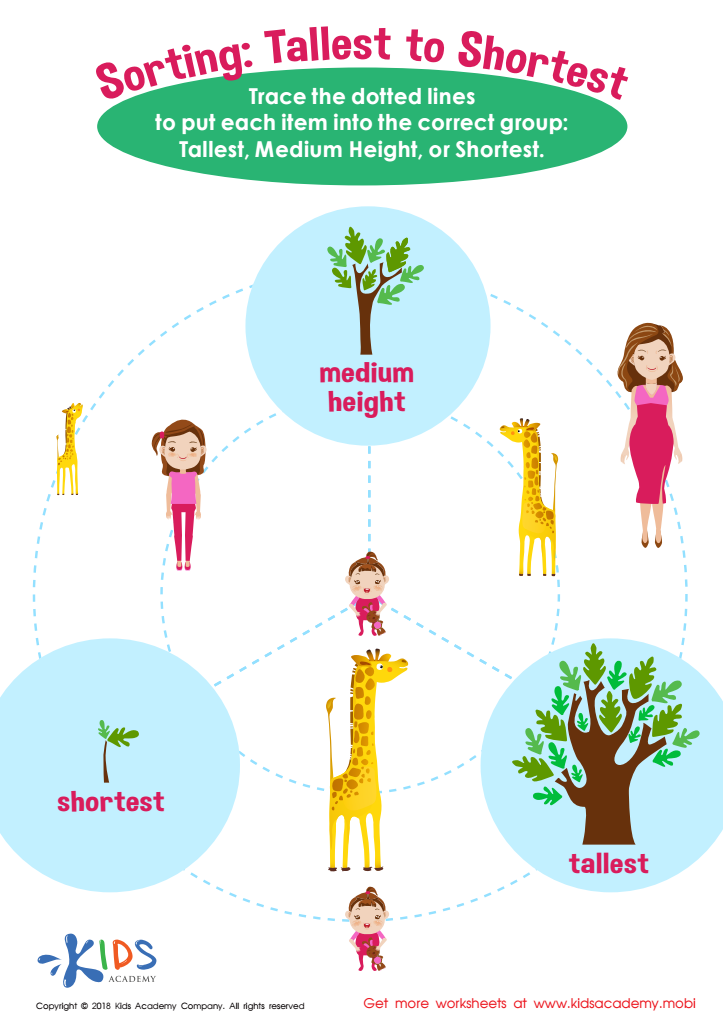
Sorting: Tallest to Shortest Worksheet
 Assign to My Students





Sorting and categorizing are essential skills crucial for children's cognitive development between ages 4-8. During this stage, children are naturally curious and eager to make sense of the world around them. When parents and teachers promote sorting and categorizing activities, they help children learn how to identify similarities and differences among objects, fostering critical thinking and analytical skills.
These skills not only build a foundation for broader mathematical concepts, such as classification and sets, but also enhance vocabulary development as children learn to describe properties, like color, size, or shape. Engaging in sorting activities improves observational skills, encourages attention to detail, and promotes organizational abilities.
Moreover, sorting fosters collaboration and communication skills as children often engage in group activities that require discussion and teamwork to categorize items effectively. This social interaction is vital for developing interpersonal skills.
Ultimately, when parents and teachers prioritize sorting and categorizing, they are equipping children with lifelong learning skills. These activities instill a sense of structure and order, making transitions to more complex subjects smoother as children progress in their education. Therefore, fostering these abilities should be a central component in early childhood education.








