Vocabulary Building Addition & Subtraction Worksheets for Ages 4-8
6 filtered results
-
From - To
Discover our engaging Vocabulary Building Addition and Subtraction Worksheets designed exclusively for children ages 4-8! These worksheets combine foundational math skills with vocabulary enhancement, promoting both numerical understanding and language development. Each activity encourages young learners to master basic addition and subtraction concepts while expanding their word knowledge and comprehension. Tailored for early education, our fun-filled worksheets feature colorful illustrations and interactive problems that keep kids motivated and excited about learning. Perfect for home or classroom use, these resources will help your child improve their math skills while fostering a love for words. Start enhancing learning today with our exciting worksheets!
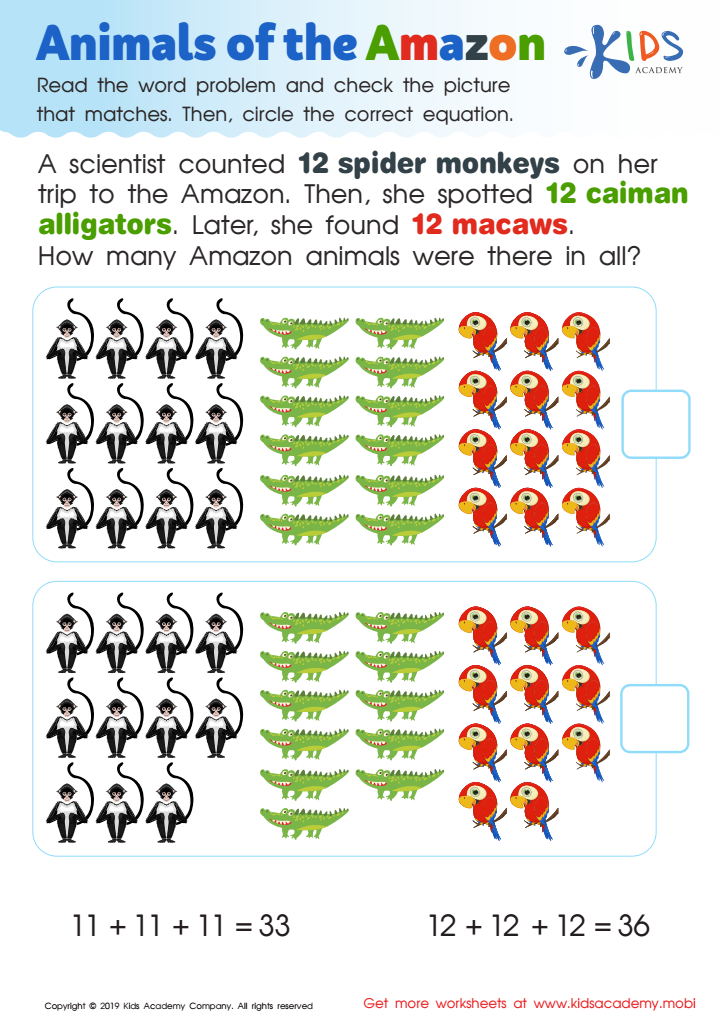
Animals of Amazon Worksheet
 Assign to My Students








Vocabulary building in addition and subtraction for ages 4-8 is crucial for several reasons. At this age, children are developing foundational math skills that are strongly linked to their language abilities. When kids learn mathematical terms such as "sum," "difference," "add," and "subtract," they gain more than just numeracy skills; they also enhance their comprehension and communication.
Understanding vocabulary related to mathematical concepts allows children to grasp problem-solving techniques and aids in their ability to express mathematical ideas clearly. For instance, when children use terms like "more than" or "less than," they can better articulate their thoughts and reasoning while solving problems. This fosters critical thinking and lays the groundwork for more complex mathematical understanding later on.
Moreover, building a rich vocabulary can boost confidence. Children who feel comfortable using mathematical language are more likely to engage in discussions and ask questions, leading to deeper learning experiences. Parents and teachers who prioritize this vocabulary-building approach ensure their students develop not only math skills but also the crucial language skills that support overall academic success. Thus, investing time in vocabulary development during these years ultimately transforms both math and reading competencies, paving the way for lifelong learning.








