
Fine motor skills development Numbers Worksheets for Ages 4-8
3 filtered results
Difficulty Level
Grade
Age
-
From - To
Subject
Activity
Standards
Enhance your child's fine motor skills while they learn numbers with our engaging worksheets designed specifically for ages 4-8. These printable activities seamlessly blend learning and fun, allowing young learners to practice counting, tracing, and number recognition. Each worksheet is thoughtfully crafted to improve hand-eye coordination, dexterity, and control, essential skills for early writing and drawing. With vibrant illustrations and interactive tasks, your child will stay motivated and excited to explore the world of numbers. Download our fine motor skills development worksheets today and support your child's educational journey while fostering their creativity and confidence!
Favorites
With answer key
Interactive
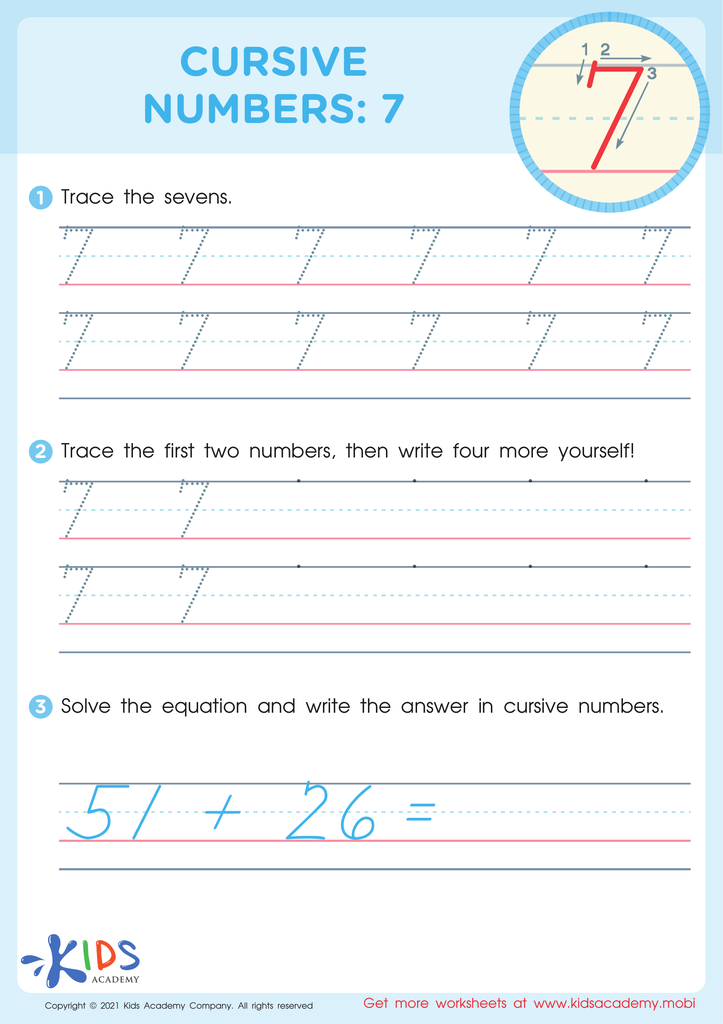
Cursive Numbers: 7 Worksheet
Kids learn best with engaging and easy-to-understand materials. This tracing worksheet is ideal for developing kids' writing skills, with two exercises to help them write the number 7. The first involves tracing the 6s provided and the second asking them to write four cursive 7s independently.
Cursive Numbers: 7 Worksheet
Worksheet
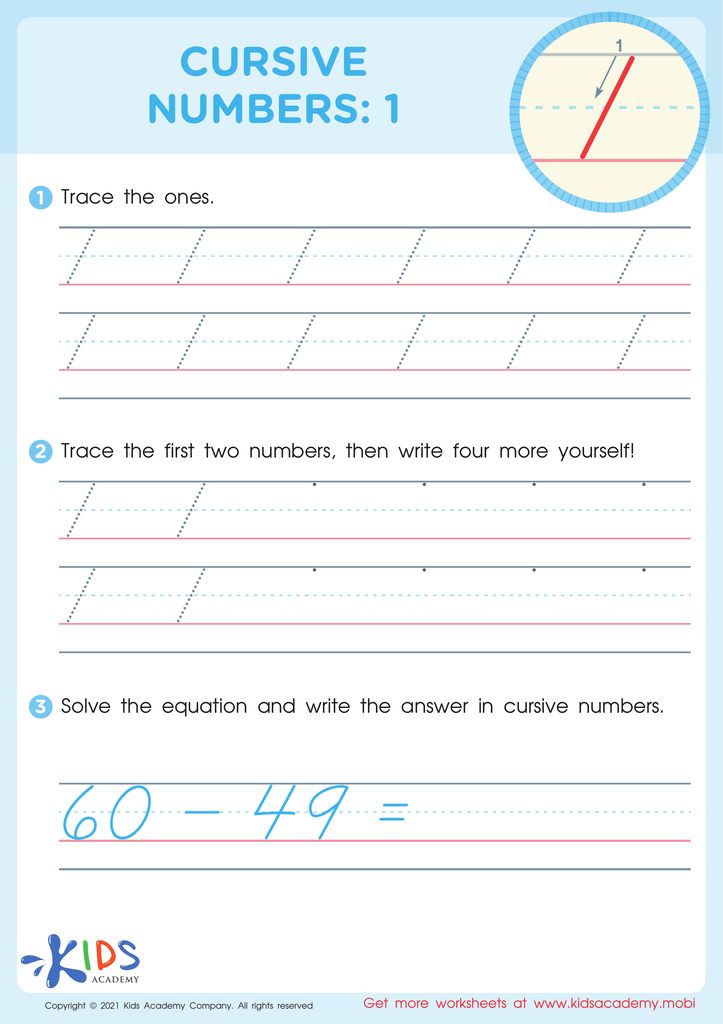
Cursive Numbers: 1 Worksheet
Math and handwriting are connected! Try these traceable worksheets to help your children learn cursive numbers. The tracing lines make it easy to follow, plus there's a simple subtraction exercise at the bottom for them to try. This is perfect for kids who struggle with handwriting and gives them a fun way to practice.
Cursive Numbers: 1 Worksheet
Worksheet
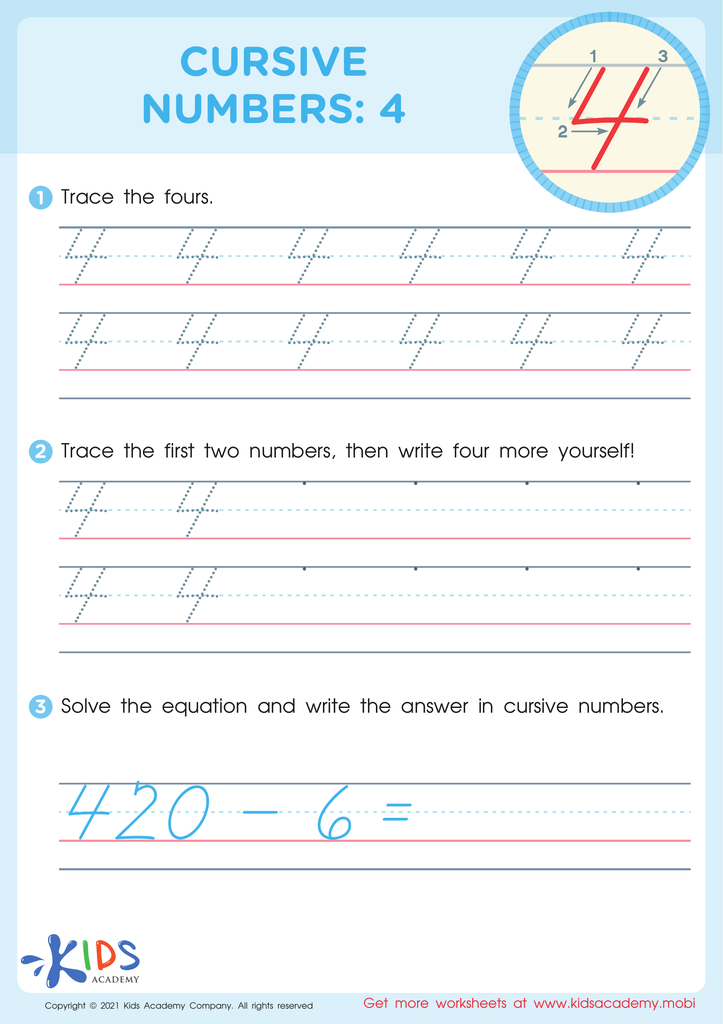
Cursive Numbers: 4 Worksheet
Math is challenging, and teaching cursive alongside it can be overwhelming. Make lessons enjoyable and your child will be more likely to stay engaged. Utilize worksheets to practice tracing the number 4 in cursive. With regular practice, your child can learn to write the number on their own.
Cursive Numbers: 4 Worksheet
Worksheet
Join Kids Academy for Free
Who is primarily going to use this learning content?








Fine motor skills are crucial for children aged 4-8, laying the foundation for their overall development and lifelong learning. These skills involve the coordination of small muscles in movements typically involving the hands and fingers, which are essential for numerous everyday tasks. For parents and teachers, fostering fine motor skills in young children helps in their academic readiness and overall growth.
Firstly, fine motor skills impact children’s ability to perform tasks that are vital for independence, such as buttoning shirts, tying shoelaces, and using utensils effectively. Additionally, high levels of fine motor coordination enhance performance in writing and drawing, leading to improved academic abilities in literacy and mathematics.
Secondly, fine motor development evokes self-esteem and confidence. Children with strong motor skills may participate more actively in classroom and social activities, reducing frustration and anxiety.
Moreover, the cultivation of these skills encourages cognitive processes, such as problem-solving and creativity, which are essential for future learning. Educational activities that promote fine motor skills—like cutting, coloring, and crafting—also enhance focus and attention spans.
By prioritizing fine motor skill development, parents and teachers significantly contribute to a child’s ability to learn, socialize, and thrive in various environments.








