
Math problem-solving Reading Worksheets for Ages 4-8
7 filtered results
Difficulty Level
Grade
Age
-
From - To
Subject
Activity
Standards
Explore our engaging Math Problem-Solving Reading Worksheets for children ages 4-8! Designed to foster critical thinking and enhance math skills, these worksheets combine reading comprehension with practical problem-solving activities. As young learners navigate fun scenarios, they will develop essential math concepts through hands-on practice. Our resources cater to various skill levels and are perfect for classroom use or at-home learning. Each worksheet encourages logical reasoning and helps children learn to interpret mathematical problems in a narrative form. Boost your child’s confidence and ability in math while making learning enjoyable! Download your worksheets today and watch them thrive!
Favorites
With answer key
Interactive
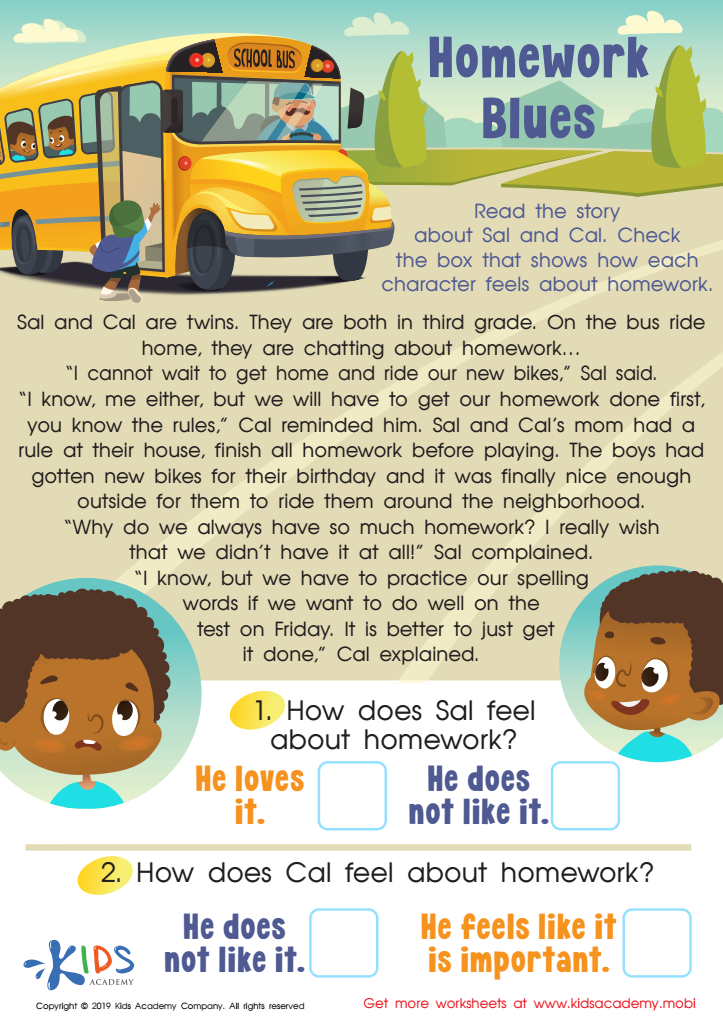
Homework Blues Worksheet
Cal and Sal don't love doing homework, just like your kids. Use this worksheet to help your children understand why homework is important. Read the passage together and then answer the questions at the bottom of the page. It's a fun way to learn together!
 Assign to My Students
Homework Blues Worksheet
Worksheet
Join Kids Academy for Free
Who is primarily going to use this learning content?








Math problem-solving reading for ages 4-8 is crucial for early childhood development and lays the foundation for future academic success. During these formative years, children develop critical thinking and reasoning skills essential for tackling real-world challenges. Parents and teachers should care about this age group's comprehension of math problem-solving because it enhances not only math literacy but also boosts reading skills simultaneously.
Engaging children in math through stories and problems stimulates curiosity and nurtures their ability to understand complex concepts. When children interpret math-related narratives, they learn to break down problems, analyze information, and formulate logical solutions, fostering resilience and perseverance. Moreover, math problem-solving reading cultivates a positive attitude towards both subjects, demystifying math and encouraging a love for learning.
Incorporating math into reading reinforces essential connections between numbers, operations, and real-life contexts. This multidisciplinary approach helps children practice vocabulary, enhances comprehension, and connects mathematical concepts to everyday experiences, making learning more relatable and fun. Ultimately, prioritizing math problem-solving reading enriches children's overall cognitive development, preparing them for advanced learning and equipping them with the skills needed for future challenges in academics and beyond.








