
Enhancing critical thinking Community Worksheets for Ages 4-8
3 filtered results
Difficulty Level
Grade
Age
-
From - To
Subject
Activity
Standards
Unlock the power of young minds with our "Enhancing Critical Thinking Community Worksheets for Ages 4-8." Specially crafted to engage and challenge, these worksheets are designed to boost critical thinking skills in children within familiar community themes. Through fun activities reflecting everyday scenarios, kids practice observation, analysis, and problem-solving. Encourage your child to explore different perspectives and develop valuable reasoning skills. Our printable resources can be seamlessly integrated into both classroom and at-home learning. Empower your child’s early education journey and watch them thrive as critical thinkers equipped for a bright future. Suitable for ages 4-8.
Favorites
With answer key
Interactive
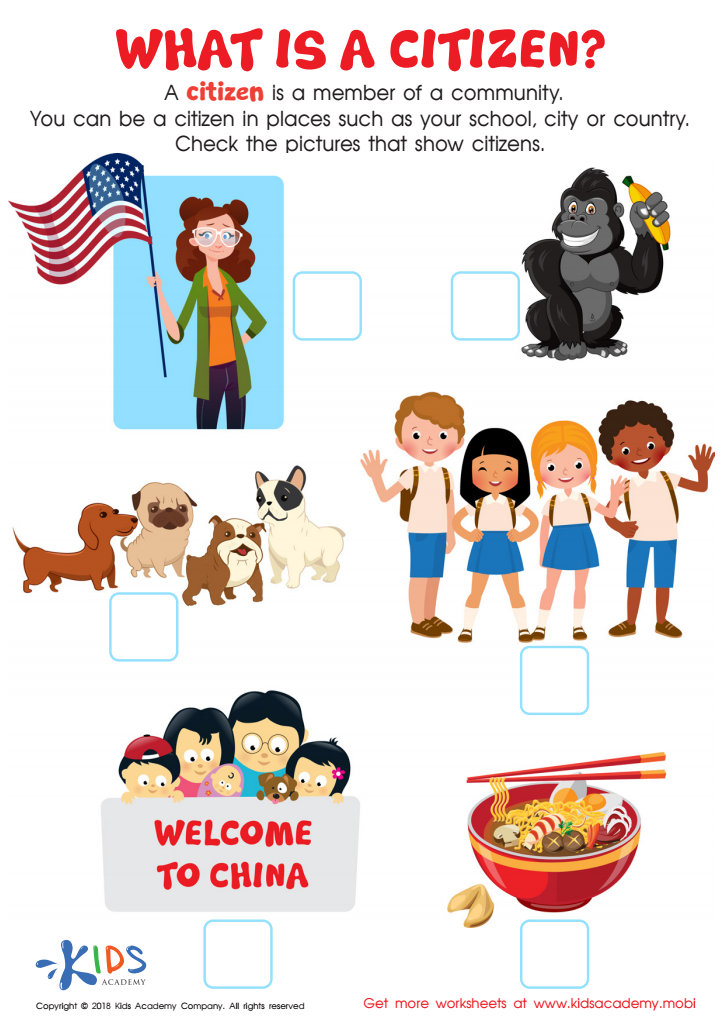
What is a Citizen? Worksheet
Do your students know who a citizen is? Use this worksheet to teach them: a citizen is a member of a community, such as your school, city or country. Look at the pictures in the pdf with your students. Ask them to identify who or what is in the pictures, and help them check which are citizens.
 Assign to My Students
What is a Citizen? Worksheet
Worksheet
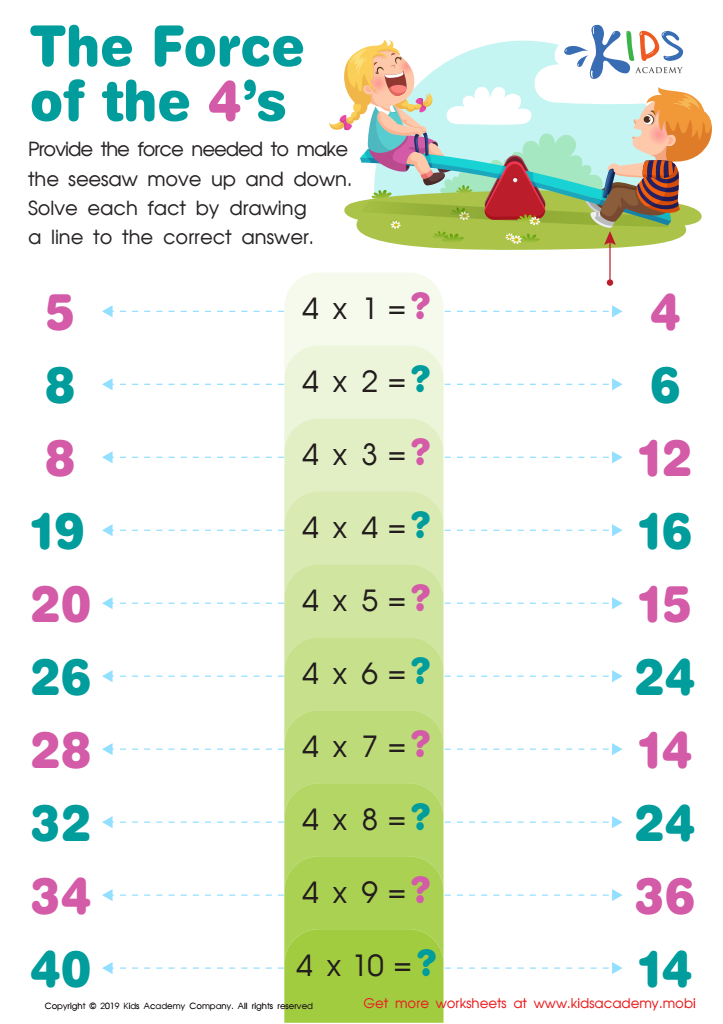
The Force of the 4's Worksheet
Ride a seesaw with your child and explore the physics behind it! Explain how it needs two people and how force makes it go up and down. Use the memories of the pleasurable experience to teach your kid a lesson in force. Show them how to solve the worksheet by drawing a line to the correct answer. This way, they'll learn the force needed for the seesaw to move.
The Force of the 4's Worksheet
Worksheet
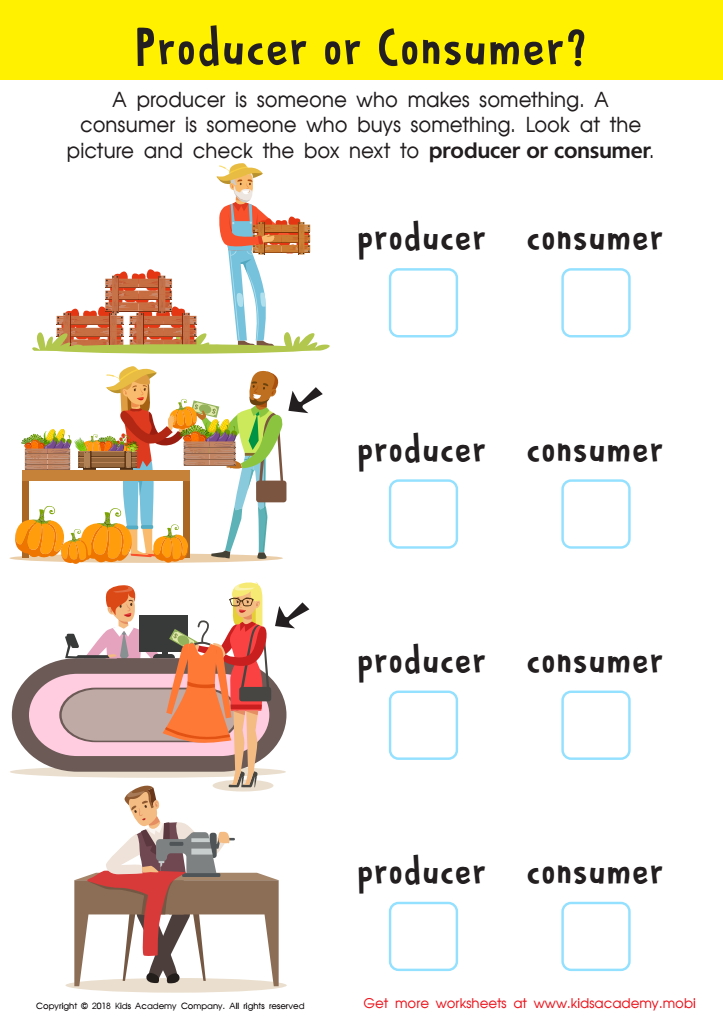
Producer or Consumer? Worksheet
Test your child's knowledge by asking who's a producer and consumer. Explain producer makes things and consumer buys them. Use a snack example. Look at the picture with your kids and help them check the box next to producer or consumer.
Producer or Consumer? Worksheet
Worksheet
Join Kids Academy for Free
Who is primarily going to use this learning content?







Parents and teachers should prioritize enhancing critical thinking in children ages 4-8 because it lays a crucial foundation for their lifelong learning and problem-solving abilities. Critical thinking encourages young minds to question, analyze, and reflect rather than passively absorb information. In early childhood, fostering these skills can help children understand cause-and-effect relationships, recognize patterns, and develop curiosity about the world around them.
Engaging children in activities that stimulate critical thinking can improve their academic performance across subjects as they are better able to understand and apply concepts. This cognitive development also promotes creativity and innovation, as children learn to think outside the box and come up with original ideas.
Furthermore, children who are trained in critical thinking from an early age are better equipped to make informed decisions and solve problems independently. These skills are not only vital for academic success but are also essential for everyday life. For instance, they learn to distinguish between reliable and unreliable information, an increasingly crucial ability in the digital age.
Building a community that emphasizes critical thinking creates a supportive environment where young children can practice these skills through interaction and collaboration with peers. It fosters a culture of learning and inquiry, setting the stage for successful educational journeys and well-rounded personal development.








