
Spatial awareness Writing Worksheets for Ages 4-8
3 filtered results
Difficulty Level
Grade
Age
-
From - To
Subject
Activity
Standards
Unlock your child's potential with our Spatial Awareness Writing Worksheets designed for ages 4-8! These engaging resources foster essential skills by combining writing practice with fun spatial awareness activities. Children will explore concepts like direction, position, and distance through colorful illustrations and interactive exercises. Our worksheets encourage creativity and critical thinking, empowering young learners to improve their coordination and understanding of their surroundings. Ideal for home or classroom use, these worksheets promote a strong foundation in spatial reasoning, enhancing overall cognitive development. Start your child’s journey to mastering spatial awareness today and watch them thrive in their learning adventures!
Favorites
With answer key
Interactive
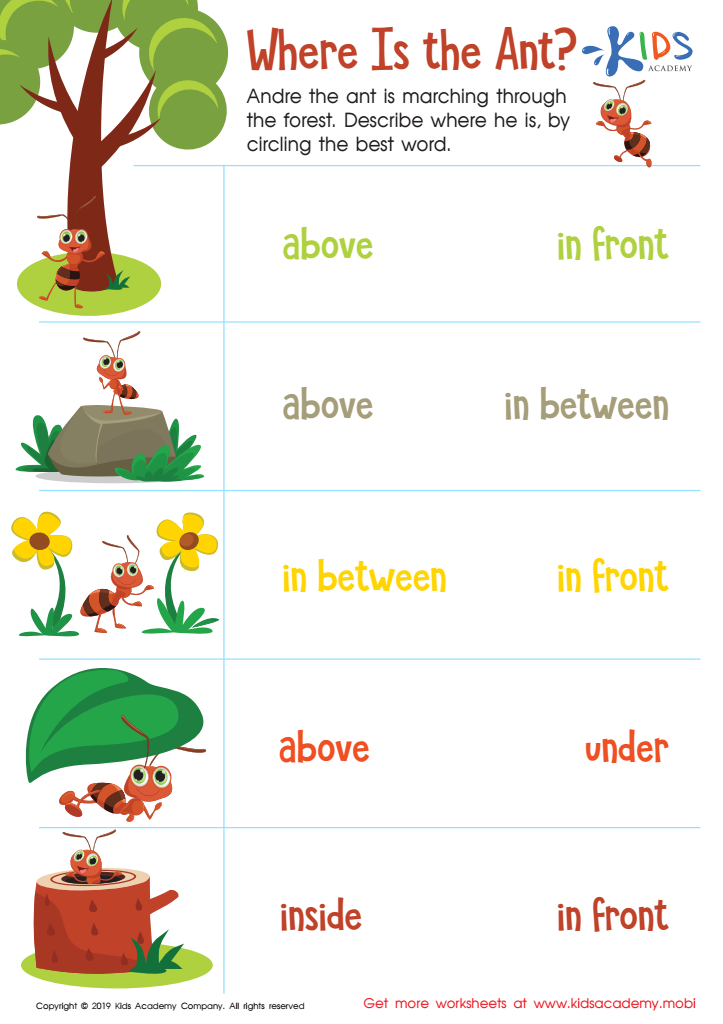
Where Is the Ant? Worksheet
Kids are captivated by ants. Andre is a busy ant, marching through the forest. Help your child circle the best word that best describes what he's doing in each picture. This colorful printout will show them the way.
 Assign to My Students
Where Is the Ant? Worksheet
Worksheet
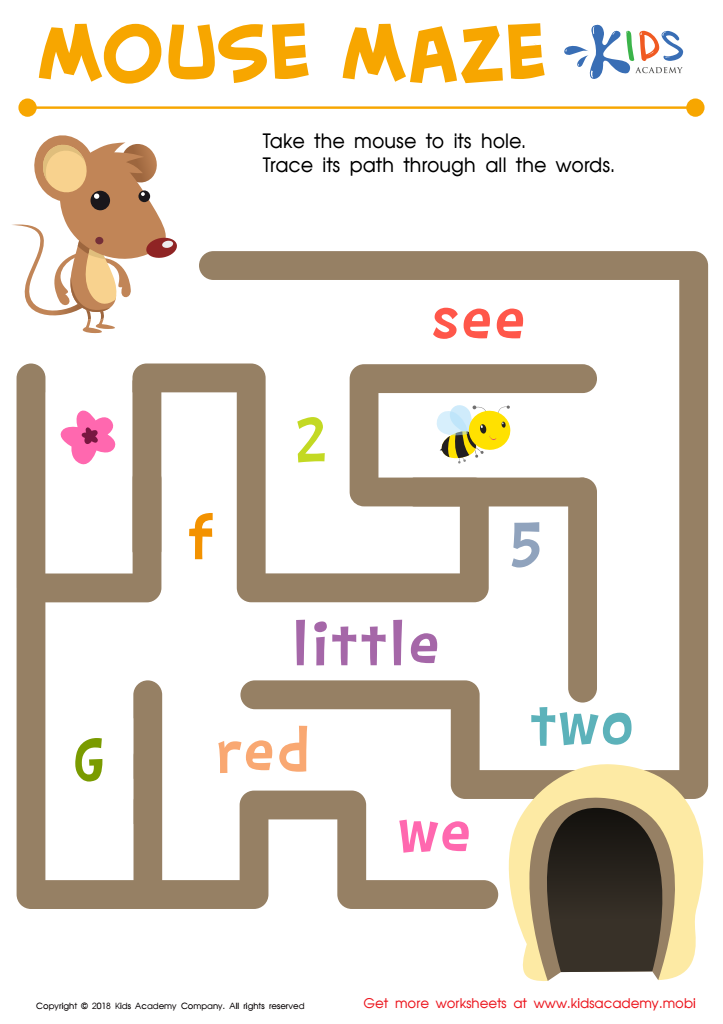
Find Words Mouse Maze Worksheet
Help your child identify words and guide the mouse home! Ask them to point out the colorful animal on the worksheet, then take their hand and show them how to trace the path, going through all the words in the maze to get the mouse back to its hole.
Find Words Mouse Maze Worksheet
Worksheet
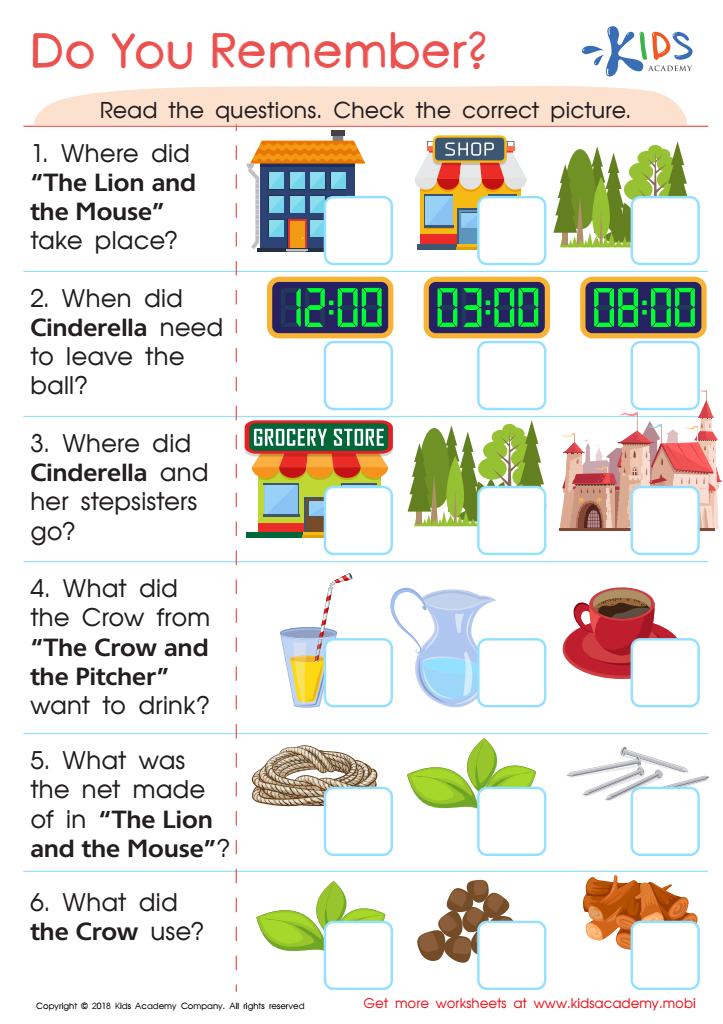
Do You Remember? Worksheet
Read "Cinderella", "The Crow and the Pitcher" and "The Lion and the Mouse" to your child. Discuss the plot and characters, and how their choices shape the story. Use this worksheet to check their comprehension and memory. Read the questions and have them select the correct picture answer.
Do You Remember? Worksheet
Worksheet
Join Kids Academy for Free
Who is primarily going to use this learning content?



.jpg)


Spatial awareness is a crucial skill that helps children understand and navigate the world around them. For parents and teachers of children aged 4 to 8, fostering this ability is essential for various reasons. Firstly, spatial awareness lays the foundation for academic success, particularly in subjects like mathematics and science. Understanding spatial relationships enhances problem-solving skills and geometrical reasoning.
Moreover, spatial awareness contributes to children's safety and mobility. Children who can gauge distances and understand their surroundings are more adept at navigating play areas and avoiding accidents, which is vital for their well-being.
In addition to academic and safety implications, spatial awareness also promotes creativity and imagination. Activities like drawing, building with blocks, or playing spatial games encourage children to visualize and manipulate objects in their minds, which can enhance their artistic skills and innovative thought processes.
Finally, supportive environments that promote spatial learning—through both structured activities and unstructured play—can lead to better social interaction and teamwork. Encouraging collaboration in spatial tasks helps develop communication and cooperation skills essential for future relationships. Thus, prioritizing spatial awareness in early childhood education is vital for holistic development and lifelong success.








