Data analysis skills Worksheets for Ages 4-9
3 filtered results
-
From - To
Enhance your child's cognitive development with our Data Analysis Skills Worksheets for Ages 4-9. Our expertly designed worksheets introduce young learners to essential data analysis concepts in an engaging and enjoyable way. These printable resources help kids to understand, interpret, and organize information through fun activities involving charts, graphs, sorting, and categorizing. Perfect for both classroom and home use, these worksheets foster critical thinking and problem-solving skills. Prepare your child for future success in math and science by developing their ability to analyze and make sense of data from an early age. Visit our site to download now.
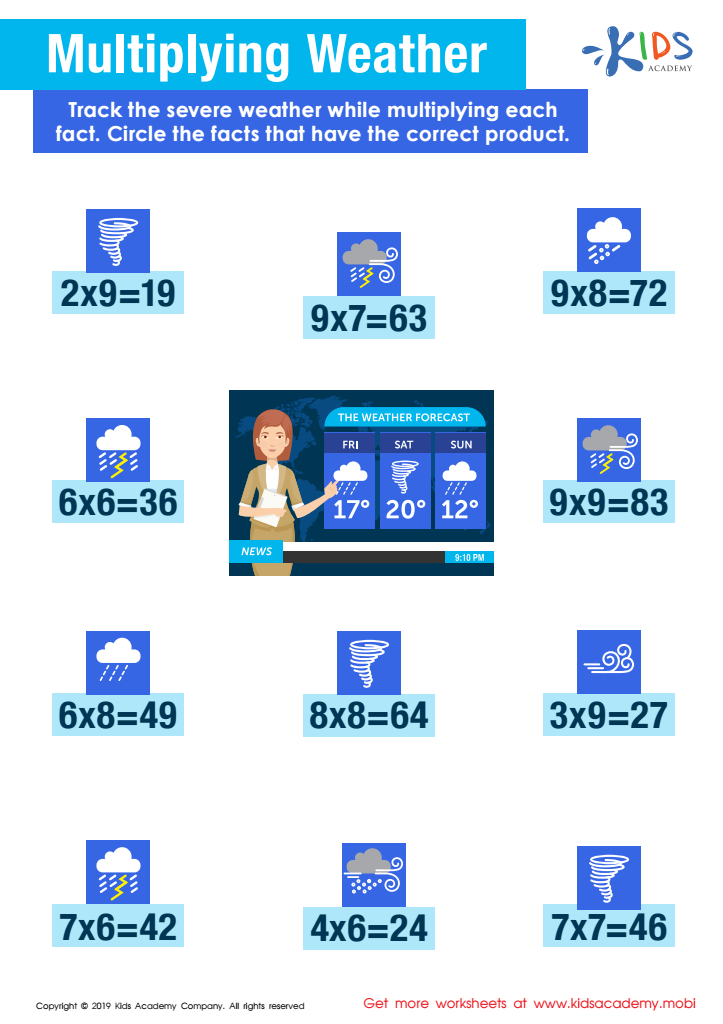
Multiplying Weather Worksheet
 Assign to My Students

Birdy Graph Matching Worksheet








Introducing data analysis skills to children aged 4-9 is essential for several key reasons. First, it lays the foundation for critical thinking, as children learn to organize and interpret information, make decisions based on data, and solve problems logically. These skills are not only crucial for academic success across subjects but mirror real-world applications, preparing them for future careers in a data-driven world.
Second, early exposure to data analysis nurtures curiosity. Children become more engaged and inquisitive, asking questions like "What happens if...?" or "Why does this occur?" Such inquiries drive deeper understanding and discovery. They also develop descriptive and inferential skills by observing patterns, making predictions, and verifying outcomes.
Third, data analysis promotes numeracy skills. As young children categorize objects, count, and compare quantities, they build a solid mathematical foundation. Learning to manage data sets, even simple ones involving everyday activities or objects, strengthens their grasp of basic arithmetic operations, measurement, and geometry.
Lastly, early data analysis activities foster collaborative learning. Group projects that involve sharing data and interpreting results encourage teamwork, communication, and social interaction. These soft skills are just as important as academic skills, contributing to overall growth and development. Thus, prioritizing data analysis from an early age sets children on a path to becoming well-rounded, analytical, and informed individuals.








