
Enhance fine motor skills Worksheets for Ages 4-9
6 filtered results
Difficulty Level
Grade
Age
-
From - To
Subject
Activity
Standards
Our "Enhance Fine Motor Skills Worksheets for Ages 4-9" offer engaging, age-appropriate activities designed to strengthen your child's dexterity, hand-eye coordination, and precision. These worksheets are perfect for young learners, blending fun with education through coloring, tracing, cutting, and other hands-on tasks. By utilizing our expertly crafted worksheets, children can develop essential fine motor skills needed for everyday tasks and academic success. Ideal for use at home or in the classroom, our worksheets make learning enjoyable and effective, fostering confidence and skill in young minds. Explore our collection today and watch your child's abilities flourish!
Favorites
With answer key
Interactive
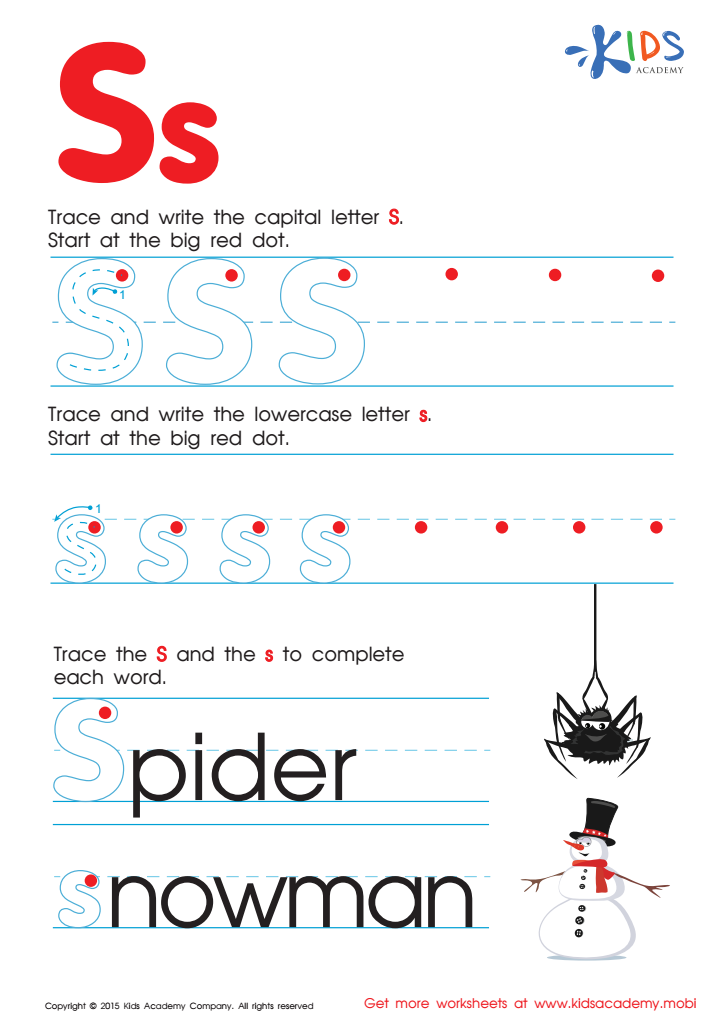
Letter S Tracing Page
Trace and write the capital and lowercase "S" on this ABC worksheet for kindergarten. Start with the big red dot and be careful. When you finish, help the spider and snowman in the pictures restore their words with the capital and lowercase letters. Continue learning the alphabet with Kids Academy.
 Assign to My Students
Letter S Tracing Page
Worksheet

Join Kids Academy for Free
Who is primarily going to use this learning content?






Parents and teachers should prioritize enhancing fine motor skills for children ages 4-9 because these skills are integral to a child's overall development and academic success. Fine motor skills involve the coordination of small muscles in the hands and fingers, which are essential for everyday tasks such as writing, buttoning clothes, and tying shoelaces. Proficient fine motor skills enable children to perform these actions with greater ease and independence, fostering self-confidence and self-reliance.
In an academic setting, strong fine motor skills are crucial for holding pencils, writing legibly, cutting with scissors, and manipulating small objects—all activities that are part of the curriculum in early education. Difficulty with these tasks can lead to frustration and a reluctance to engage in schoolwork, potentially impacting academic performance and literacy development.
Moreover, developing fine motor skills enhances hand-eye coordination, spatial awareness, and precision, aiding cognitive growth and hand-brain connectivity. These foundational skills support more complex abilities needed in higher grades, such as detailed artwork and intricate projects.
Neglecting fine motor skills can result in delayed personal-social and self-care skills, influencing a child's overall development and interactions with peers. Therefore, early and consistent practice of fine motor activities nurtures holistic development, resulting in well-rounded and capable young individuals.








