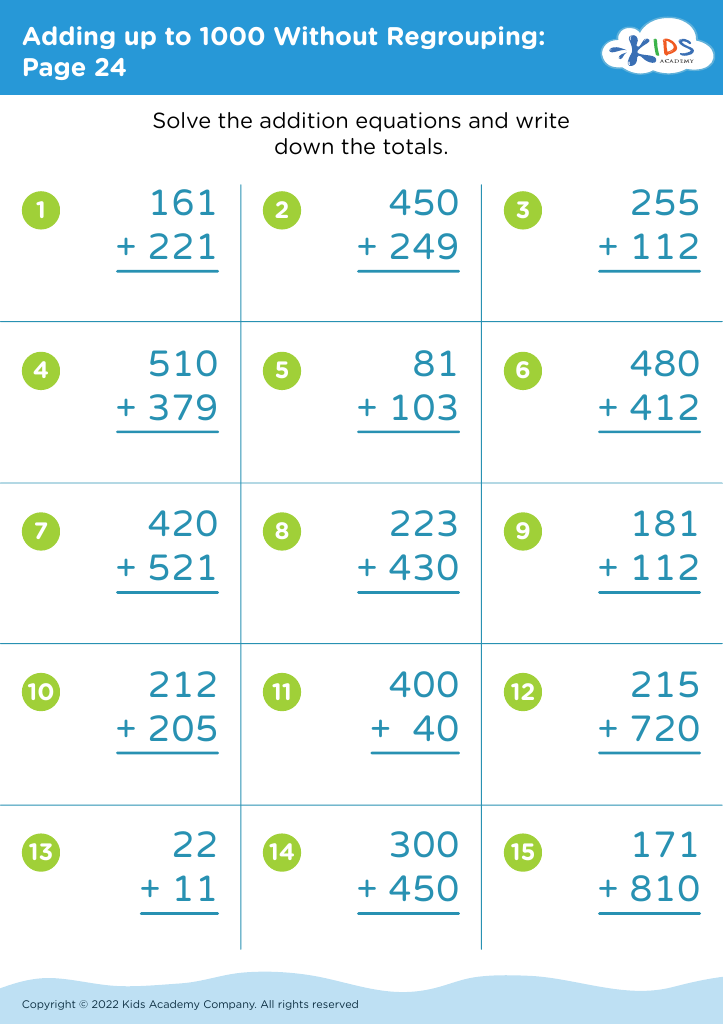
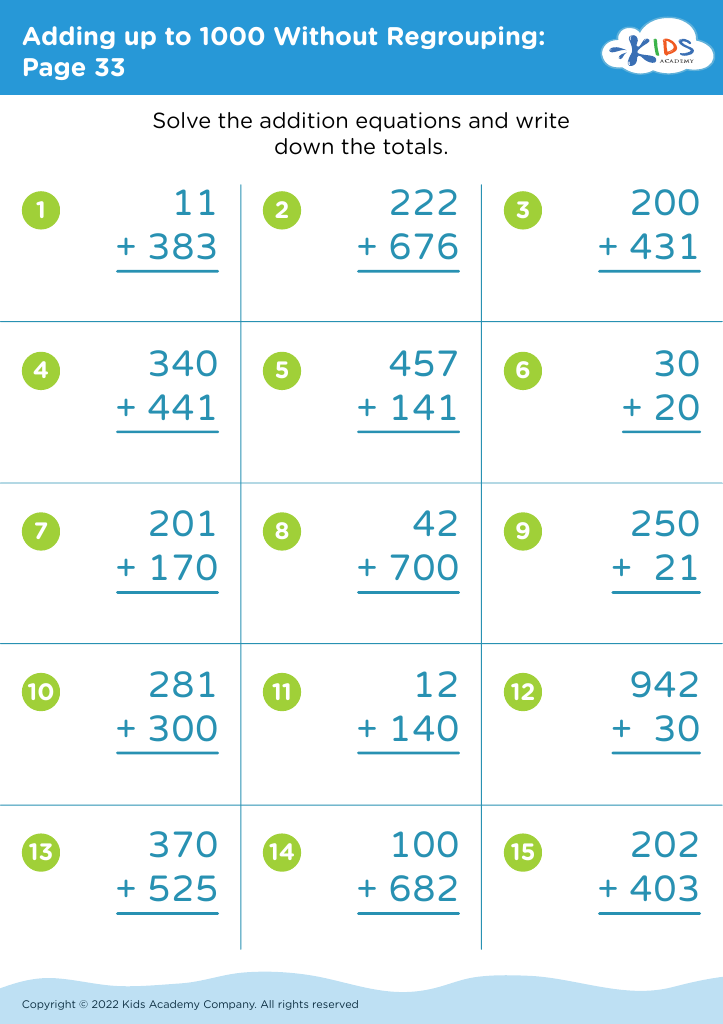
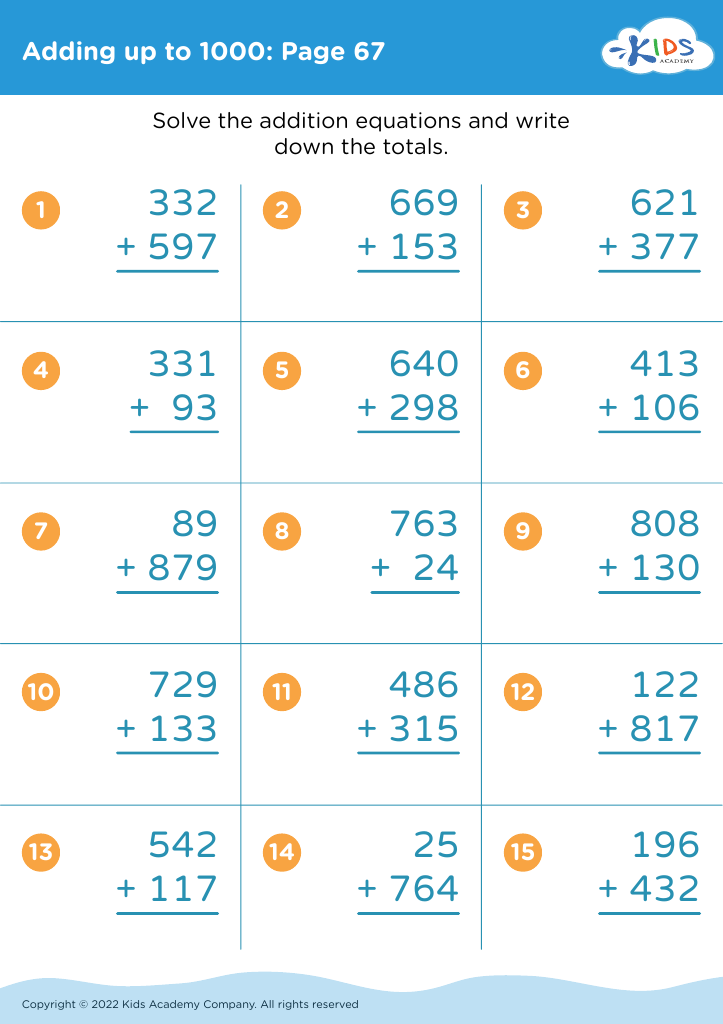




Introducing the concept of adding up to 1000 for children aged 4-9 lays a solid foundation for both mathematical proficiency and critical thinking skills that are essential for their future academics and everyday life. At this developmental stage, children’s brains are highly receptive to new information, making it a crucial period for building essential math skills.
Understanding numbers and the ability to perform basic arithmetic promotes cognitive development and enhances problem-solving skills. When children engage with larger numbers, such as adding up to 1000, they learn to comprehend the magnitude and different place values, which are critical concepts in math. This sets the stage for more advanced arithmetic operations and algebraic thinking.
Additionally, early exposure to adding up to 1000 cultivates a positive attitude toward mathematics. Children gain confidence as they master increasingly complex tasks, which can translate into better performance in school and standardized tests. Moreover, these arithmetic skills are practical; they help children manage real-life situations like handling money, measuring ingredients while cooking, or even organizing their schedules.
Engaging children in such numerical activities also offers them a sense of accomplishment and builds habits of perseverance and logical reasoning, which are invaluable life skills. Altogether, focusing on basic addition up to 1000 can have long-lasting educational and personal benefits.








