
Understanding quadrilaterals Geometry Worksheets for Ages 4-9
4 filtered results
Difficulty Level
Grade
Age
-
From - To
Subject
Activity
Standards
Enhance your child's geometry skills with our "Understanding Quadrilaterals Geometry Worksheets for Ages 4-9." These engaging activities are designed to introduce young learners to the fascinating world of quadrilaterals. Through fun exercises, kids will explore different types of quadrilaterals, learn to identify them, and understand their unique properties. Our worksheets are perfect for reinforcing classroom learning, homeschooling, or additional practice at home. With clear visuals and step-by-step guidance, your child will build a strong foundation in geometry. Visit our website and download these educational worksheets to make learning math an enjoyable adventure for your young student!
Favorites
With answer key
Interactive
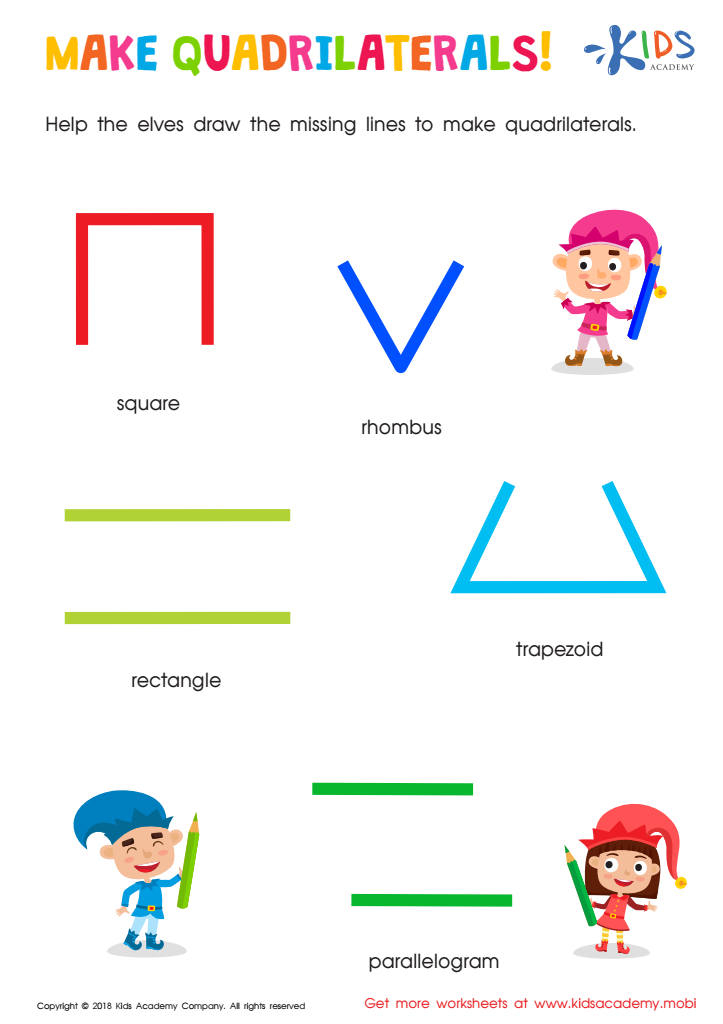
Make Quadrilaterals Worksheet
This fun and colorful worksheet will help your child understand and identify quadrilaterals. It's simple and encourages them to draw lines to create a square, rectangle, rhombus, trapezoid, and parallelogram. Stimulate their minds and watch them learn while they have fun!
 Assign to My Students
Make Quadrilaterals Worksheet
Worksheet











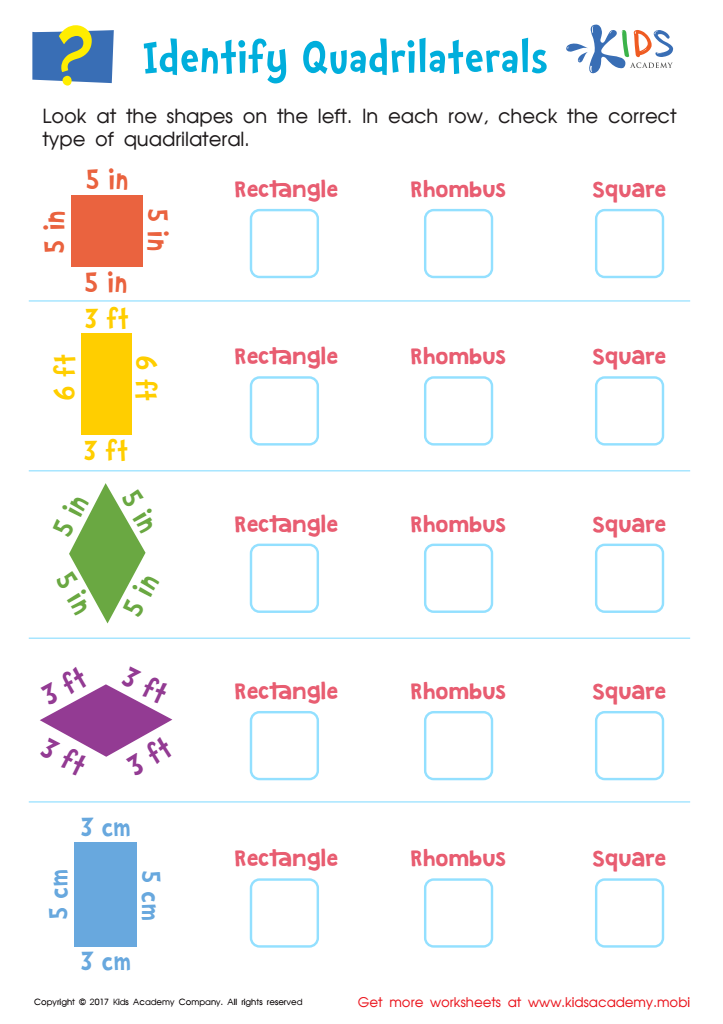
Identify Quadrilaterals Worksheet
This PDF worksheet helps kids identify different quadrilaterals using pictures and measurements. From rectangles to diamonds, children will use their knowledge of geometry to observe and classify shapes. A colorful and fun way to learn!
Identify Quadrilaterals Worksheet
Worksheet
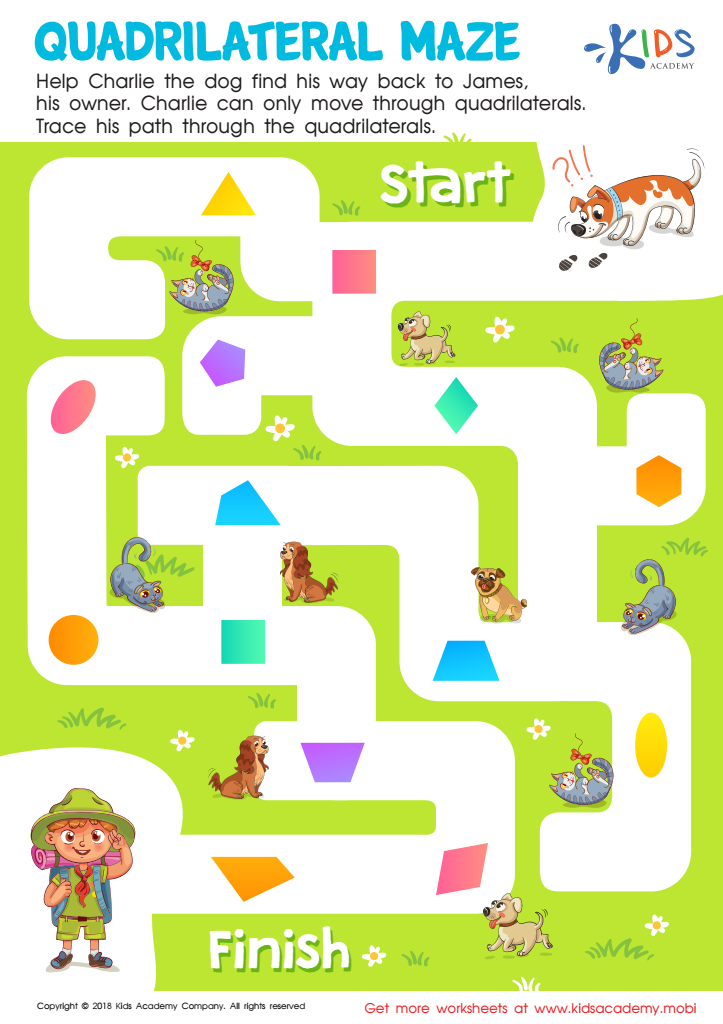
Quadrilateral Maze Worksheet
Does your kid love dogs? If so, this exercise is ideal for them! Help Charlie the pup find his way back to his owner, James, in the quadrilateral maze worksheet. Your child must trace Charlie's path only through squares and rhombuses in order to solve it. Careful planning is key!
Quadrilateral Maze Worksheet
Worksheet
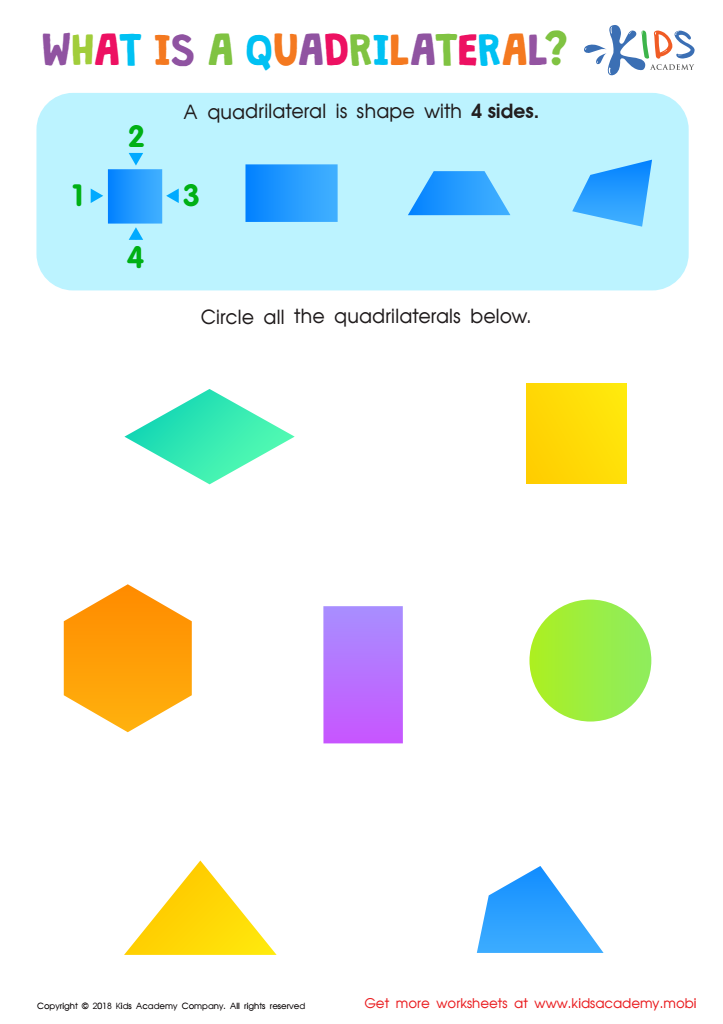
What Is a Quadrilateral? Worksheet
Does your kid know what a quadrilateral is? If not, this worksheet can help teach them. Explain that a quadrilateral is a shape with four sides and give examples, like a square or a rectangle. Then ask them to circle the quadrilaterals in the pictures. If they already know what a quadrilateral is, this task might be too easy.
What Is a Quadrilateral? Worksheet
Worksheet
Join Kids Academy for Free
Who is primarily going to use this learning content?








Understanding quadrilaterals in geometry is crucial for children aged 4-9 because it lays the foundation for essential cognitive, mathematical, and analytical skills. At this developmental stage, learning about shapes like squares, rectangles, rhombuses, and trapezoids helps kids recognize and categorize geometric figures, enriching their spatial awareness. This crucial understanding aids in problem-solving abilities and helps children make sense of the world around them.
When kids grasp the properties of quadrilaterals, such as the number of sides and angles, they improve their classification and comparison skills, which are transferable to other areas of learning and everyday tasks. These concepts can also enhance their abilities in logic, reasoning, and critical thinking. For example, being able to identify and compare shapes is an early form of analytical reasoning, a skill necessary in advanced mathematics and real-life problem-solving.
Moreover, incorporating geometry into their learning activities engages different learning modalities — visual, tactile, and kinesthetic — making lessons more dynamic and memorable. Using hands-on activities like drawing or building with blocks can make learning about quadrilaterals both fun and effective.
Overall, early introduction to quadrilaterals nurtures a child’s curiosity and sets a strong mathematical foundation, paving the way for future academic success and practical life skills.








