Comparing object weights Math Worksheets for Ages 4-9
3 filtered results
-
From - To
Discover engaging "Comparing Object Weights" math worksheets, perfect for children ages 4-9. These educational activities help young learners understand weight comparison by exploring fun exercises that involve everyday objects. Each worksheet is designed to build essential math skills, fostering critical thinking and problem-solving abilities. Your child will enjoy colorful illustrations and interactive tasks that make learning enjoyable and effective. Whether used at home or in the classroom, these resources are ideal for enhancing their understanding of math concepts. Boost your child's confidence and proficiency in comparing weights with these expertly crafted worksheets from Kids Academy.
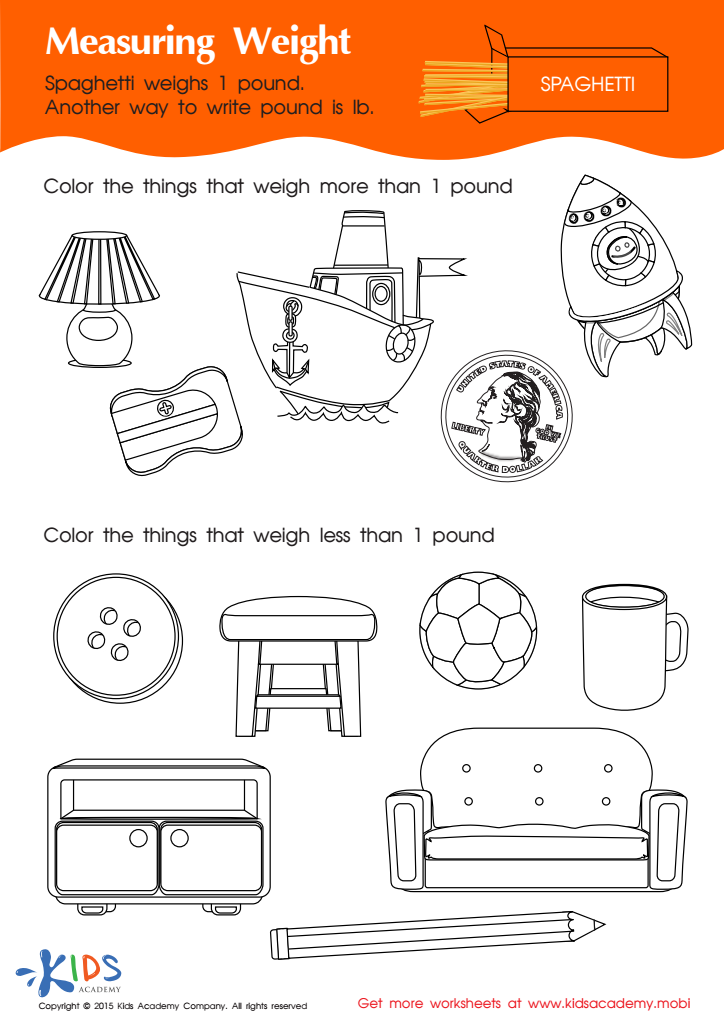
 Assign to My Students
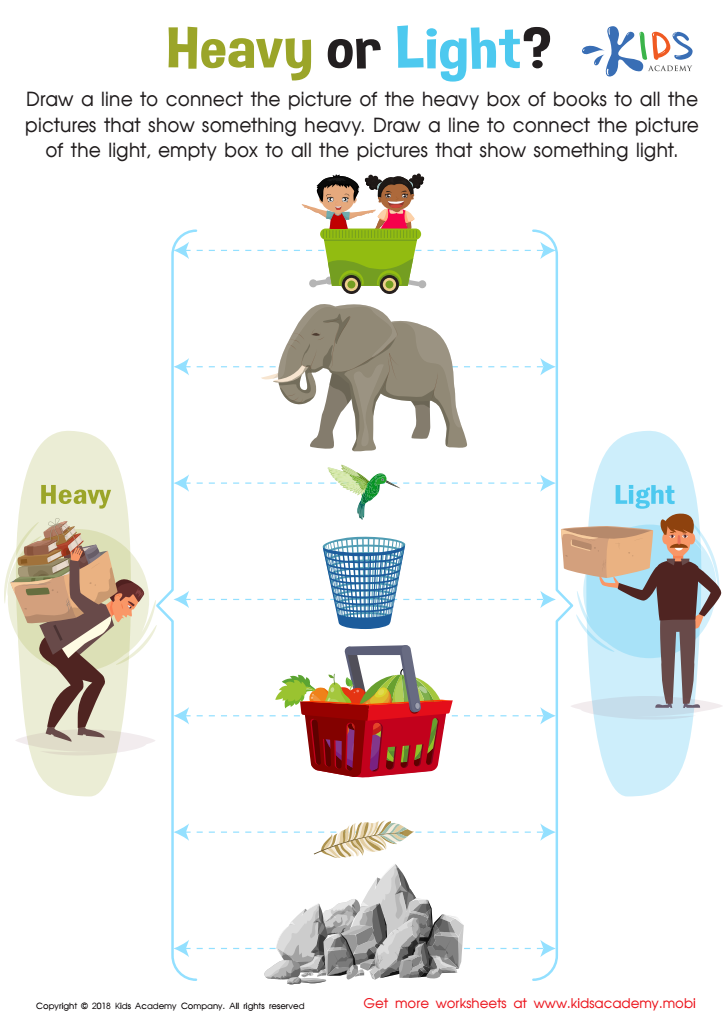
Heavy or Light? Worksheet
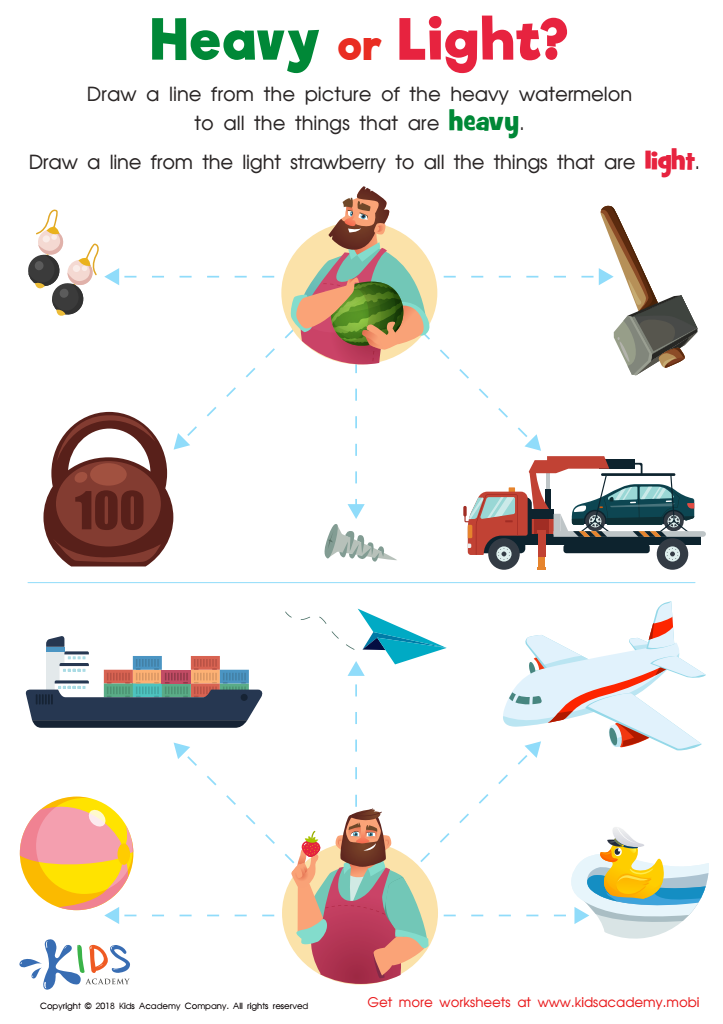
Heavy or Light? Worksheet







Understanding the concept of comparing object weights is crucial for children aged 4-9 as it lays the foundation for essential cognitive and mathematical skills. Engaging with these concepts helps to develop their analytical and observational abilities. At this age, children are typically in the preoperational and concrete operational stages of cognitive development, as described by Piaget. They learn best through hands-on experiences and visual comparison.
When children compare object weights, they employ critical thinking and problem-solving skills. They begin to understand mathematical concepts such as measurement, estimation, and the principles of balance and volume. These activities also introduce them to the scientific method, encouraging them to make predictions, conduct experiments, and draw conclusions based on observed evidence.
Additionally, comparing weights helps to enhance vocabulary and language skills. Words like "heavier," "lighter," "equal," and "compare" become meaningful through practical use, which supports literacy development. Doing these activities in group settings or with parental involvement fosters cooperative learning and communication skills.
For teachers and parents, facilitating learning scenarios where children compare object weights also uncovers individual learning paces and preferences, allowing for tailored educational strategies. Engaging with these foundational math concepts at an early age effectively primes children for more advanced topics, ensuring a smoother transition into formal education.








