Recognize shapes Math Worksheets for Ages 4-9
9 filtered results
-
From - To
Unlock your child's potential with our engaging "Recognize Shapes" math worksheets, designed for ages 4-9! These interactive activities introduce young learners to the world of shapes, helping them identify, compare, and classify various geometric figures. With fun illustrations and age-appropriate exercises, children will gain confidence in their math skills while boosting their problem-solving abilities. Our worksheets are perfect for home or classroom settings, offering a comprehensive approach to shape recognition that aligns with educational standards. Watch your child's understanding grow as they enjoy discovering the wonderful world of shapes, setting a strong foundation for future math success!
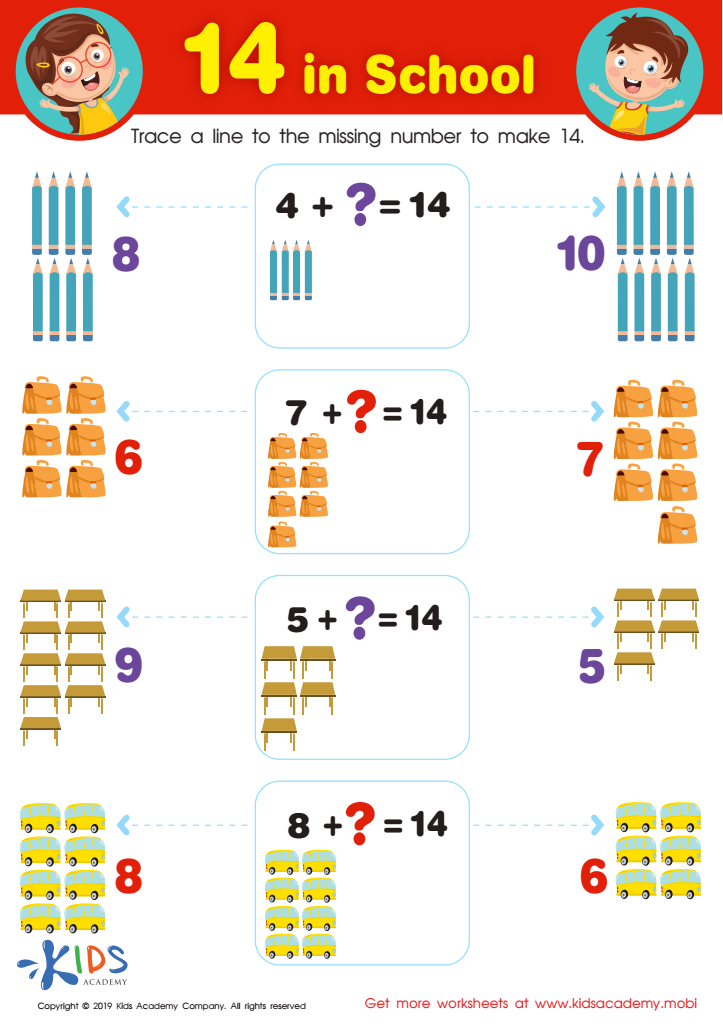
14 in School Worksheet
 Assign to My Students








Recognizing shapes is a foundational skill in early math education for children aged 4-9, and it plays a critical role in their cognitive development and everyday problem-solving capabilities. Firstly, shape recognition fosters spatial awareness, enabling children to understand their environment better and navigate it more effectively. This skill is essential not only in mathematics but also in various real-world situations, such as understanding maps, constructing objects, or engaging in arts and crafts.
Moreover, learning shapes helps develop logical thinking and reasoning skills. As children identify and differentiate shapes, they practice categorization and pattern recognition, which are significant components of critical thinking. These skills lay the groundwork for more advanced mathematical concepts, preparing them for higher-level learning.
Additionally, shape recognition enhances language development. When children learn to describe shapes and their characteristics, they build their vocabulary and communication abilities. It also encourages collaborative play and interaction among peers, promoting social skills.
Ultimately, by fostering shape recognition, parents and teachers help cultivate a well-rounded education that supports not only early math proficiency but also cognitive, social, and language development. Engaging with shapes sets the stage for lifelong learning and adaptability in various disciplines.








